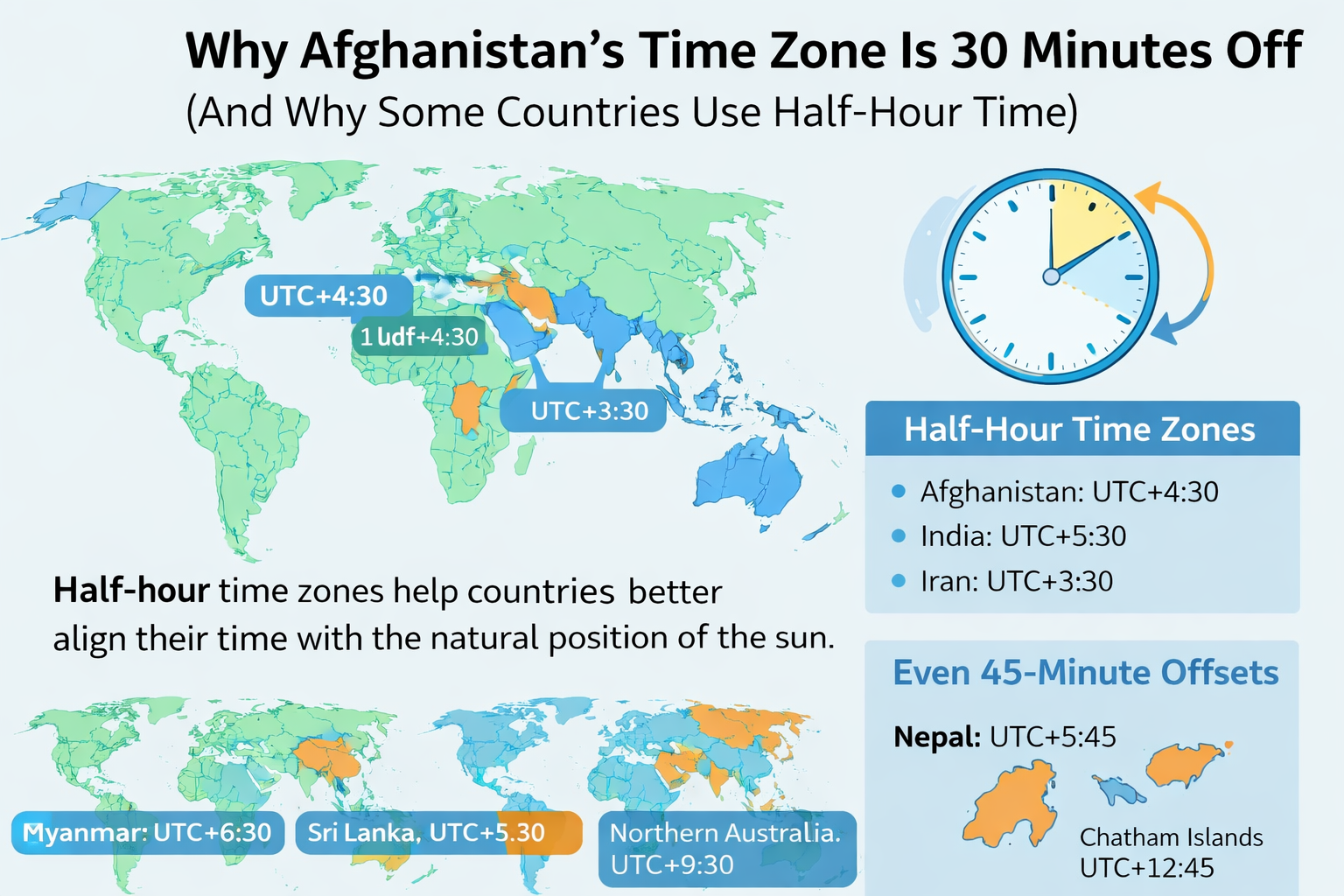
If you check the time in Afghanistan, you might notice something unusual. Instead of being one hour ahead or behind another country, Afghanistan operates on UTC+4:30 — meaning it is four hours and thirty minutes ahead of Coordinated Universal Time.
Many people wonder: Why does Afghanistan use a 30-minute time zone instead of a full hour like most countries?
The answer comes from geography, history, and how countries organize their official time systems.
Understanding Time Zones First
Before explaining Afghanistan’s time zone, it helps to understand how time zones work.
The world is divided into 24 main time zones, each generally separated by one hour. These zones follow lines of longitude across the Earth.
The global reference point for time is called Coordinated Universal Time (UTC).
Countries adjust their local time relative to UTC.
Examples:
| Country | Time Zone |
|---|---|
| United Kingdom | UTC+0 |
| Germany | UTC+1 |
| United Arab Emirates | UTC+4 |
| Afghanistan | UTC+4:30 |
Most countries use whole-hour offsets, but a few use half-hour or even 45-minute offsets.
Why Afghanistan Uses UTC+4:30
Afghanistan sits geographically between two major time zones:
If Afghanistan followed Iran, its time would be too early for the eastern part of the country.
If it followed Pakistan, the western regions would experience very late sunrises and sunsets.
To balance this, Afghanistan adopted UTC+4:30, placing it roughly in the middle.
This creates a more practical national time:
- Sunrise and sunset times are more balanced
- Business hours align better across the country
- The time better reflects Afghanistan’s geographic location
Countries That Use Half-Hour Time Zones
Afghanistan is not the only country using a half-hour time zone. Several countries do this for similar geographic or historical reasons.
Examples include:
| Country | Time Zone |
|---|---|
| Afghanistan | UTC+4:30 |
| India | UTC+5:30 |
| Iran | UTC+3:30 |
| Myanmar | UTC+6:30 |
| Sri Lanka | UTC+5:30 |
| Australia (Northern Territory) | UTC+9:30 |
These countries chose half-hour offsets to better match solar time in their regions.
Some Places Even Use 45-Minute Time Zones
Even more unusual are 45-minute offsets, which are extremely rare.
Examples:
| Location | Time Zone |
|---|---|
| Nepal | UTC+5:45 |
| Chatham Islands (New Zealand) | UTC+12:45 |
Nepal adopted this system to create a time exactly between India and China.
Why Don’t All Countries Use Perfect Hour Time Zones?
Although the world map shows clean hourly divisions, real borders rarely follow straight lines.
Countries choose their official time zone based on several factors:
Geography
Large countries may sit across multiple natural time zones.
Politics
Governments sometimes choose a time zone that aligns with economic partners.
Trade and business
Countries may align their clocks with major trading partners.
National unity
Some countries prefer a single national time even if they span several geographic zones.
Does Afghanistan Use Daylight Saving Time?
Afghanistan does not observe daylight saving time.
This means the country stays on UTC+4:30 all year round, without moving clocks forward or backward.
Many countries near the equator or in regions with stable daylight hours choose not to use daylight saving time.
Why Half-Hour Time Zones Matter
Half-hour time zones might seem unusual, but they help countries align their clocks more closely with natural daylight cycles.
Without them, some places would experience:
- Sunrises very late in the morning
- Sunsets extremely early in the afternoon
- Business hours poorly aligned with daylight
By adjusting time slightly, countries can create a more practical daily schedule.
Check the Current Time Anywhere in the World
If you’re curious about the exact time in different countries, you can explore live global clocks on timenowonline.com to see:
- Current time by country
- Local time in major cities
- Time differences between regions
- Global time zone information
Understanding how time zones work can make travel, remote work, and international communication much easier.
Final Thoughts
Afghanistan’s UTC+4:30 time zone exists because the country sits between two major time zones. The half-hour offset provides a balanced local time that better matches daylight patterns across the country.
While most nations follow hourly time zones, several countries use half-hour or even 45-minute offsets to better fit their geography and daily life.
These unique time zones are a reminder that global timekeeping is both a scientific system and a practical solution shaped by history, geography, and human needs.
Leave a Reply