When traveling across countries or continents, one of the first things you may notice is that the local time changes. A flight that lasts only a few hours can result in arriving at a destination where the clock shows a completely different time.
This happens because the Earth is divided into time zones, which allow different regions of the world to keep time according to their position relative to the sun.
Understanding why time zones change when you travel can help you better plan trips, avoid scheduling confusion, and adjust to new local times more easily.
Why the World Uses Time Zones
The Earth rotates once every 24 hours, creating the cycle of day and night.
To manage time across the globe, the world is divided into 24 main time zones, each representing roughly one hour of time difference.
Each time zone covers about 15 degrees of longitude, because the Earth rotates 360 degrees in 24 hours.
360 ÷ 24 = 15 degrees per hour.
This system allows each region to have a local time that matches daylight patterns, so noon occurs when the sun is near its highest point in the sky.
What Happens When You Cross a Time Zone
When you travel east or west across the Earth, you may move into a different time zone.
Each time zone shift usually changes the clock by one hour.
For example:
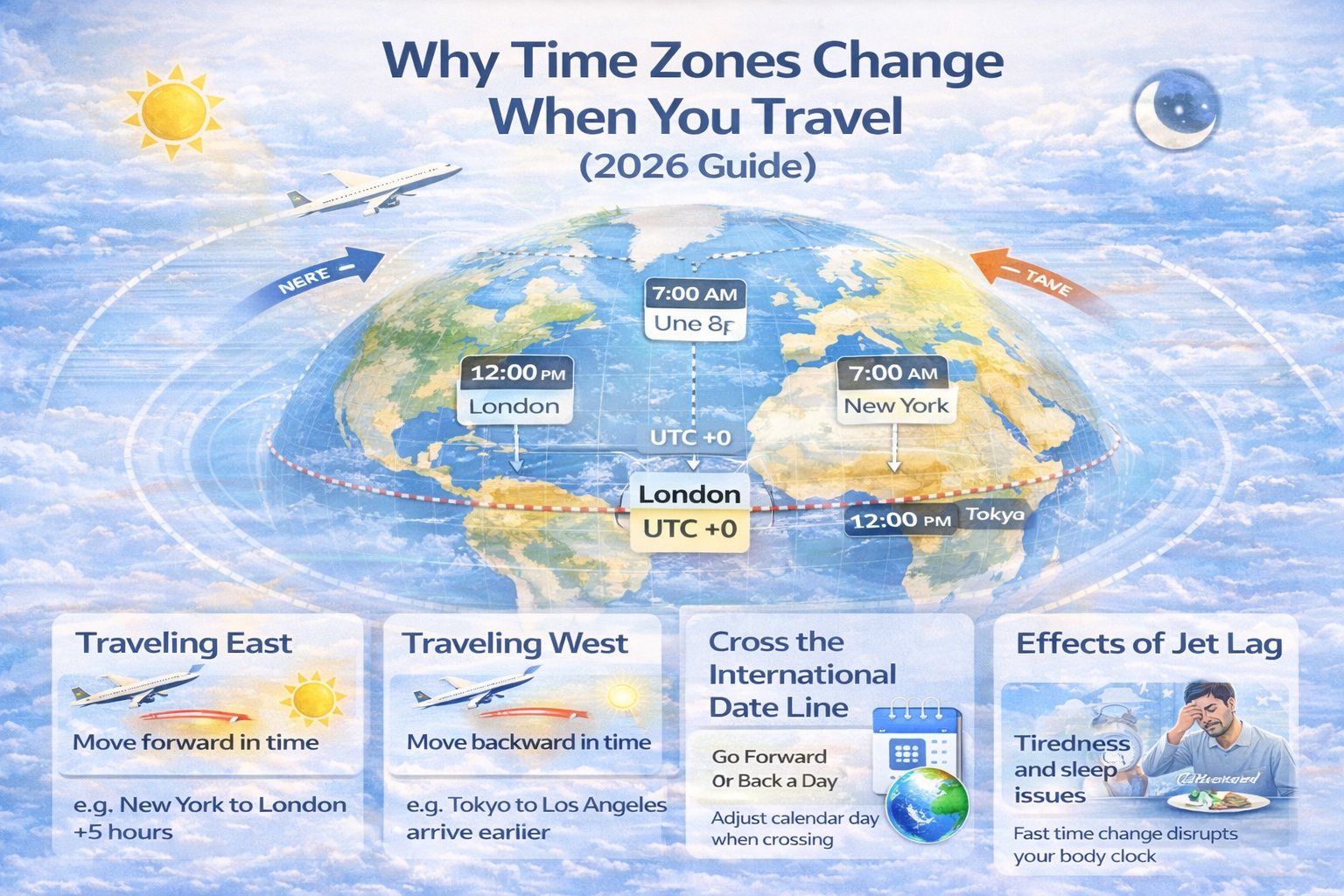
If it is 12:00 PM in London:
This difference exists because these cities are located at different longitudes around the Earth.
Traveling East vs Traveling West
The direction you travel also affects how the time changes.
Traveling East
When you travel east, you move forward in time.
Example:
If you fly from New York to London, the clock moves ahead by about 5 hours.
So if you leave New York at 6:00 PM, it may already be early morning in London when you arrive.
Traveling West
When traveling west, you move backward in time.
Example:
Flying from Tokyo to Los Angeles means the local time moves earlier.
You may even arrive on the same calendar day you left, even after a long flight.
What Is the International Date Line?
One of the most interesting aspects of global timekeeping is the International Date Line.
This imaginary line runs roughly along the 180-degree longitude in the Pacific Ocean.
When travelers cross this line:
- Traveling west adds one day
- Traveling east subtracts one day
This adjustment keeps the calendar aligned worldwide.
For example, crossing the date line from Asia to North America can cause you to arrive on the previous day.
How Airlines Handle Time Zones
Airlines use the local time of departure and arrival cities when listing flight schedules.
This means:
- A flight may appear longer or shorter depending on time zone changes
- Arrival times always reflect the local time of the destination
Pilots and aviation systems often rely on UTC (Coordinated Universal Time) to avoid confusion during international flights.
Why Time Zones Can Cause Jet Lag
Changing time zones quickly can affect the body’s natural internal clock, also known as the circadian rhythm.
When travelers cross multiple time zones, their sleep schedule may no longer match the local day-night cycle.
Common jet lag symptoms include:
- Fatigue
- Difficulty sleeping
- Reduced concentration
- Digestive discomfort
The more time zones crossed during travel, the stronger the jet lag effects may be.
Tips for Adjusting to a New Time Zone
Travelers can take several steps to adapt more quickly when arriving in a different time zone.
Adjust sleep schedules before departure
Gradually shifting bedtime can help prepare your body.
Stay hydrated during travel
Long flights and cabin air can cause dehydration.
Get sunlight after arrival
Natural light helps reset the body’s internal clock.
Avoid heavy meals before sleep
Eating lightly may help improve rest during the adjustment period.
Why Understanding Time Zones Matters
Time zones affect more than just travel. They also influence:
- International meetings
- Global business operations
- Flight scheduling
- Online events
- Remote work coordination
Knowing how time zones change when traveling helps avoid confusion and ensures better planning across different regions.
Final Thoughts
Time zones exist because the Earth rotates and different parts of the world experience daylight at different times. As travelers move across the globe, they pass through these zones, causing local time to shift forward or backward.
Understanding how time zones work can make international travel easier and help travelers adjust more smoothly to new schedules.
Using reliable world clock tools can also help confirm the correct time anywhere in the world.
Leave a Reply