
How Atomic Clocks Keep the World’s Time Accurate (2026 Guide)
Learn how atomic clocks keep the world’s time accurate to the second. Discover how they work, why they are so precise, and how they power global time systems in 2026.
TIME GUIDES
Rachel
4/6/20263 min read
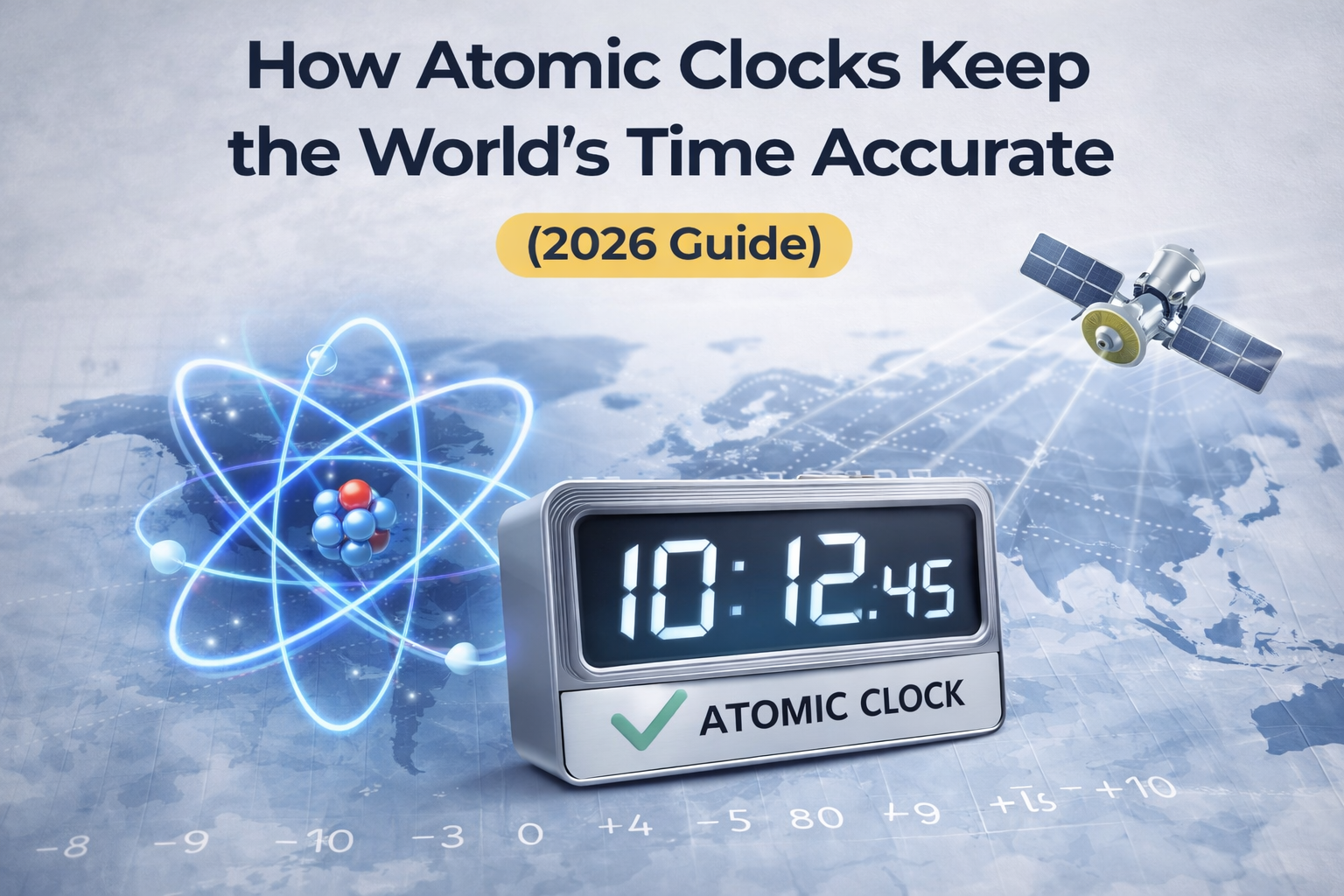

When you check the time on your phone, computer, or a world clock website, you might assume the time simply comes from a regular clock somewhere. In reality, the global time system relies on some of the most precise machines ever created: atomic clocks.
Atomic clocks are responsible for maintaining the official time standard used around the world, ensuring that millions of systems stay synchronized to the exact second. From GPS satellites to financial markets and international communication networks, atomic clocks quietly keep everything running on time.
In this guide, we’ll explain how atomic clocks work, why they are so accurate, and how they keep global time synchronized.
What Is an Atomic Clock?
An atomic clock is a highly precise device that measures time using the natural vibrations of atoms.
Unlike traditional clocks that rely on gears, springs, or electronic oscillators, atomic clocks track the frequency of energy transitions in atoms. These transitions occur at an extremely stable and predictable rate, making them ideal for measuring time.
Most modern atomic clocks use cesium atoms, which vibrate at a very specific frequency when exposed to microwave radiation.
In fact, the official definition of one second is based on this atomic vibration.
One second equals:
9,192,631,770 oscillations of a cesium-133 atom.
This incredibly precise measurement forms the foundation of the global timekeeping system.
Why Atomic Clocks Are So Accurate
Atomic clocks are considered the most accurate timekeeping devices ever created.
Some of the newest atomic clocks are so precise that they would lose less than one second over millions of years.
This level of accuracy is possible because atomic vibrations remain extremely stable under controlled laboratory conditions.
Compared to other clocks:
Clock TypeAccuracyMechanical clockmay drift seconds per dayQuartz clockmay drift seconds per monthAtomic clockaccurate to billionths of a second
Because of this precision, atomic clocks serve as the global reference for official time.
Coordinated Universal Time (UTC)
The world’s official time standard is known as Coordinated Universal Time (UTC).
UTC is maintained using a network of atomic clocks located in laboratories around the world. These clocks work together to calculate the most accurate global time.
International organizations monitor these clocks and combine their measurements to produce a single unified time standard.
Every time zone in the world is ultimately based on UTC offsets, such as:
This system allows clocks worldwide to remain synchronized.
How Atomic Clocks Synchronize the World
Atomic clocks play a crucial role in keeping global systems synchronized.
Their signals are used to coordinate time across many technologies.
GPS Satellites
Global Positioning System satellites rely on extremely precise timing to calculate location. Even tiny timing errors could cause major navigation mistakes.
Atomic clocks onboard GPS satellites ensure accurate positioning.
Internet Time Servers
Many computers and smartphones synchronize their clocks using Network Time Protocol (NTP) servers, which ultimately reference atomic clock systems.
Financial Markets
Stock exchanges and trading platforms require extremely accurate time stamps for transactions.
Atomic clocks help ensure trades are recorded precisely.
Telecommunications Networks
Communication systems depend on synchronized timing to transmit signals correctly.
Without atomic clocks, modern communication networks would quickly fall out of sync.
The Global Network of Atomic Clocks
Instead of relying on a single clock, the global time system uses hundreds of atomic clocks around the world.
These clocks are located in national time laboratories and research institutes.
Some well-known organizations involved in maintaining global time include:
National Institute of Standards and Technology (NIST) – United States
National Physical Laboratory (NPL) – United Kingdom
Bureau International des Poids et Mesures (BIPM) – France
Data from these laboratories is combined to create the official UTC time standard.
Leap Seconds and Time Adjustments
Because the Earth’s rotation is not perfectly consistent, small adjustments must sometimes be made to keep atomic time aligned with astronomical time.
To correct these differences, scientists occasionally add leap seconds to UTC.
Leap seconds help ensure that:
Atomic time remains aligned with Earth’s rotation
Global clocks stay synchronized with the natural day-night cycle
These adjustments happen very rarely but are important for maintaining long-term accuracy.
Why Accurate Global Time Matters
Precise timekeeping may seem simple, but it is essential for many parts of modern life.
Atomic clocks help support:
Global communication networks
Satellite navigation systems
Scientific research
International transportation systems
Without extremely accurate timekeeping, many technologies we rely on every day would not function properly.
Final Thoughts
Atomic clocks form the foundation of the modern timekeeping system. By measuring the stable vibrations of atoms, these clocks provide a level of accuracy that far exceeds traditional mechanical or electronic clocks.
Through a global network of laboratories and synchronization systems, atomic clocks maintain Coordinated Universal Time (UTC) and ensure that clocks around the world remain aligned.
Whether you’re checking the time online, navigating with GPS, or scheduling international meetings, atomic clocks are quietly working behind the scenes to keep the world running on time.
Time Now Online
Time Now Online delivers accurate, real-time local time for cities, countries, and time zones worldwide. Compare time zones, convert time instantly, and plan meetings with ease using our fast, free tools.
About Us
Legal
© 2026. All rights reserved.
Time data is based on standard global time zone databases and updates automatically.
Places & Seasons
time & meetings