
How Many Time Zones Are There in the World? (Complete Guide for 2026)
Discover how many time zones exist worldwide and how they are defined. Learn how global time is structured, why it varies, and how it affects daily life in 2026.
TIME ZONES
Rachel
4/6/20263 min read
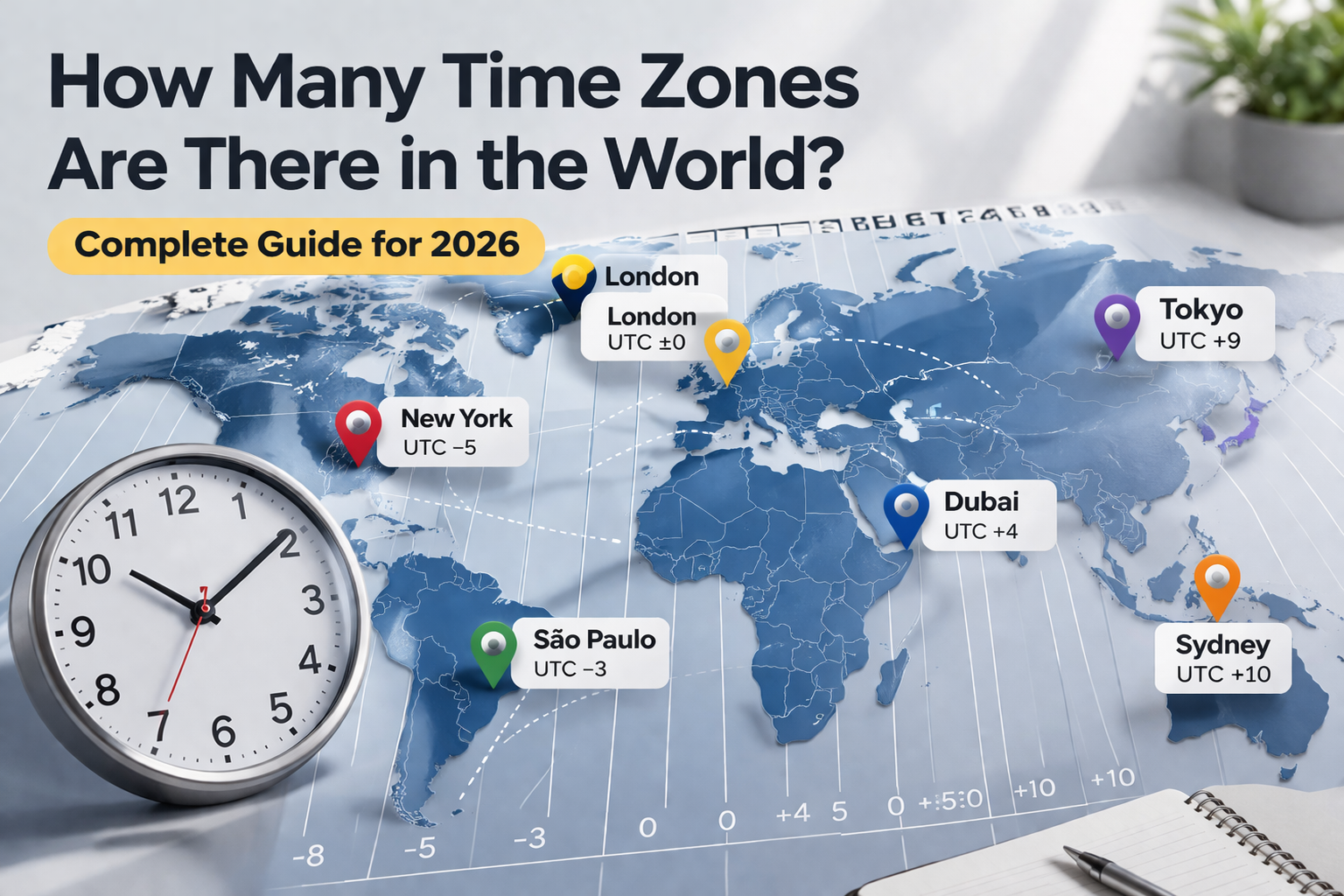
When people look at a world map, it might seem like time moves evenly across the planet. However, the global time system is more complex than many realize. Time zones help organize the world’s clocks so that people in different regions can coordinate daily life, travel, communication, and business.
But exactly how many time zones are there in the world? The answer depends on how they are measured and how countries choose to use them.
In this guide, we’ll explain how time zones work, how many exist globally, and why some countries follow unusual time offsets.
The Basic Time Zone System
The Earth rotates once every 24 hours, which creates the cycle of day and night. To manage this rotation, the world was divided into 24 primary time zones, each representing roughly one hour of time.
Each time zone is typically 15 degrees of longitude apart, because the Earth rotates 360 degrees in 24 hours.
360 ÷ 24 = 15 degrees per hour.
This system allows each region of the world to keep a local time that roughly matches the position of the sun in the sky.
Coordinated Universal Time (UTC)
Modern time zones are based on Coordinated Universal Time (UTC).
UTC acts as the global reference point from which all time zones are measured.
For example:
These offsets show how many hours a location is ahead of or behind UTC.
Why the World Has More Than 24 Time Zones
Although the Earth is divided into 24 main zones, the real number of time zones used worldwide is actually around 38 different time offsets.
This happens because some countries use half-hour or even 45-minute differences instead of full hours.
Examples include:
These adjustments help countries align their official time more closely with their daylight hours.
Countries With Multiple Time Zones
Large countries often use more than one time zone because they stretch across wide geographic areas.
Some examples include:
The United States uses six main time zones, including:
Eastern Time
Central Time
Mountain Time
Pacific Time
Alaska Time
Hawaii-Aleutian Time
Russia spans 11 time zones, making it the country with the most time zones in the world.
Australia uses three primary time zones:
Australian Eastern Standard Time (AEST)
Australian Central Standard Time (ACST)
Australian Western Standard Time (AWST)
What Is Daylight Saving Time?
Many countries adjust their clocks during part of the year using Daylight Saving Time (DST).
During DST, clocks are moved forward by one hour to extend evening daylight during warmer months.
Countries that use DST include:
Most European countries
Parts of Australia
However, many countries do not use daylight saving time at all, especially those near the equator where daylight hours change very little throughout the year.
Why Time Zones Can Be Confusing
Despite the global system, time zones can sometimes be confusing because:
Not all countries follow whole-hour offsets.
Daylight saving time changes schedules twice a year.
Some regions within the same country use different times.
Because of these factors, people often rely on online tools to check accurate local time around the world.
The Easiest Way to Check World Time
Instead of calculating time zones manually, many people use online world clock websites to instantly check the current time anywhere.
These tools allow users to:
Compare time zones between countries
Checking accurate global time online has become especially important as remote work and international communication continue to grow.
Final Thoughts
Although the Earth is divided into 24 standard time zones, the real number of time offsets used worldwide is closer to 38 due to half-hour and 45-minute variations.
Time zones help organize the daily schedules of billions of people around the globe, allowing countries to maintain consistent time based on their location relative to the sun.
Understanding how time zones work makes it easier to schedule meetings, plan travel, and communicate across different regions of the world.
Time Now Online
Time Now Online delivers accurate, real-time local time for cities, countries, and time zones worldwide. Compare time zones, convert time instantly, and plan meetings with ease using our fast, free tools.
About Us
Legal
© 2026. All rights reserved.
Time data is based on standard global time zone databases and updates automatically.
Places & Seasons
time & meetings