
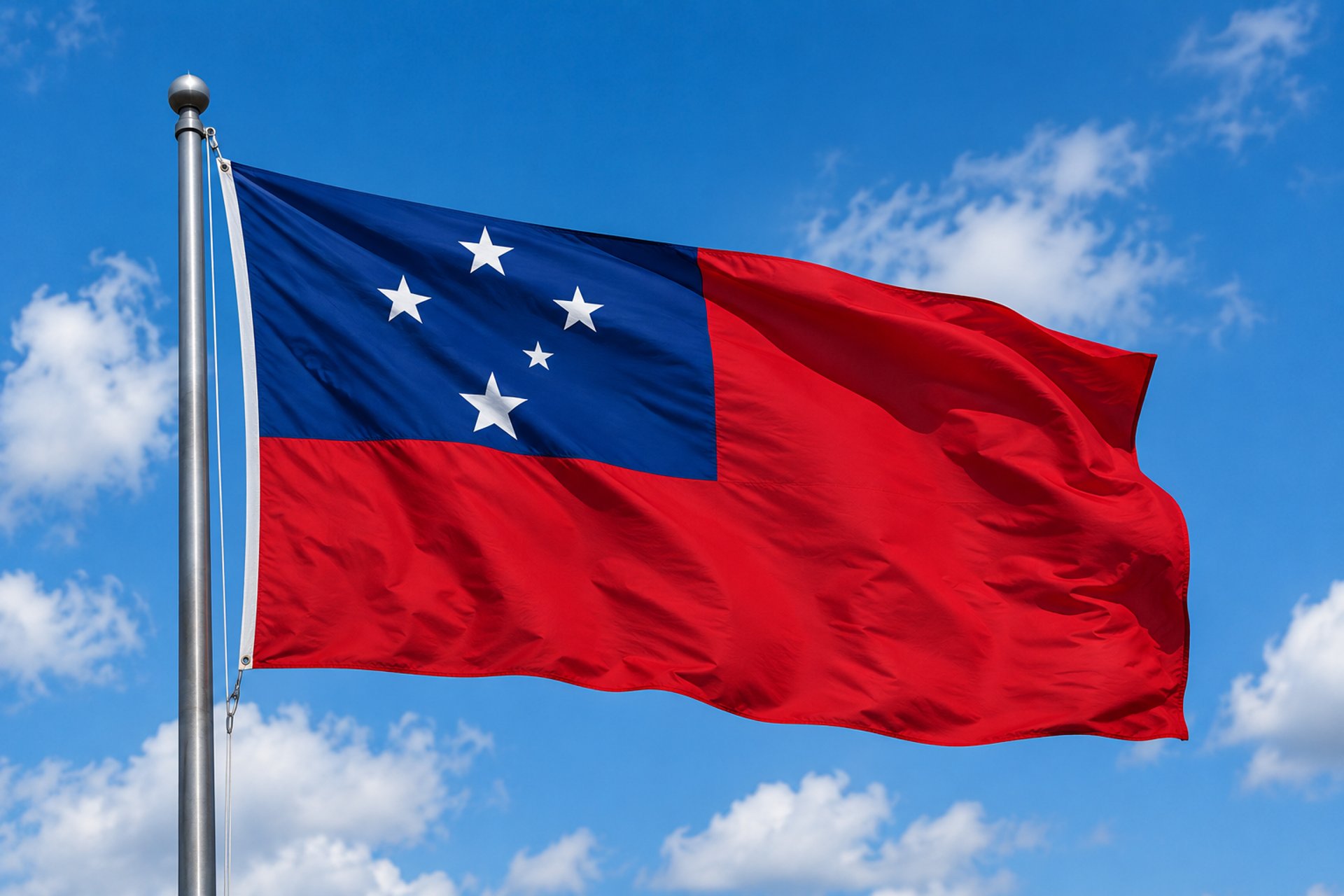
samoa flag_timenowonline.com

Samoa Time Now

Stay updated with the current time in Samoa and plan your calls, travel, and business activities with confidence.

Samoa follows Samoa Standard Time (SST), UTC+13 throughout the year.

Samoa does not observe daylight saving time, so the local time remains stable year-round.

Because Samoa uses one official national time zone, the current time remains consistent across the country, from Apia to Savaiʻi, Upolu, and nearby island communities.

About Samoa

Samoa is a beautiful island nation located in the South Pacific Ocean, known for its tropical scenery, Polynesian culture, warm climate, and relaxed island lifestyle. The country consists of two main islands, Upolu and Savaiʻi, along with several smaller islands surrounded by coral reefs, beaches, waterfalls, and lush rainforest landscapes.

The capital city of Samoa is Apia, located on the island of Upolu. Apia serves as the country’s main centre for government, tourism, business, shipping, and cultural activities. Samoa has a strong Polynesian heritage, and traditional customs known as Fa’a Samoa (“The Samoan Way”) continue to play an important role in daily life, family structure, respect, and community traditions.

Samoa follows Samoa Standard Time (SST), UTC+13, and does not observe daylight saving time. The country is one of the first places in the world to experience a new day due to its location near the International Date Line.

Tourism is an important part of Samoa’s economy, with visitors attracted to its natural beauty, friendly communities, clear lagoons, volcanic landscapes, waterfalls, and cultural experiences. Popular destinations include To Sua Ocean Trench, Lalomanu Beach, Savaiʻi lava fields, and traditional coastal villages.

Samoa is also known for:

  • Traditional Polynesian dance and music

  • Fire knife performances

  • Rugby culture and international athletes

  • Coconut and tropical agriculture

  • Fishing and marine life

  • Handcrafted cultural artwork and weaving

The climate in Samoa is tropical year-round, with warm temperatures, sunshine, and seasonal rainfall. The dry season generally runs from May to October, while the wetter season occurs from November to April.

Because Samoa uses one national time zone, local time remains consistent across the country, making travel, communication, and business coordination easier throughout the islands.

Samoa Quick Facts Table

a beach with rocks and palm trees on a sunny day

Samoa operates on a single official time zone nationwide, meaning the entire country follows the same local time across all islands and regions.

This keeps timekeeping simple and consistent throughout Samoa, including the capital city of Apia and major areas such as Savaiʻi, Upolu, Salelologa, Vaitele, Faleula, and Safotu.

Samoa follows:

  • Samoa Standard Time (SST) – UTC+13

Samoa is one of the first countries in the world to experience a new calendar day due to its location near the International Date Line.

Samoa does not observe daylight saving time, so local time remains stable year-round without seasonal clock changes.

Because Samoa is located in the South Pacific Ocean, its time zone supports coordination for tourism, flights, business communication, island travel, and international connections with Australia, New Zealand, Asia, and the Pacific region.

Understanding Samoa Time

Samoa’s time system is unique because the country follows Samoa Standard Time (SST) – UTC+13, placing it among the first countries in the world to experience a new calendar day.

Because Samoa maintains a single national time zone, scheduling is generally simple and consistent across the country.

Daily life in Samoa typically starts early in the morning, with schools, local markets, tourism services, businesses, and government offices operating throughout the day, especially in Apia, Salelologa, Vaitele, Faleula, Safotu, and Upolu.

For international coordination, knowing the current time in Samoa is useful for planning:

  • Business meetings

  • International calls

  • Remote work schedules

  • Tourism and travel itineraries

  • Flight coordination

  • Online meetings and conferences

Samoa does not observe daylight saving time, so local time remains stable throughout the year.

Because Samoa is located in the South Pacific Ocean near the International Date Line, its time zone supports regional coordination with Australia, New Zealand, the Pacific Islands, Asia, and international travel networks.

What Time Is It in Samoa Right Now?

Samoa Time vs Major World Cities

Samoa follows Samoa Standard Time (SST) – UTC+13 throughout the entire year and does not observe daylight saving time.

Because Samoa maintains a fixed national time zone year-round, international time differences remain generally stable without seasonal clock changes.

Samoa’s location in the South Pacific Ocean near the International Date Line allows practical coordination with Australia, New Zealand, Asia, the Americas, and Pacific Island nations.

Business and tourism activity in Samoa is especially active in areas such as Apia, Salelologa, Vaitele, Faleula, Safotu, and Upolu, where international communication and travel planning are common.

For global coordination:

  • New Zealand is usually same time or 1 hour ahead depending on daylight saving time

  • Australia is generally 2–4 hours behind depending on the region

  • Japan and South Korea are usually 4 hours behind

  • Singapore, Malaysia, and China are generally 5 hours behind

  • India is typically 7 hours 30 minutes behind

  • The United Kingdom is usually 12–13 hours behind depending on the season

  • The United States is significantly behind Samoa depending on the state and season

  • Hawaii is generally 23 hours behind, almost a full calendar day difference

Knowing Samoa’s time difference helps with:

  • International business communication

  • Remote work coordination

  • Online meetings and conferences

  • Airline schedules and travel planning

  • Tourism bookings

  • International events and livestreams

  • Family and international calls

  • Pacific region coordination

Note: Samoa does not observe daylight saving time, so its local time remains stable throughout the year. However, time differences with countries such as Australia, New Zealand, Japan, the United Kingdom, Asia, or the United States may still shift slightly when those countries adjust their clocks seasonally.

Best Time to Call Samoa

From Australia

Samoa is generally ahead of Australia, although the exact difference depends on the Australian state and daylight saving time.

  • Sydney / Melbourne: Samoa is usually 2–3 hours ahead depending on daylight saving time.

  • Brisbane: Samoa is generally 3 hours ahead.

  • Perth: Samoa is usually 5–6 hours ahead.

For business calls, aim for morning to afternoon in Australia (8:00 AM – 3:00 PM) to reach working hours in Samoa.

From the United Kingdom

Samoa is significantly ahead of the UK, so planning ahead is important.

  • Samoa is usually 11–13 hours ahead of the United Kingdom depending on British Summer Time (BST).

  • Call between 7:00 PM and 11:00 PM UK time to reach daytime business hours in Samoa.

This allows practical coordination for tourism, business, and international communication.

From the United States
The United States is significantly behind Samoa, so advance scheduling is important.
  • East Coast (New York): Samoa is usually 17 hours ahead.

  • West Coast (Los Angeles): Samoa is generally 20 hours ahead.

Early evening calls in the United States are often needed to reach daytime hours in Samoa.

From Asia

Asia is generally behind Samoa, although work overlap is still possible.

Morning to afternoon in Asia generally provides the best overlap.

From the Middle East

The Middle East is several hours behind Samoa, making advance scheduling important.

Morning calls in the Middle East often align best with afternoon or evening hours in Samoa.

This helps smooth coordination for business, tourism, remote work, airline schedules, and international meetings.

a large body of water surrounded by mountains

Famous Cities and Regions in Samoa

  • Apia — The capital city of Samoa, known for government institutions, local markets, waterfront areas, cultural attractions, and business activity.

  • Upolu Island — Samoa’s most populated island, famous for beaches, resorts, waterfalls, villages, and the capital city of Apia.

  • Savai‘i Island — The largest island in Samoa, recognised for volcanic landscapes, lava fields, traditional villages, rainforests, and natural beauty.

  • Mulifanua — A coastal town on Upolu Island known for ferry services connecting Upolu and Savai‘i, beaches, and local tourism.

  • Salelologa — The main commercial centre on Savai‘i Island, known for markets, ferry terminals, shops, and regional trade.

  • Lalomanu — One of Samoa’s most famous beach destinations, recognised for white sand beaches, turquoise waters, and seaside resorts.

  • Manono Island — A peaceful island community known for traditional Samoan village life, walking trails, and scenic coastal views.

  • Namua Island — A small tropical island popular for snorkelling, marine life, beach huts, and eco-tourism activities.

  • To Sua Ocean Trench Region — One of Samoa’s best-known natural attractions, famous for its giant swimming hole, lush gardens, and dramatic coastal scenery.

  • Falealupo — A western Savai‘i region known for rainforest conservation areas, canopy walkways, caves, and traditional Samoan legends.

Samoa has a small island-based economy supported by tourism, agriculture, fishing, remittances, local trade, transportation, and government services.

The country does not operate a major international stock exchange, but financial services are supported through local banks, regional Pacific partnerships, and commercial business networks.

Key business sectors in Samoa include:

  • Tourism and hospitality services

  • Agriculture and coconut production

  • Fishing and seafood industries

  • Retail and local trade

  • Transportation and shipping services

  • Handicrafts and cultural products

  • Telecommunications and mobile services

  • Construction and infrastructure projects

  • Government and public administration

  • Renewable energy and environmental programs

Business and commercial activity is mainly centred around Apia, Upolu Island, Salelologa, Mulifanua, and major coastal communities.

Most business offices in Samoa generally operate between 8:00 AM and 5:00 PM, Monday to Friday, although schedules may vary depending on industry and region.

Samoa maintains strong economic and regional connections with Pacific nations through tourism, shipping routes, agriculture, fisheries, and international trade partnerships.

Note: Samoa follows Samoa Standard Time (SST), UTC+13 throughout the year and does not observe daylight saving time. Time differences with countries such as Australia, New Zealand, Japan, China, the United Kingdom, or the United States may still shift slightly when those countries adjust their clocks seasonally.

Stock Exchange and Business Hours in Samoa

man dancing fire dance surrounded by people at beach

What Samoa Is Famous For

  • Beautiful Tropical Islands — Samoa is famous for its lush tropical islands, turquoise lagoons, white sand beaches, waterfalls, and scenic Pacific Ocean landscapes.

  • Traditional Samoan Culture — The country is internationally recognised for its strong Polynesian traditions, village life, cultural ceremonies, music, dance, and the famous fa’a Samoa way of life.

  • Apia — Samoa’s capital city is known for local markets, waterfront areas, cultural landmarks, museums, and government institutions.

  • To Sua Ocean Trench — One of Samoa’s most famous natural attractions, known for its crystal-clear swimming hole surrounded by tropical gardens and cliffs.

  • Savai‘i Island — Samoa’s largest island is admired for volcanic scenery, lava fields, waterfalls, rainforests, caves, and traditional villages.

  • Beaches and Marine Life — Samoa is recognised for coral reefs, snorkelling, diving, sea turtles, tropical fish, and coastal eco-tourism.

  • Waterfalls and Natural Attractions — The islands are home to famous waterfalls such as Papapapaitai Falls and Fuipisia Falls, along with blowholes, caves, and rainforest trails.

  • Polynesian Hospitality — Samoa is admired for its welcoming communities, relaxed island lifestyle, family values, and strong sense of hospitality.

  • Surfing and Ocean Activities — Samoa is known for surfing, fishing, kayaking, paddleboarding, sailing, and other Pacific Ocean adventures.

  • Traditional Food and Handicrafts — Samoa is recognised for local cuisine, coconut-based dishes, woven mats, wood carving, tapa cloth art, and handmade cultural crafts.

Weather and Seasons in Samoa

Samoa has a tropical island climate, with warm temperatures, ocean breezes, sunshine, and humidity throughout the year across its islands and coastal regions.

🌴 Dry Season (May – October)

The dry season is generally sunnier, cooler, and more comfortable for outdoor activities, tourism, and beach travel.

  • Temperatures often range from 24°C to 30°C

  • Trade winds help create breezier and less humid conditions

  • Lower rainfall compared to the wet season

  • Popular season for beaches, snorkelling, diving, and sightseeing

  • Excellent time for visiting Apia, Upolu, and Savai‘i Island

🌧️ Wet Season (November – April)

The wet season brings warmer temperatures, tropical rainfall, and higher humidity across the islands.

  • Temperatures usually range from 25°C to 32°C

  • Rain showers can be heavy but are often short

  • Tropical storms and cyclones may occasionally occur

  • Rainforests, waterfalls, and vegetation become greener and more vibrant

  • Humidity levels are generally higher throughout the islands

🌺 Festival and Cultural Season

Many cultural celebrations and community events take place throughout the year, especially during holiday periods and village festivals.

  • Traditional dance and cultural ceremonies are common

  • Local markets and food festivals become more active

  • Coastal tourism and resort activities increase during peak travel periods

  • Popular time for cultural experiences and island celebrations

  • Tourism is especially busy around Christmas and New Year

🌊 Ocean and Coastal Conditions

Samoa’s warm Pacific waters support year-round marine tourism and outdoor recreation.

  • Ocean temperatures remain warm throughout the year

  • Good conditions for swimming, kayaking, fishing, and snorkelling

  • Coral reefs and lagoons are popular tourist attractions

  • Coastal scenery is especially vibrant during sunny months

  • Waterfalls and rainforest areas are most active after rainfall

🌿 Overall Climate Experience

Samoa experiences a warm tropical climate year-round with abundant sunshine, lush vegetation, and scenic coastal landscapes across the Pacific islands.

The country remains suitable for beach holidays, eco-tourism, surfing, diving, cultural travel, and island exploration throughout most of the year.

Facts About Samoa

  1. Samoa uses Samoa Standard Time (SST), UTC+13. The country follows a single official time zone nationwide.

  2. Samoa does not observe daylight saving time. Local time remains consistent throughout the year across all islands.

  3. Apia is the capital and largest city of Samoa. It serves as the political, cultural, and economic centre of the country.

  4. Samoa is located in the South Pacific Ocean. The nation consists of beautiful volcanic islands surrounded by coral reefs and tropical waters.

  5. Samoa is famous for its tropical beaches and island scenery. The country is known for lagoons, waterfalls, rainforests, and coastal landscapes.

  6. Traditional Samoan culture remains very important in daily life. The fa’a Samoa way of life emphasises family, community, respect, and village traditions.

  7. Samoan and English are the official languages of Samoa. Samoan culture, music, dance, and storytelling are widely celebrated across the islands.

  8. Tourism and agriculture are important to Samoa’s economy. Coconut products, fishing, tourism, handicrafts, and local trade support many communities throughout the country.

a man standing on a wooden bridge over water

Frequently Asked Questions About Samoa

1. What time zone does Samoa use?

Samoa uses Samoa Standard Time (SST), UTC+13 throughout the year.

2. Does Samoa observe daylight saving time?

No. Samoa does not observe daylight saving time, so the local time remains stable year-round.

3. What is the capital city of Samoa?

The capital city of Samoa is Apia, located on Upolu Island.

4. Is Samoa ahead of Australia in time?

Yes. Samoa is generally ahead of most parts of Australia, although the exact difference can vary depending on daylight saving time in Australia.

5. What is Samoa famous for?

Samoa is famous for its tropical beaches, waterfalls, Polynesian culture, traditional villages, coral reefs, and scenic Pacific islands.

6. What language do people speak in Samoa?

The official languages of Samoa are Samoan and English.

7. What is the best time to visit Samoa?

The dry season from May to October is usually considered the best time to visit Samoa for beach holidays, sightseeing, and outdoor activities.

8. What are the main islands in Samoa?

The two main islands are Upolu and Savai‘i, along with several smaller islands and islets.

man diving in water

Explore More Country Time Zones

🌏 Closest Time Zones (Same or Near)

🌍 Pacific Regions & Nearby Countries
Time Now Online

Time Now Online delivers accurate, real-time local time for cities, countries, and time zones worldwide. Compare time zones, convert time instantly, and plan meetings with ease using our fast, free tools.

About Us

Legal

© 2026. All rights reserved.

Time data is based on standard global time zone databases and updates automatically.

Places & Seasons

time & meetings