Tag: current time worldwide

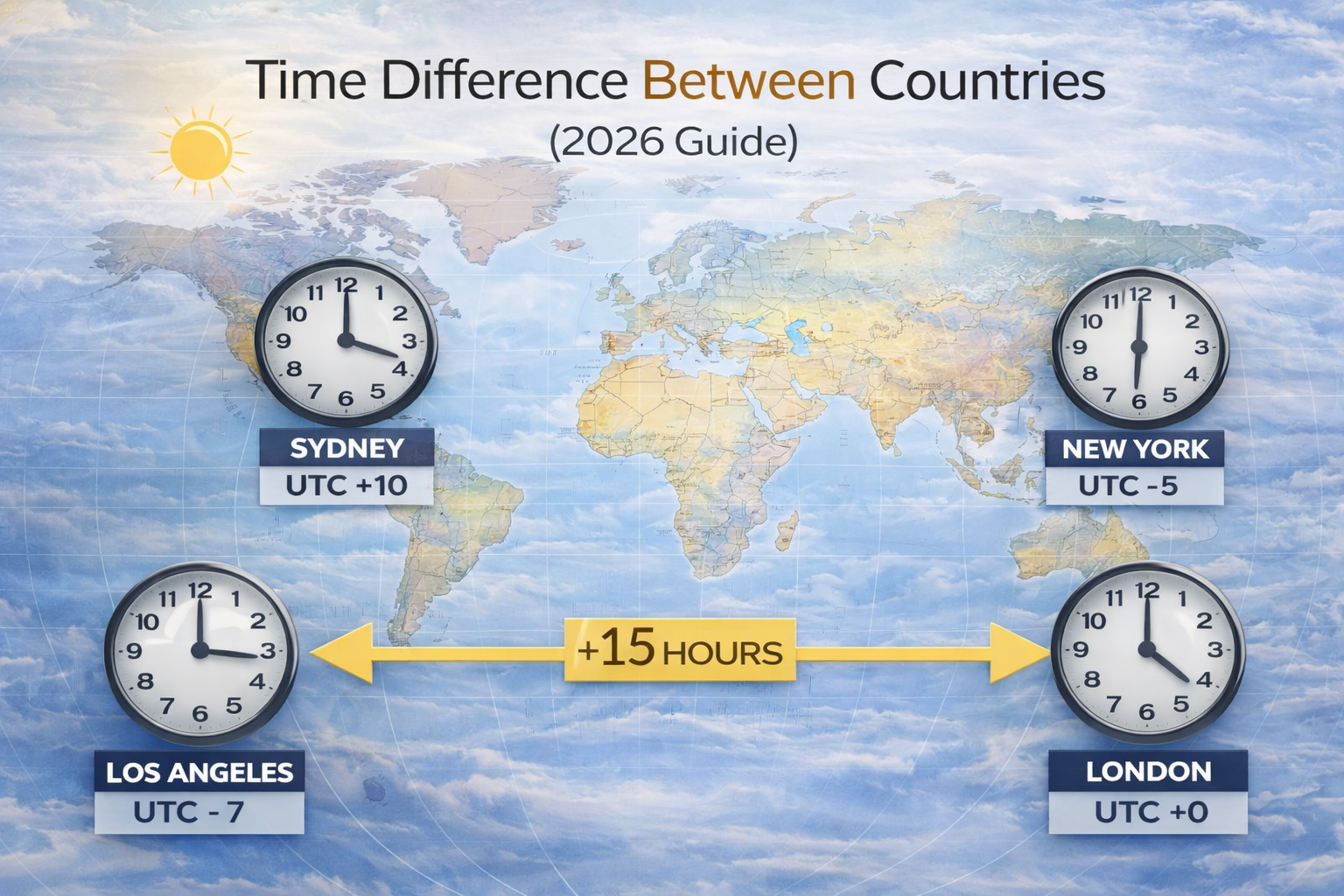
  • Time Difference Between Countries: Simple Guide (2026)

    Time Difference Between Countries: Simple Guide (2026)

    Trying to figure out the time difference between countries can be confusing—especially when you’re dealing with multiple time zones.

    Whether you’re planning a meeting, traveling, or running an online business, understanding time differences is essential to avoid missed calls and delays.

    In this guide, we’ll break it down in the simplest way possible.


    What Is a Time Difference?

    A time difference is the number of hours (and sometimes minutes) between two locations based on their time zones.

    Each country operates in a specific time zone, measured from Coordinated Universal Time (UTC).

    For example:

    • London → UTC +0
    • New York → UTC -5
      👉 Time difference = 5 hours

    How to Calculate Time Difference (Simple Method)

    Follow these steps:

    1. Find both time zones

    Example:

    • Sydney → UTC +10
    • Los Angeles → UTC -8

    2. Subtract the numbers

    👉 10 – (-8) = 18 hours difference

    3. Adjust forward or backward

    Sydney is 18 hours ahead of Los Angeles.


    🌍 Common Time Differences Around the World

    Here are popular comparisons people search for:

    From → ToTime Difference
    SydneyNew York+15 hours
    LondonDubai+4 hours
    TokyoLos Angeles+16 hours
    India UK+5.5 hours

    Why Time Differences Can Be Tricky

    Time differences aren’t always straightforward because of:

    Daylight Saving Time (DST)

    Some countries move their clocks forward or backward during the year.

    Multiple Time Zones

    Countries like the USA have several time zones.

    Half-Hour Differences

    Places like India use UTC +5:30, not full hours.


    Easiest Way to Check Time Difference

    Instead of calculating manually, you can use tools on TimeNowOnline.com.

    With a few clicks, you can:

    • Instantly compare two countries
    • See live time updates
    • Avoid costly mistakes in scheduling

    Tips for Managing Global Time

    • ✔️ Always confirm the local time before meetings
    • ✔️ Use calendar tools with time zone support
    • ✔️ Schedule during overlapping working hours
    • ✔️ Double-check during DST changes

    Why This Matters (Especially for Online Work)

    If you run an online business, time differences can impact:

    • Customer response time
    • Order processing
    • Supplier communication
    • Sales performance

    👉 Getting timing right can increase conversions and customer satisfaction


    Conclusion

    Understanding time differences between countries doesn’t have to be complicated. Once you know how time zones work—or use the right tools—you can stay organized and avoid mistakes.

    👉 Use TimeNowOnline.com to check time differences instantly and stay on track globally.

    Related Tools

  • Time Differences Between Locations Worldwide: A Simple Guide to Understanding Global Time

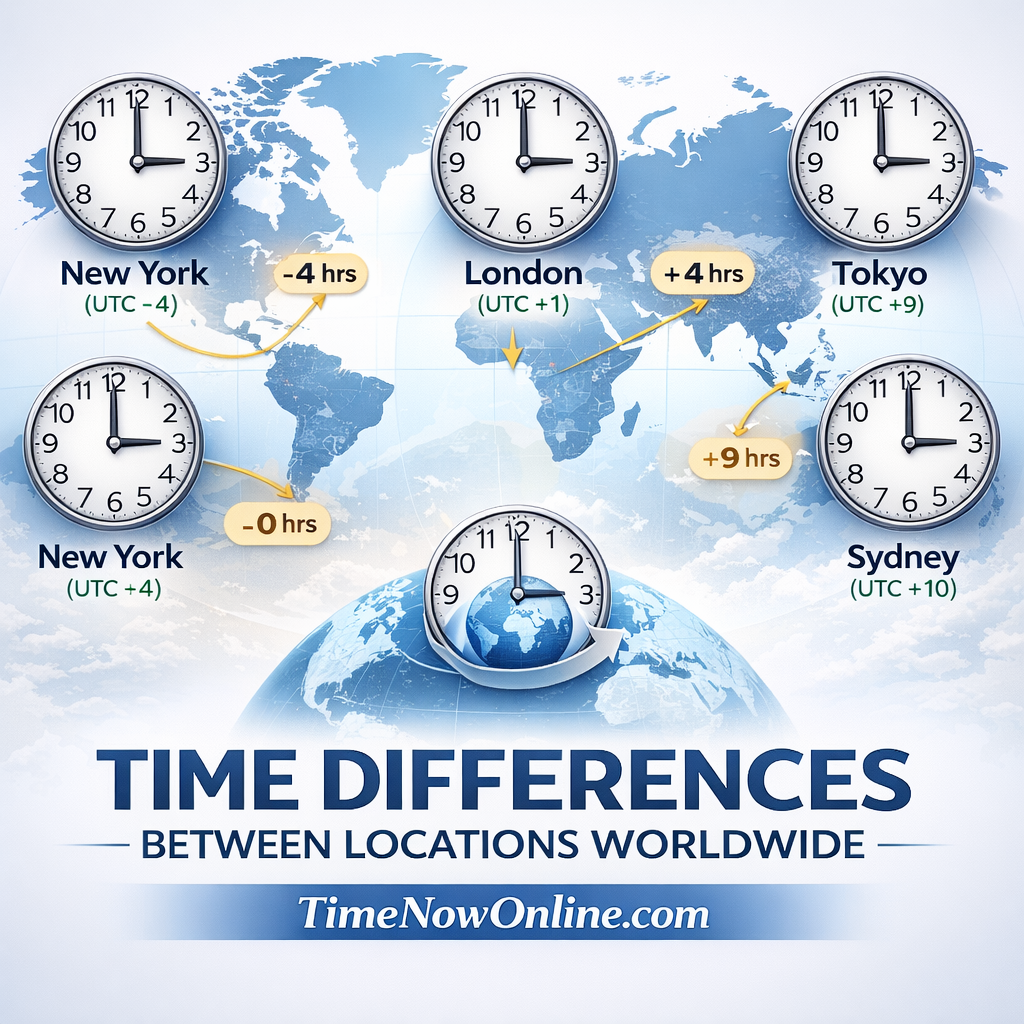
    Time Differences Between Locations Worldwide: A Simple Guide to Understanding Global Time

    When you communicate, travel, or do business across countries, one of the first things you notice is that time is different in every location. While it might be morning in one country, it could already be evening in another.

    Understanding time differences between locations worldwide helps people schedule meetings, plan travel, coordinate global teams, and connect with family across continents.

    Websites like timenowonline.com make it easier to check the current local time anywhere in the world.


    What Are Time Differences?

    Time differences happen because the Earth rotates on its axis. As the planet turns, different parts of the world face the Sun at different times.

    To organize global time, the world is divided into 24 time zones, each roughly representing one hour of difference.

    For example:

    CityTime ZoneExample Time
    New YorkUTC -58:00 AM
    LondonUTC +01:00 PM
    DubaiUTC +45:00 PM
    SydneyUTC +1112:00 AM

    Each step between zones usually equals one hour of time difference.


    Why Time Zones Exist

    Before time zones were introduced, every town followed its own local solar time, based on the position of the Sun.

    This worked fine until the 19th century, when railways and global travel made scheduling very confusing.

    In 1884, countries agreed to divide the world into time zones based on the Prime Meridian in Greenwich, England.

    This standard became known as Greenwich Mean Time (GMT) and later evolved into Coordinated Universal Time (UTC).


    How to Calculate Time Differences

    Calculating time differences between two locations is simple when you know their UTC offsets.

    Example:

    Sydney: UTC +11
    London: UTC +0

    Difference:

    11 hours ahead

    So if it is:

    10:00 AM in London
    It will be 9:00 PM in Sydney.

    Many people use online world clocks to calculate this instantly.


    Examples of Global Time Differences

    Here are some common time differences people check regularly:

    LocationCompared ToTime Difference
    Sydney New York15–16 hours
    London Tokyo9 hours
    Dubai Sydney7 hours
    Los AngelesLondon8 hours
    Singapore New York12–13 hours

    These differences may change slightly due to Daylight Saving Time (DST).


    Daylight Saving Time and Time Differences

    Some countries move their clocks forward or backward during certain parts of the year. This is called Daylight Saving Time.

    Because not every country follows DST, time differences can temporarily change.

    For example:

    Sydney London

    This is why checking a live time website is often the easiest solution.

    • During Australian summer: 11 hours
    • During other periods: 10 hours

    Why Time Differences Matter

    Understanding time differences is important for many reasons.

    Global Business

    Companies working with international teams must coordinate across multiple time zones.

    Travel Planning

    Travelers need to adjust to jet lag and arrival times.

    Online Communication

    People scheduling meetings or video calls must avoid contacting others at inconvenient hours.

    International Events

    Sports events, financial markets, and product launches depend on accurate time coordination.


    Tools to Check Time Differences

    Several online tools can help you quickly find the time anywhere in the world:

    • World clock websites
    • Time difference calculators
    • Smartphone clock apps
    • Online meeting schedulers

    On timenowonline.com, you can browse cities and countries to instantly see their current local time and time zone.


    Frequently Asked Questions

    How many time zones are there in the world?

    There are 24 primary time zones, but when including half-hour and quarter-hour differences, there are over 38 time variations worldwide.

    Which country has the most time zones?

    France technically has the most time zones due to overseas territories, while Russia spans 11 time zones.

    What is the largest time difference between two places?

    The biggest difference can reach 26 hours between certain Pacific islands due to the International Date Line.

    Why do some countries have half-hour time zones?

    Countries like India (UTC +5:30) and Nepal (UTC +5:45) use half-hour or quarter-hour offsets to better match their geographic position.


    Conclusion

    Time differences between locations exist because the Earth rotates and countries follow different time zones. Understanding these differences helps people communicate, travel, and work more efficiently in a connected world.

    With global tools and websites like timenowonline.com, checking the time anywhere in the world is now fast and simple.


© 2026 Time Now Online. All rights reserved.