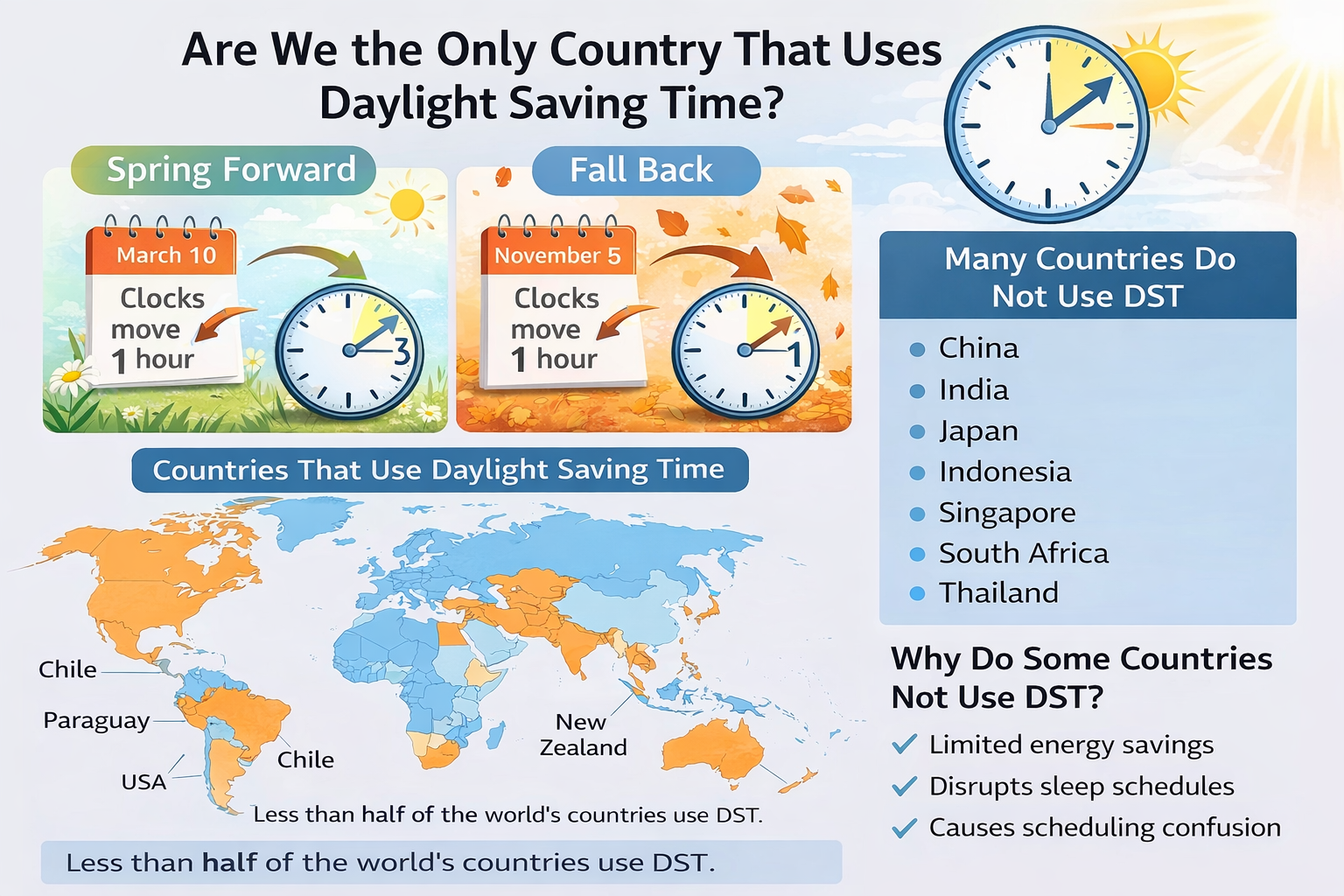
Many people wonder whether their country is the only one that changes clocks during the year. When the time suddenly moves forward or backward, it can feel like a strange system that only a few places follow.
In reality, many countries around the world use daylight saving time, but most countries actually do not.
Understanding how daylight saving time works globally can help explain why some countries adopt it while others decide not to.
What Is Daylight Saving Time?
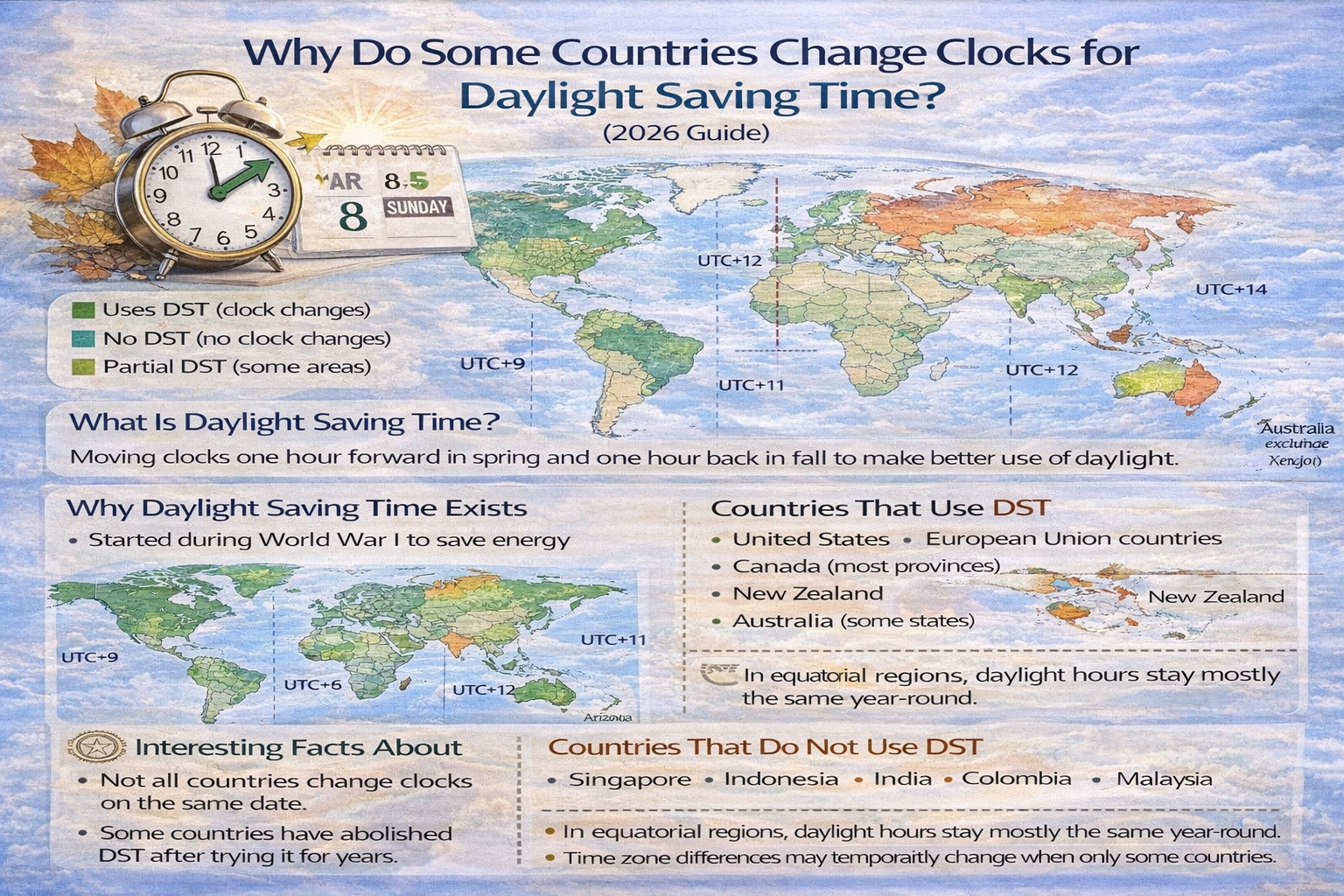
Daylight Saving Time (DST) is when clocks are adjusted during part of the year to make better use of daylight.
Typically the system works like this:
| Season | Clock Change |
|---|---|
| Spring | Clocks move forward by 1 hour |
| Autumn / Fall | Clocks move back by 1 hour |
Moving clocks forward allows evenings to stay brighter for longer, giving people more daylight after work or school.
Which Countries Use Daylight Saving Time?
Daylight saving time is used in several parts of the world.
North America
Some countries in North America use DST, including:
- United States
- Canada
- Some regions of Mexico
Most areas follow a similar schedule, adjusting clocks in spring and autumn.
Europe
Many European countries change clocks at the same time each year.
These countries follow Central European Summer Time, which applies across much of Europe.
Examples include:
The clock change typically occurs in March and October.
Other Regions
Some countries in other regions also use daylight saving time during certain parts of the year.
Examples include:
However, the number of countries using DST has slowly decreased over time.
Why Many Countries Do Not Use Daylight Saving Time
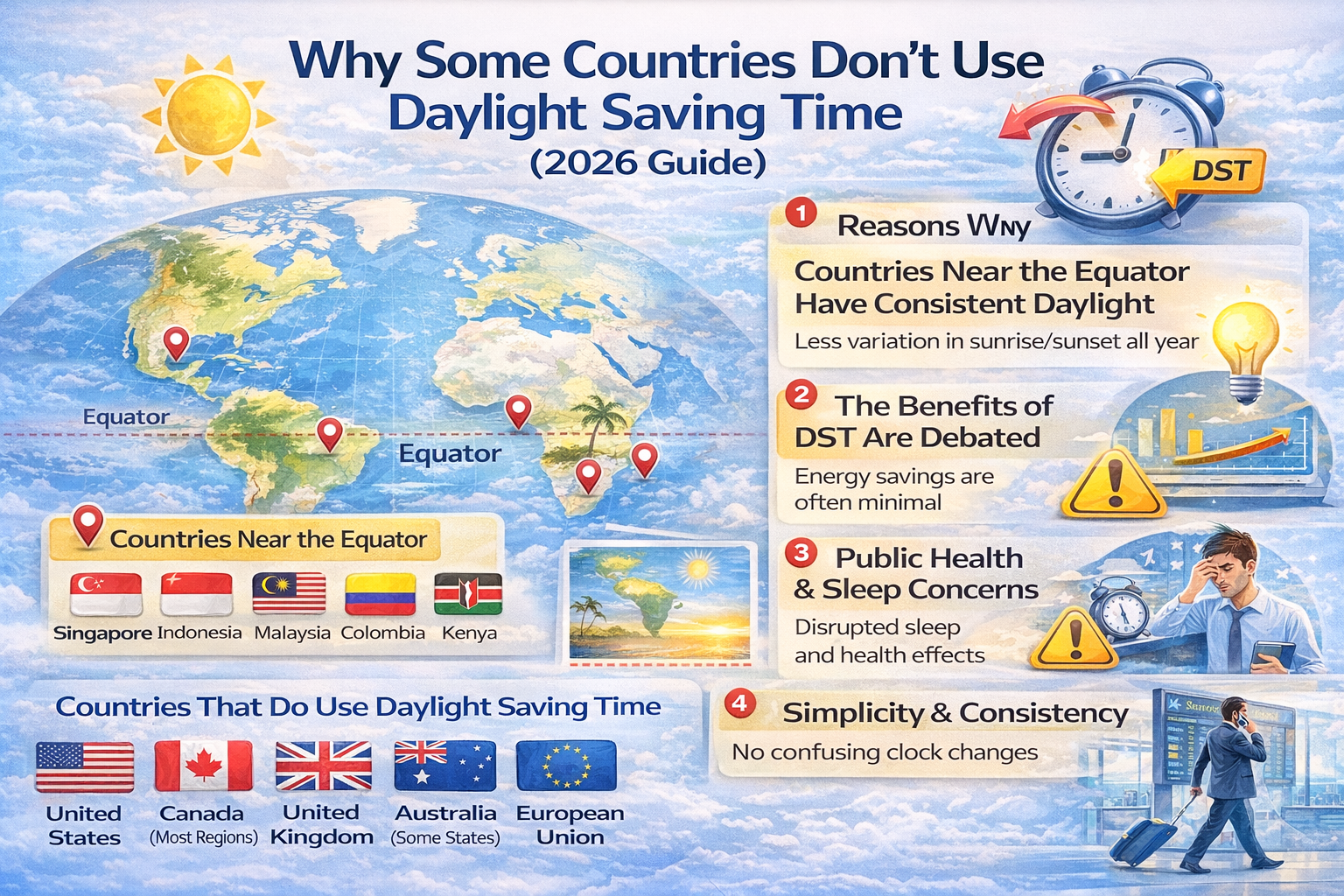
Most countries in the world do not change their clocks.
Examples include:
Many of these countries are located near the equator, where the difference between summer and winter daylight hours is small. Because sunrise and sunset times stay relatively consistent throughout the year, adjusting clocks provides little benefit.
Why Some Countries Stopped Using DST
Several countries that once used daylight saving time have decided to stop.
Common reasons include:
Limited energy savings
Early studies suggested DST would reduce electricity use, but modern research shows the savings are often small.
Health concerns
Changing clocks can disrupt sleep patterns and daily routines.
Scheduling confusion
The time change can complicate international travel, business meetings, and technology systems.
Because of these concerns, some governments have considered removing DST entirely.
How Many Countries Actually Use Daylight Saving Time?
Globally, less than half of the world’s countries use daylight saving time.
DST is mainly used in:
- North America
- Europe
- A few countries in South America
- Parts of Oceania
Most countries prefer to keep the same time all year.
How Global Time Is Organized
Modern timekeeping is based on Coordinated Universal Time (UTC).
UTC acts as the global reference point from which all time zones are calculated.
Each country chooses its local time zone relative to UTC based on geography, politics, and economic considerations.
Daylight saving time is simply an additional seasonal adjustment used by some countries.
Check the Current Time Anywhere in the World
If you want to see the current time in cities and countries worldwide, you can use timenowonline.com to quickly check:
- live local time
- time differences between countries
- time zone information
- global clock comparisons
This can help with travel planning, remote work, and international communication.
Final Thoughts
Your country is not the only place that uses daylight saving time, but many countries do not use it either. The system is mainly used in regions where daylight hours change significantly between seasons.
While daylight saving time continues to be debated around the world, it remains an important part of timekeeping in several countries.
Understanding how different nations manage their clocks can make global communication and travel much easier.