Tag: global time zones

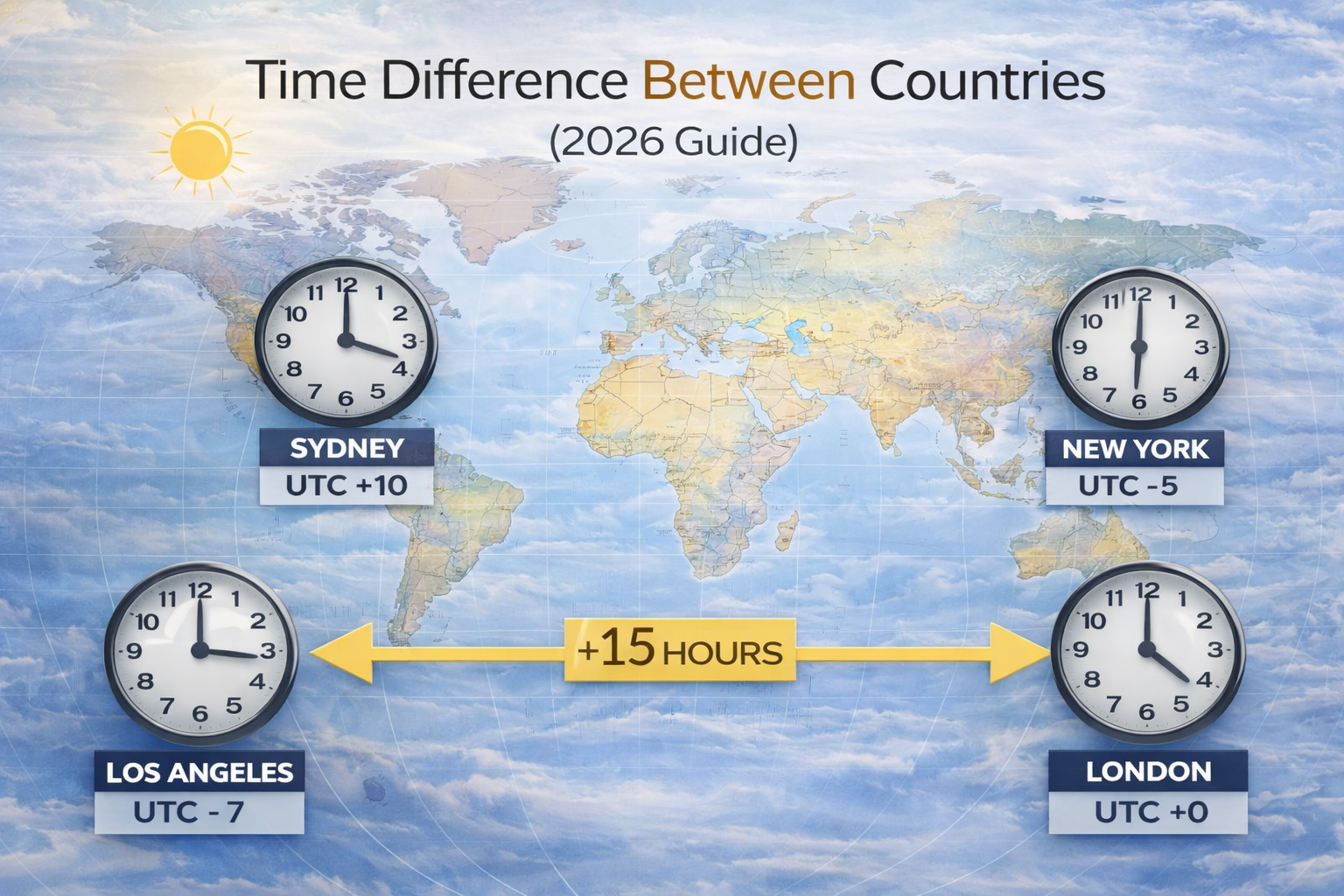
  • Time Difference Between Countries: Simple Guide (2026)

    Time Difference Between Countries: Simple Guide (2026)

    Trying to figure out the time difference between countries can be confusing—especially when you’re dealing with multiple time zones.

    Whether you’re planning a meeting, traveling, or running an online business, understanding time differences is essential to avoid missed calls and delays.

    In this guide, we’ll break it down in the simplest way possible.


    What Is a Time Difference?

    A time difference is the number of hours (and sometimes minutes) between two locations based on their time zones.

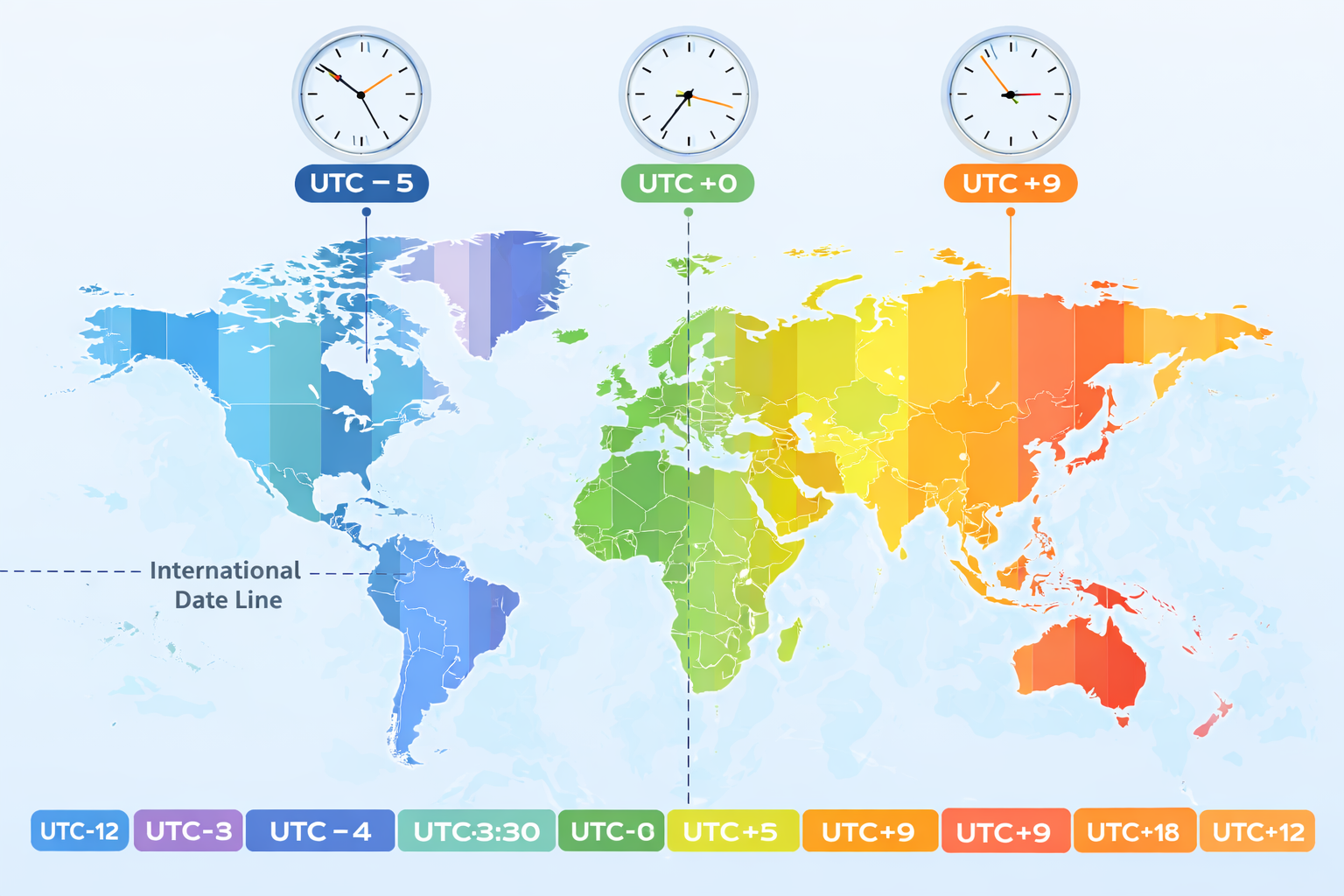
    Each country operates in a specific time zone, measured from Coordinated Universal Time (UTC).

    For example:

    • London → UTC +0
    • New York → UTC -5
      👉 Time difference = 5 hours

    How to Calculate Time Difference (Simple Method)

    Follow these steps:

    1. Find both time zones

    Example:

    • Sydney → UTC +10
    • Los Angeles → UTC -8

    2. Subtract the numbers

    👉 10 – (-8) = 18 hours difference

    3. Adjust forward or backward

    Sydney is 18 hours ahead of Los Angeles.


    🌍 Common Time Differences Around the World

    Here are popular comparisons people search for:

    From → ToTime Difference
    SydneyNew York+15 hours
    LondonDubai+4 hours
    TokyoLos Angeles+16 hours
    India UK+5.5 hours

    Why Time Differences Can Be Tricky

    Time differences aren’t always straightforward because of:

    Daylight Saving Time (DST)

    Some countries move their clocks forward or backward during the year.

    Multiple Time Zones

    Countries like the USA have several time zones.

    Half-Hour Differences

    Places like India use UTC +5:30, not full hours.


    Easiest Way to Check Time Difference

    Instead of calculating manually, you can use tools on TimeNowOnline.com.

    With a few clicks, you can:

    • Instantly compare two countries
    • See live time updates
    • Avoid costly mistakes in scheduling

    Tips for Managing Global Time

    • ✔️ Always confirm the local time before meetings
    • ✔️ Use calendar tools with time zone support
    • ✔️ Schedule during overlapping working hours
    • ✔️ Double-check during DST changes

    Why This Matters (Especially for Online Work)

    If you run an online business, time differences can impact:

    • Customer response time
    • Order processing
    • Supplier communication
    • Sales performance

    👉 Getting timing right can increase conversions and customer satisfaction


    Conclusion

    Understanding time differences between countries doesn’t have to be complicated. Once you know how time zones work—or use the right tools—you can stay organized and avoid mistakes.

    👉 Use TimeNowOnline.com to check time differences instantly and stay on track globally.


    Related Tools

  • Time Zone Converter: Easily Convert Time Between Cities Worldwide (2026 Guide)

    Time Zone Converter: Easily Convert Time Between Cities Worldwide (2026 Guide)

    What Is a Time Zone Converter?

    A time zone converter is a tool that allows you to quickly convert the time from one city or country to another. Whether you’re scheduling meetings, working remotely, or planning travel, knowing the correct local time is essential.

    Instead of manually calculating time differences, a converter automatically adjusts for:

    • Time zone differences
    • Daylight Saving Time (DST)
    • Date changes across regions

    👉 Try it here: https://timenowonline.com/time-converter/


    Why You Need a Time Converter

    In today’s global world, people work, communicate, and do business across multiple time zones daily.

    Here’s why a time converter is essential:

    • Remote work – Coordinate with teams worldwide
    • Client meetings – Avoid scheduling mistakes
    • Travel planning – Know arrival and departure times
    • Ecommerce operations – Manage international customers
    • Global business – Stay aligned across regions

    How the Time Now Online Converter Works

    Our tool makes it simple to convert time between cities in seconds.

    Steps:

    1. Select your From City
    2. Select your To City
    3. Choose the date and time
    4. Instantly see the converted time and difference

    👉 Use the tool now: https://timenowonline.com/time-converter/


    Example Time Conversion

    Let’s say:

    • 9:00 AM in Canberra, Australia
    • Converts to 6:00 PM (previous day) in Baltimore, USA

    This shows how time differences can cross into different days, which is critical when scheduling.


    Key Features of Our Time Converter

    • ✔️ Real-time accurate conversions
    • ✔️ Automatic daylight saving adjustments
    • ✔️ Supports cities worldwide
    • ✔️ Simple and user-friendly interface
    • ✔️ Instant time difference display

    Common Time Zone Challenges

    Many people struggle with:

    • Confusing AM/PM across countries
    • Forgetting daylight saving changes
    • Miscalculating time differences
    • Booking meetings on the wrong day

    A reliable time converter eliminates these issues completely.


    Best Use Cases

    Here’s when you should always use a time converter:

    • Scheduling Zoom or Teams meetings
    • Hiring international freelancers
    • Running global ecommerce stores
    • Coordinating events across countries
    • Managing offshore teams

    Frequently Asked Questions

    What is the easiest way to convert time zones?

    The easiest way is to use an online tool like our converter that automatically calculates everything for you.

    Does the converter include daylight saving time?

    Yes, it automatically adjusts for daylight saving changes where applicable.

    Can I convert between any cities?

    Yes, you can convert time between major cities worldwide instantly.

    Why is the date sometimes different?

    Because some countries are ahead or behind by many hours, the converted time may fall on the previous or next day.


    Final Thoughts

    A time zone converter is one of the most essential tools for anyone working or communicating globally. It saves time, prevents mistakes, and ensures you stay aligned with people anywhere in the world.

    👉 Start converting time instantly:
    https://timenowonline.com/time-converter/

  • Best Time to Call Internationally: A Simple Guide for Global Communication (2026)

    Best Time to Call Internationally: A Simple Guide for Global Communication (2026)

    In today’s connected world, working and communicating across different countries is more common than ever. Whether you’re managing a remote team, speaking with clients overseas, or connecting with family, knowing the best time to call internationally can save you from awkward timing and missed opportunities.

    This guide will help you understand how to schedule calls efficiently across time zones.


    Why Time Zones Matter

    Every country operates within a specific time zone, and some even observe daylight saving time. This means that the time difference between two locations can change throughout the year.

    For example:

    Without checking the correct time, you might end up calling someone in the middle of the night.


    The Best Time Window for International Calls

    A good rule of thumb is to find overlapping working hours.

    Ideal overlap:

    • 8:00 AM – 10:00 AM (your time)
    • 4:00 PM – 6:00 PM (their time)

    This ensures:

    • Both parties are awake and alert
    • You avoid very early or very late calls

    Example: Australia Calling the USA

    If you’re in Sydney and need to call someone in New York:

    • Sydney morning = New York afternoon (previous day)
    • Best time:
      • Sydney: 7:00 AM – 9:00 AM
      • New York: 3:00 PM – 5:00 PM (previous day)

    This overlap is commonly used by global teams.


    Best Time for Business Calls

    For professional communication, timing is even more important.

    Tips:

    • Avoid weekends unless necessary
    • Stay within business hours (9 AM – 6 PM local time)
    • Confirm time zones before scheduling meetings

    Use Tools to Avoid Mistakes

    Instead of guessing, use tools like:

    These tools help you instantly compare multiple time zones and avoid confusion.


    Common Mistakes to Avoid

    • Forgetting daylight saving time changes
    • Assuming all countries follow the same schedule
    • Mixing up AM and PM
    • Not double-checking the date difference

    Final Thoughts

    Scheduling international calls doesn’t have to be complicated. By understanding time zones and using simple tools, you can communicate smoothly across the world.

    If you regularly work with people in different countries, building the habit of checking time differences will save you time and improve your productivity.

  • Why Does India Use UTC+5:30?

    Why Does India Use UTC+5:30?

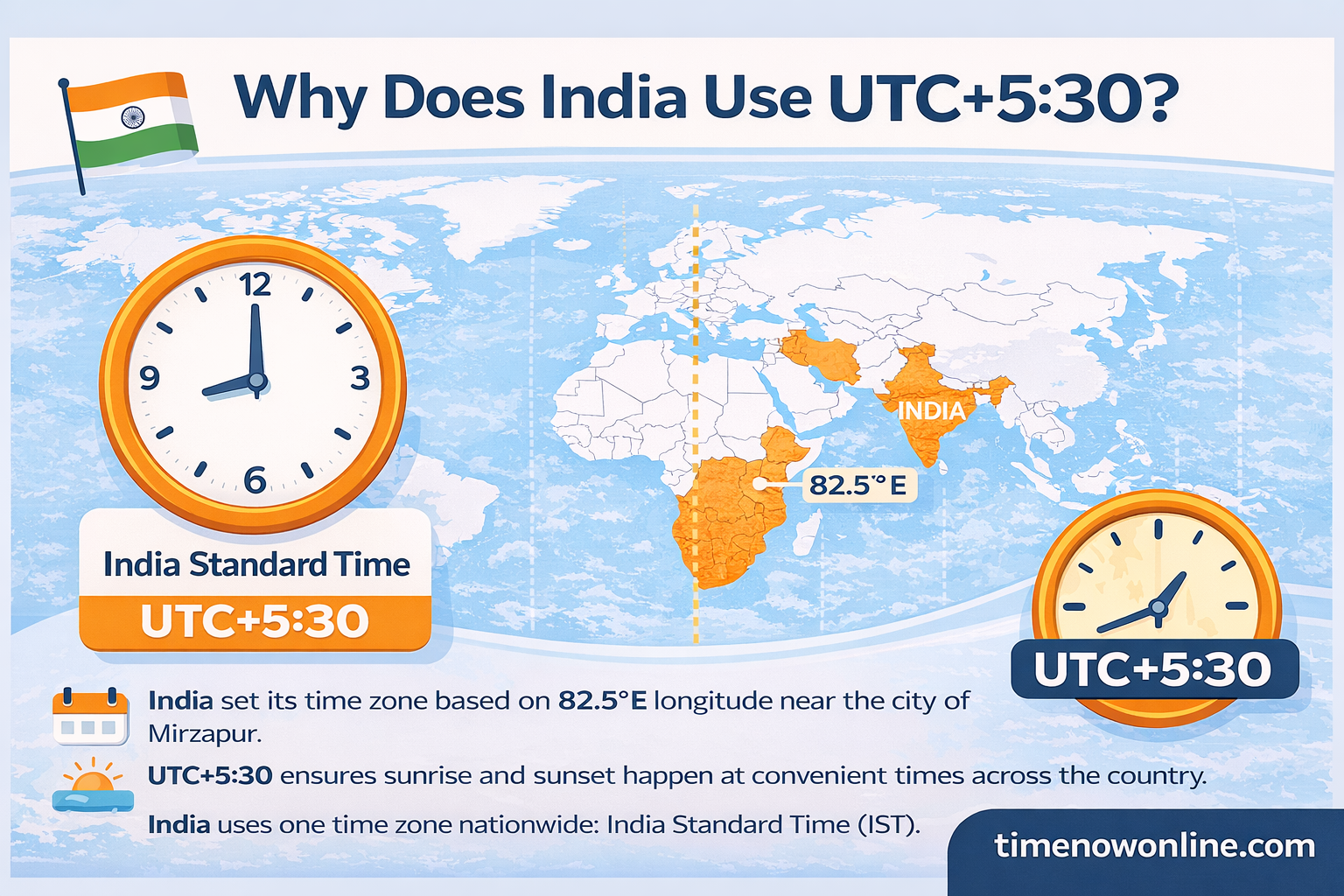
    India uses Indian Standard Time (IST), which is 5 hours and 30 minutes ahead of Coordinated Universal Time (UTC+5:30). Unlike many countries that use whole-hour time zones such as UTC+5 or UTC+6, India’s time zone includes a 30-minute offset, which often surprises people around the world.

    But there is a practical and historical reason behind this. India’s unique time zone was chosen to better match the country’s geography and daily sunlight patterns.


    Understanding UTC and Time Zones

    To understand why India uses UTC+5:30, we first need to understand how time zones work.

    The Earth is divided into 24 main time zones, each roughly covering 15 degrees of longitude. This is because the Earth rotates 360 degrees in 24 hours, which means every 15 degrees corresponds to about one hour of time difference.

    The global reference point for time is Coordinated Universal Time (UTC), which is based on atomic clocks and serves as the standard for all time zones.

    Countries set their local time by choosing a UTC offset, such as:

    India’s time zone is UTC+5:30.


    Why India Chose UTC+5:30

    India’s time zone was designed to better align with the country’s geographic location.

    India stretches across about 30 degrees of longitude, meaning the eastern and western parts of the country experience sunrise and sunset at noticeably different times. If India used a standard hourly time zone like UTC+5 or UTC+6, sunrise and sunset would feel unnatural in many parts of the country.

    The solution was to adopt a half-hour offset, placing the official time exactly between the two possible hourly zones.

    This helps ensure that:

    • mornings begin with daylight in most regions
    • work hours align better with daylight
    • daily life follows natural daylight cycles

    The Origin of Indian Standard Time

    Before India adopted a single national time, several cities used their own local time.

    During the late 19th century under British rule, major cities operated on separate time systems, including:

    • Bombay Time
    • Calcutta Time
    • Madras Time

    This created confusion, especially for railway schedules and communication.

    To simplify timekeeping across the country, Indian Standard Time (IST) was officially adopted in 1906.

    The reference longitude chosen was 82.5° East, which passes near the city of Mirzapur in Uttar Pradesh. This longitude corresponds exactly to UTC+5:30.


    Why India Does Not Use Daylight Saving Time

    Many countries adjust their clocks during summer months using Daylight Saving Time (DST) to extend evening daylight.

    However, India does not observe daylight saving time.

    There are several reasons for this:

    1. India’s location near the equator means daylight hours remain relatively consistent throughout the year.
    2. The benefits of daylight saving would be minimal compared to countries at higher latitudes.
    3. Maintaining a single stable time zone simplifies national coordination.

    Because of this, IST remains the same all year round.


    Cities That Use Indian Standard Time

    India uses one single time zone nationwide, meaning every city follows IST.

    Major cities using IST include:

    You can check the current time in these cities on our website.


    Other Countries With Half-Hour Time Zones

    India is not the only country with a half-hour time zone.

    Several regions around the world use similar offsets to better match local geography.

    Examples include:

    • Iran – UTC+3:30
    • Afghanistan – UTC+4:30
    • Myanmar – UTC+6:30
    • Australia (Northern Territory) – UTC+9:30
    • Newfoundland (Canada) – UTC−3:30

    There are even 45-minute time zones, such as Nepal (UTC+5:45).

    These unusual offsets exist because countries sometimes prioritize practical daylight alignment over perfectly rounded time zones.


    Advantages of India’s Time Zone

    India’s use of UTC+5:30 offers several benefits.

    1. Better Alignment With Daylight

    The half-hour offset helps ensure sunrise and sunset occur at reasonable times for most of the country.

    2. Simplified National Coordination

    Using a single time zone keeps schedules consistent across the entire country.

    3. Efficient Transportation and Communication

    Railways, airlines, and businesses can operate with one official national time.


    Challenges of a Single Time Zone

    Although IST works well overall, there have been discussions about introducing multiple time zones in India.

    Eastern regions of India experience sunrise much earlier than western regions. In some areas, the sun rises before 5 AM during certain seasons.

    Some experts suggest splitting India into two time zones to improve productivity and reduce electricity use.

    However, for now, India continues to use one standard time zone nationwide.


    Frequently Asked Questions

    What does IST stand for?

    IST stands for Indian Standard Time.

    What is the UTC offset for India?

    India’s time zone is UTC+5:30.

    Does India observe daylight saving time?

    No. India uses the same time throughout the year.

    Why is India not UTC+5 or UTC+6?

    India chose UTC+5:30 to better match the country’s geographic position.


    Final Thoughts

    India’s use of UTC+5:30 is the result of both geography and history. By choosing a half-hour offset based on the 82.5° East longitude, India created a time system that better fits the country’s natural daylight cycle.

    Although unusual compared to standard hourly time zones, IST has worked effectively for over a century and continues to provide a consistent time reference across the entire country.

  • What Is Daylight Saving Time? Why Clocks Change Around the World

    What Is Daylight Saving Time? Why Clocks Change Around the World

    Daylight Saving Time (DST) is a system used in some countries where clocks are adjusted forward or backward during certain times of the year.

    Typically, clocks are moved forward by one hour in spring and back by one hour in autumn (fall). This adjustment is intended to make better use of daylight during the longer days of the year.

    The idea behind daylight saving time is simple: shifting the clock allows people to enjoy more daylight in the evening hours.


    Why Daylight Saving Time Exists

    Daylight saving time was introduced to make better use of natural daylight. When clocks move forward in spring, sunrise and sunset occur later in the day.

    This means people have more daylight after work or school.

    Historically, the system was believed to help:

    • reduce electricity use
    • increase productivity
    • allow more daylight activities
    • improve coordination of schedules

    Although energy savings were once a major reason for DST, modern studies show the impact may be smaller than originally expected.


    How Daylight Saving Time Works

    In most countries that use DST, the schedule follows this pattern:

    SeasonClock Change
    SpringClocks move forward 1 hour
    Autumn / FallClocks move back 1 hour

    People often remember this using the phrase:

    “Spring forward, fall back.”

    For example:

    • If the time is 2:00 AM, the clock moves forward to 3:00 AM during the spring change.
    • In autumn, 2:00 AM becomes 1:00 AM when clocks move backward.

    Countries That Use Daylight Saving Time

    Daylight saving time is used mainly in regions where seasonal daylight varies significantly.

    Countries and regions that commonly observe DST include:

    However, many countries around the world do not use daylight saving time.


    Why Some Countries Do Not Use DST

    Many countries, especially those near the equator, do not observe daylight saving time because daylight hours remain fairly consistent throughout the year.

    Examples include:

    For these countries, adjusting clocks provides little benefit.


    How DST Affects Time Zones

    Daylight saving time temporarily changes the relationship between local time and Coordinated Universal Time (UTC).

    For example:

    LocationStandard TimeDST Time
    New YorkUTC−5UTC−4
    LondonUTC+0UTC+1
    BerlinUTC+1UTC+2

    This shift can sometimes create confusion when scheduling international meetings or travel.


    Common Challenges With Daylight Saving Time

    Although DST has benefits, it also creates challenges.

    Some common issues include:

    • disrupted sleep schedules
    • confusion with international time differences
    • technology and scheduling adjustments
    • debates about whether DST should continue

    Because of these concerns, several countries have considered eliminating daylight saving time.


    Checking Time During Daylight Saving Changes

    When daylight saving time begins or ends, local clocks change, which can affect global time differences.

    You can easily check the current local time and time zone changes using timenowonline.com, which provides accurate time information for cities and countries worldwide.


    Final Thoughts

    Daylight saving time is a system designed to make better use of daylight during certain months of the year. By shifting clocks forward in spring and back in autumn, some countries aim to maximize daylight hours in the evening.

    While the system continues to be debated, daylight saving time remains an important part of timekeeping in several regions around the world.

    Understanding how DST works can help travelers, businesses, and global teams coordinate time more effectively.

  • Adjusting to Time Changes When Traveling: How to Beat Jet Lag

    Adjusting to Time Changes When Traveling: How to Beat Jet Lag

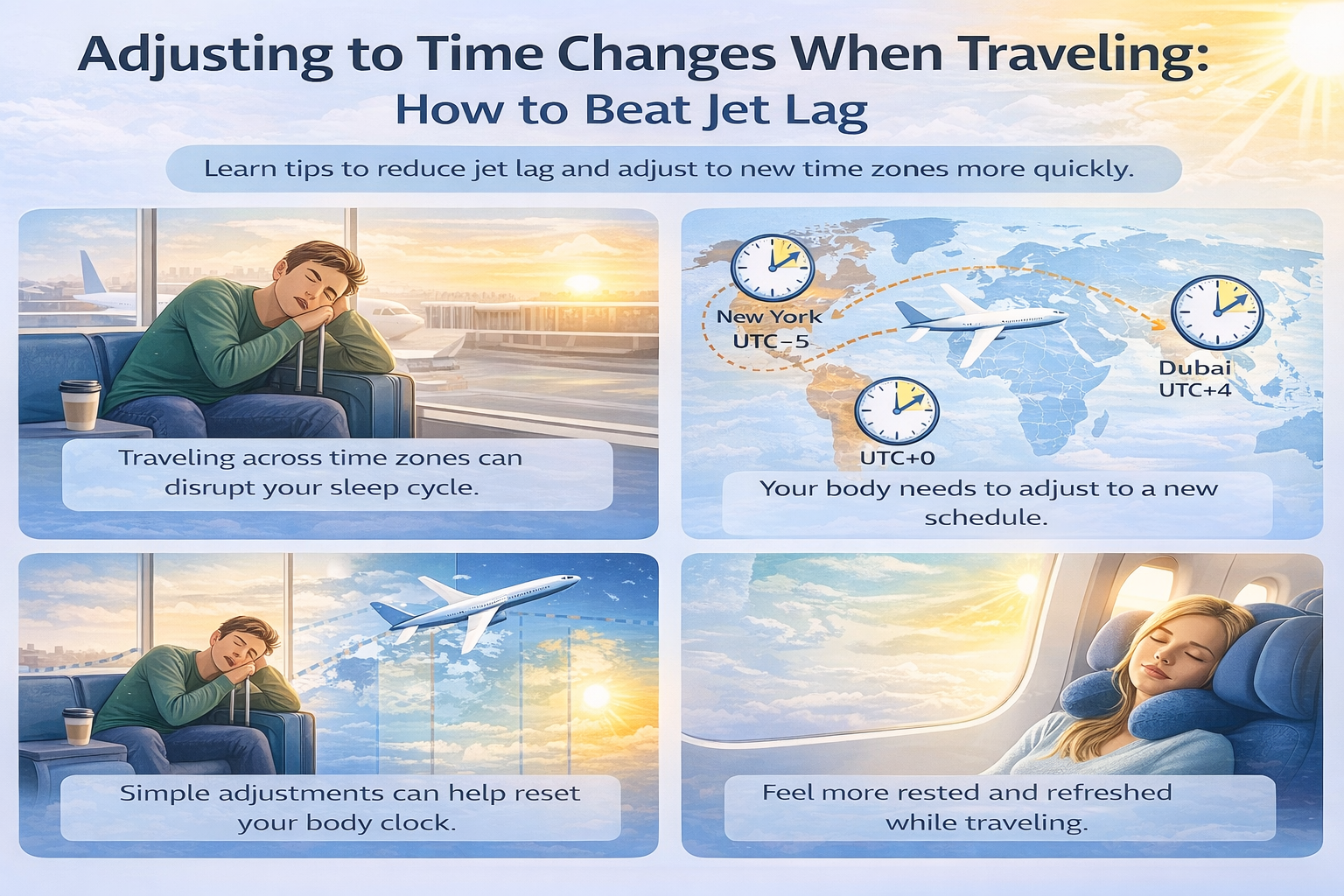
    Traveling across multiple time zones can be exciting, but it can also disrupt your body’s internal clock. Many travelers experience jet lag, a temporary sleep disorder caused by rapid travel across different time zones.

    Jet lag can lead to fatigue, difficulty sleeping, headaches, and reduced concentration. Fortunately, there are effective ways to adjust more quickly and make international travel more comfortable.

    Understanding how time zones affect your body can help you prepare before your trip and recover faster after arrival.


    What Causes Jet Lag?

    Jet lag occurs when your circadian rhythm, the body’s natural sleep–wake cycle, becomes out of sync with the local time at your destination.

    Your body is used to a regular pattern of:

    • waking up
    • eating meals
    • sleeping

    When you travel across several time zones, this rhythm no longer matches the new environment.

    The larger the time difference, the more noticeable jet lag may be.


    How Time Zones Affect Your Body

    Global time zones are organized based on Coordinated Universal Time (UTC), which serves as the reference for time worldwide.

    Each region adjusts its local time relative to UTC.

    For example:

    CityTime Zone
    New YorkUTC−5
    LondonUTC+0
    DubaiUTC+4
    TokyoUTC+9

    When traveling between these locations, your body must adapt to a completely different schedule.


    Common Symptoms of Jet Lag

    Travelers may experience several symptoms when adjusting to a new time zone.

    Typical signs include:

    • fatigue and low energy
    • trouble falling asleep
    • waking up too early
    • difficulty concentrating
    • mild headaches
    • digestive discomfort

    These symptoms usually improve within a few days as your body adjusts.


    Tips to Adjust to Time Changes Faster

    There are several strategies that can help travelers reduce the effects of jet lag.

    Adjust Your Schedule Before Departure

    A few days before your trip, gradually shift your sleep schedule toward the time zone of your destination.

    Even small adjustments can help your body prepare.


    Stay Hydrated

    Air travel can cause dehydration, which may worsen jet lag symptoms.

    Drink plenty of water before, during, and after your flight.

    Avoid excessive caffeine and alcohol while traveling.


    Get Sunlight Exposure

    Natural light is one of the most powerful signals for resetting your internal clock.

    Spending time outdoors during daylight hours at your destination can help your body adjust faster.


    Try to Sleep According to Local Time

    Once you arrive, try to follow the local schedule.

    Even if you feel tired, staying awake until the local bedtime can help your body adapt more quickly.


    Take Short Naps Only if Necessary

    Short naps of 20–30 minutes may help reduce fatigue, but long naps can make it harder to adjust to the new time zone.


    How Long Does Jet Lag Last?

    Jet lag recovery time varies depending on the number of time zones crossed.

    A general guideline is that the body needs about one day to adjust per time zone.

    For example:

    Time Zones CrossedApproximate Recovery
    2–3 zones1–2 days
    5–6 zones3–4 days
    8+ zonesup to a week

    Traveling east usually causes stronger jet lag than traveling west because it shortens your natural day.


    Why Time Awareness Helps Travelers

    Understanding global time zones can help travelers plan their trips more effectively.

    Checking the current time at your destination before departure can help you mentally prepare for the time difference.

    You can quickly see the current local time around the world using timenowonline.com, which makes it easier to plan calls, meetings, and travel schedules.


    Final Thoughts

    Jet lag is a common challenge for international travelers, but with the right preparation, it can be minimized. By adjusting your sleep schedule, staying hydrated, and following the local time at your destination, you can help your body adapt more quickly.

    Understanding how global time zones work also makes travel planning easier and helps you stay connected with people around the world.


© 2026 Time Now Online. All rights reserved.