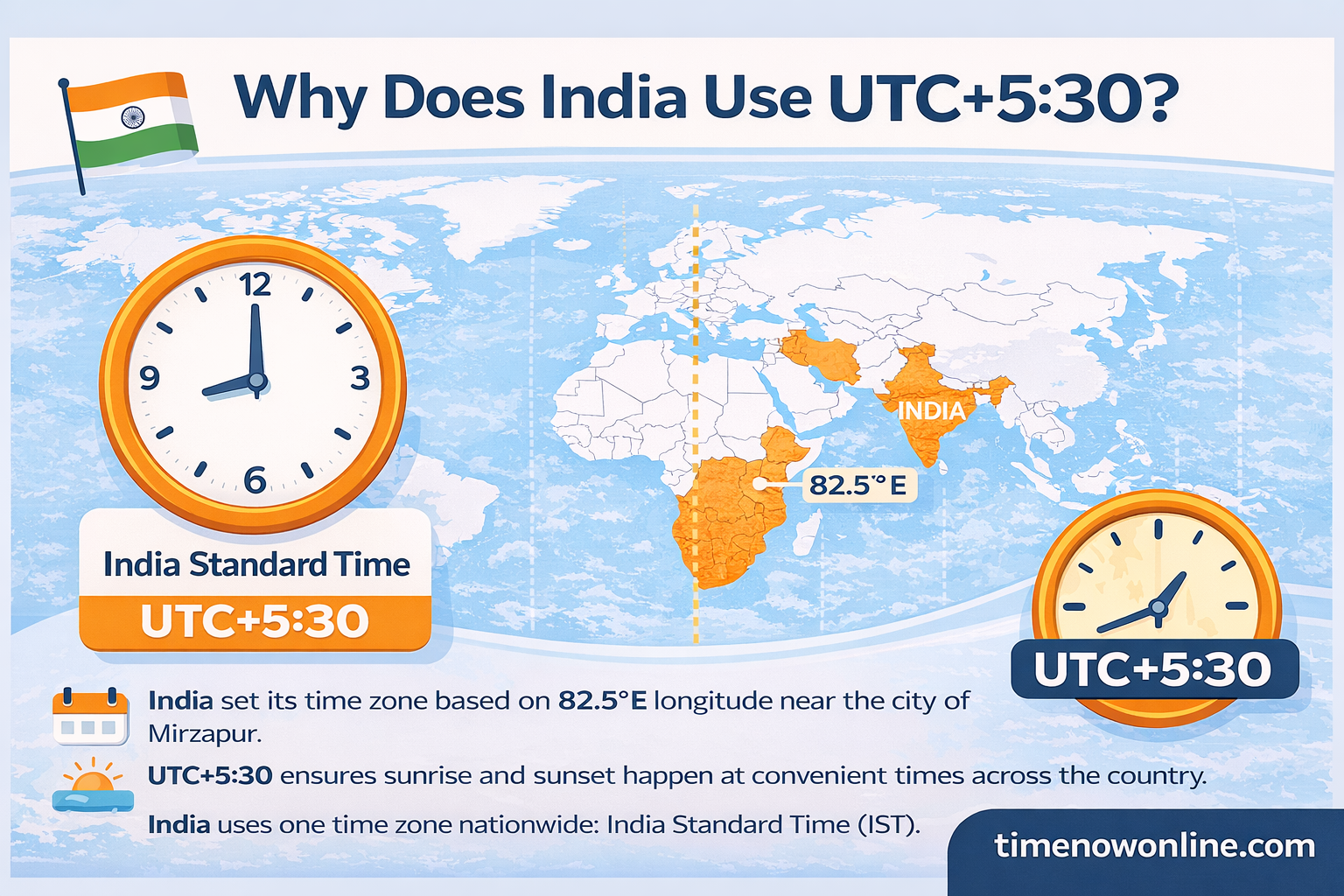
India uses Indian Standard Time (IST), which is 5 hours and 30 minutes ahead of Coordinated Universal Time (UTC+5:30). Unlike many countries that use whole-hour time zones such as UTC+5 or UTC+6, India’s time zone includes a 30-minute offset, which often surprises people around the world.
But there is a practical and historical reason behind this. India’s unique time zone was chosen to better match the country’s geography and daily sunlight patterns.
Understanding UTC and Time Zones
To understand why India uses UTC+5:30, we first need to understand how time zones work.
The Earth is divided into 24 main time zones, each roughly covering 15 degrees of longitude. This is because the Earth rotates 360 degrees in 24 hours, which means every 15 degrees corresponds to about one hour of time difference.
The global reference point for time is Coordinated Universal Time (UTC), which is based on atomic clocks and serves as the standard for all time zones.
Countries set their local time by choosing a UTC offset, such as:
India’s time zone is UTC+5:30.
Why India Chose UTC+5:30
India’s time zone was designed to better align with the country’s geographic location.
India stretches across about 30 degrees of longitude, meaning the eastern and western parts of the country experience sunrise and sunset at noticeably different times. If India used a standard hourly time zone like UTC+5 or UTC+6, sunrise and sunset would feel unnatural in many parts of the country.
The solution was to adopt a half-hour offset, placing the official time exactly between the two possible hourly zones.
This helps ensure that:
- mornings begin with daylight in most regions
- work hours align better with daylight
- daily life follows natural daylight cycles
The Origin of Indian Standard Time
Before India adopted a single national time, several cities used their own local time.
During the late 19th century under British rule, major cities operated on separate time systems, including:
- Bombay Time
- Calcutta Time
- Madras Time
This created confusion, especially for railway schedules and communication.
To simplify timekeeping across the country, Indian Standard Time (IST) was officially adopted in 1906.
The reference longitude chosen was 82.5° East, which passes near the city of Mirzapur in Uttar Pradesh. This longitude corresponds exactly to UTC+5:30.
Why India Does Not Use Daylight Saving Time
Many countries adjust their clocks during summer months using Daylight Saving Time (DST) to extend evening daylight.
However, India does not observe daylight saving time.
There are several reasons for this:
- India’s location near the equator means daylight hours remain relatively consistent throughout the year.
- The benefits of daylight saving would be minimal compared to countries at higher latitudes.
- Maintaining a single stable time zone simplifies national coordination.
Because of this, IST remains the same all year round.
Cities That Use Indian Standard Time
India uses one single time zone nationwide, meaning every city follows IST.
Major cities using IST include:
You can check the current time in these cities on our website.
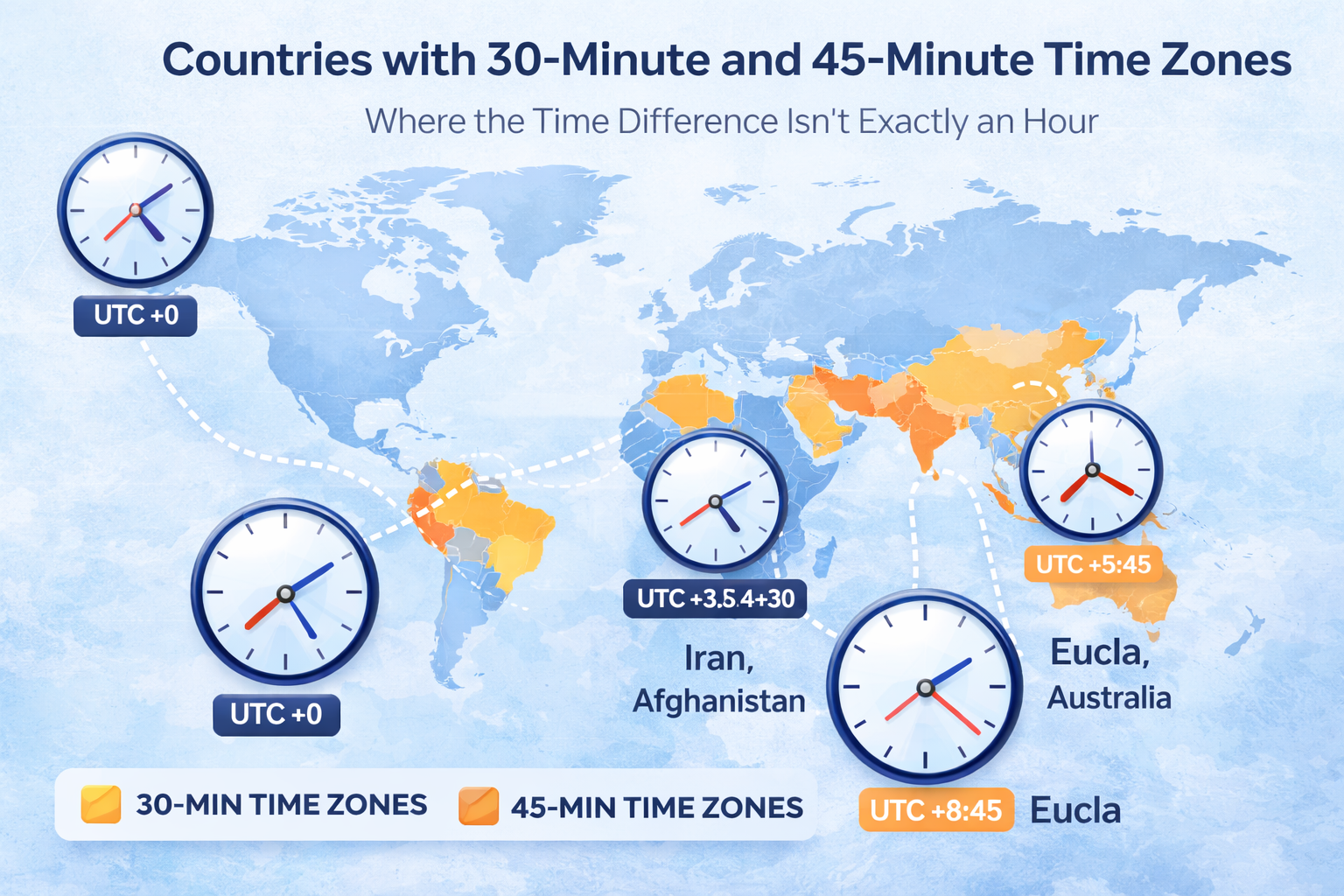
Other Countries With Half-Hour Time Zones
India is not the only country with a half-hour time zone.
Several regions around the world use similar offsets to better match local geography.
Examples include:
- Iran – UTC+3:30
- Afghanistan – UTC+4:30
- Myanmar – UTC+6:30
- Australia (Northern Territory) – UTC+9:30
- Newfoundland (Canada) – UTC−3:30
There are even 45-minute time zones, such as Nepal (UTC+5:45).
These unusual offsets exist because countries sometimes prioritize practical daylight alignment over perfectly rounded time zones.
Advantages of India’s Time Zone
India’s use of UTC+5:30 offers several benefits.
1. Better Alignment With Daylight
The half-hour offset helps ensure sunrise and sunset occur at reasonable times for most of the country.
2. Simplified National Coordination
Using a single time zone keeps schedules consistent across the entire country.
3. Efficient Transportation and Communication
Railways, airlines, and businesses can operate with one official national time.
Challenges of a Single Time Zone
Although IST works well overall, there have been discussions about introducing multiple time zones in India.
Eastern regions of India experience sunrise much earlier than western regions. In some areas, the sun rises before 5 AM during certain seasons.
Some experts suggest splitting India into two time zones to improve productivity and reduce electricity use.
However, for now, India continues to use one standard time zone nationwide.
Frequently Asked Questions
What does IST stand for?
IST stands for Indian Standard Time.
What is the UTC offset for India?
India’s time zone is UTC+5:30.
Does India observe daylight saving time?
No. India uses the same time throughout the year.
Why is India not UTC+5 or UTC+6?
India chose UTC+5:30 to better match the country’s geographic position.
Final Thoughts
India’s use of UTC+5:30 is the result of both geography and history. By choosing a half-hour offset based on the 82.5° East longitude, India created a time system that better fits the country’s natural daylight cycle.
Although unusual compared to standard hourly time zones, IST has worked effectively for over a century and continues to provide a consistent time reference across the entire country.