Tag: international time zones

  • The History of Time Zones: How the World Standardized Time (2026 Guide)

    The History of Time Zones: How the World Standardized Time (2026 Guide)

    Today, checking the time anywhere in the world is simple. With smartphones, online clocks, and digital devices, we can instantly know the time in any country or city. However, this global system of time zones did not always exist.

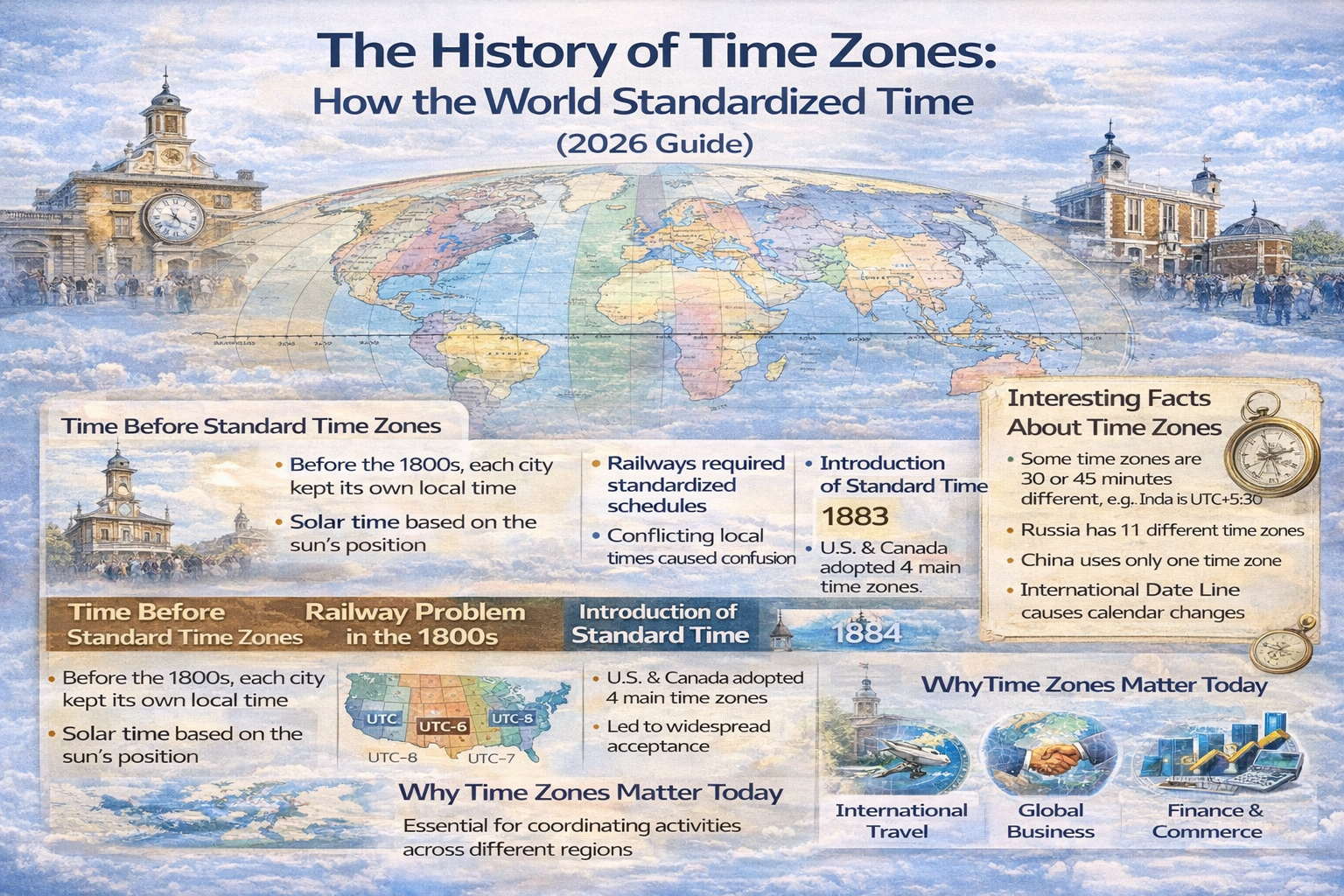
    Before the late 19th century, every city kept its own local time, based on the position of the sun in the sky. This meant that time could vary from one town to the next, even if they were only a short distance apart.

    The modern time zone system was created to solve these problems and bring consistency to global communication, travel, and commerce.


    Time Before Standard Time Zones

    Before time zones were introduced, people relied on solar time.

    Solar time was determined by the position of the sun. When the sun reached its highest point in the sky, it was considered local noon.

    Because the Earth rotates, solar noon occurs at slightly different times depending on a location’s longitude.

    This meant that neighboring cities could have clocks that differed by several minutes.

    While this system worked reasonably well for small communities, it became problematic as transportation and communication expanded.


    The Railway Problem

    The rapid expansion of railway systems during the 1800s created major challenges for timekeeping.

    Trains began connecting cities over long distances, and scheduling became extremely difficult when each town used its own local time.

    For example:

    • A train leaving one city might arrive in another where the local time was different.
    • Railway schedules became confusing and difficult to coordinate.

    This situation led to frequent scheduling errors and made travel planning complicated.

    Railway companies needed a standardized time system.


    The Introduction of Standard Time

    In 1883, railway companies in the United States and Canada introduced standardized time zones to solve scheduling problems.

    They divided the continent into four main time zones:

    • Eastern Time
    • Central Time
    • Mountain Time
    • Pacific Time

    Each region used the same clock time, making train schedules easier to manage.

    This system proved so effective that it quickly gained widespread acceptance.


    The International Meridian Conference (1884)

    A major milestone in global timekeeping occurred in 1884, when representatives from 25 countries met in Washington, D.C. for the International Meridian Conference.

    During this meeting, several important decisions were made:

    • The Prime Meridian would be located at Greenwich, England
    • Greenwich Mean Time (GMT) would serve as the global reference time
    • The world would be divided into time zones based on longitude

    This conference established the foundation for the modern global timekeeping system.


    The Development of Global Time Zones

    Following the conference, countries gradually adopted standardized time zones.

    The Earth was divided into 24 primary time zones, each roughly one hour apart.

    Each zone represents approximately 15 degrees of longitude, reflecting how far the Earth rotates in one hour.

    This system allows local time to align more closely with daylight patterns.


    The Transition from GMT to UTC

    For many years, Greenwich Mean Time (GMT) served as the global time standard.

    However, as technology advanced, scientists developed more precise methods of measuring time.

    Today, the official global time standard is Coordinated Universal Time (UTC).

    UTC is maintained using atomic clocks, which measure time based on the vibrations of atoms. These clocks are incredibly accurate and help keep global systems synchronized.


    How Time Zones Affect the Modern World

    Time zones play a critical role in modern life. They allow people across the globe to coordinate activities despite living in different regions.

    Time zones influence:

    • International travel schedules
    • Global business operations
    • Satellite navigation systems
    • Internet communications
    • Worldwide financial markets

    Without a standardized system of time zones, coordinating these activities would be extremely difficult.


    Interesting Facts About Time Zones

    Several unique facts highlight how complex global timekeeping can be.

    • Some countries use half-hour or 45-minute time zones, such as India and Nepal.
    • Russia spans 11 different time zones, the most of any country.
    • China uses only one time zone, despite being geographically very large.
    • The International Date Line helps maintain calendar consistency when traveling across the Pacific Ocean.

    These variations show that time zones are both a scientific system and a political decision.


    Final Thoughts

    The global time zone system was created to solve the challenges of transportation, communication, and international coordination. What began as a solution for railway scheduling in the 19th century eventually became the worldwide standard for organizing time.

    Today, thanks to time zones and modern atomic clocks, people across the world can coordinate activities with incredible precision.

    Understanding the history of time zones helps us appreciate the complex system that keeps the world running on time.
  • How to Calculate Time Differences Between Countries (Step-by-Step Guide for 2026)

    How to Calculate Time Differences Between Countries (Step-by-Step Guide for 2026)

    Understanding time differences between countries is more important today than ever before. In a world where people work remotely, collaborate globally, and communicate across continents, knowing the correct time difference helps avoid missed meetings, scheduling errors, and communication delays.

    Whether you’re coordinating with a business partner in another country, planning a call with family overseas, or scheduling international travel, learning how to calculate time differences can make your life much easier.

    In this guide, we’ll explain how time differences work, how to calculate them step-by-step, and how to quickly check accurate global time online.


    Why Time Differences Exist

    Time differences exist because the Earth rotates. As the planet spins, different parts of the world experience daylight and night at different times.

    To keep time organized, the world is divided into 24 primary time zones, each roughly representing one hour of time difference.

    These zones are usually measured relative to Coordinated Universal Time (UTC), which acts as the global time standard.

    For example:

    Because of this system, when it is 12:00 PM in London, it is 7:00 AM in New York and 10:00 PM in Sydney.


    Step-by-Step: How to Calculate Time Difference

    Calculating the time difference between two countries is easier than most people think.

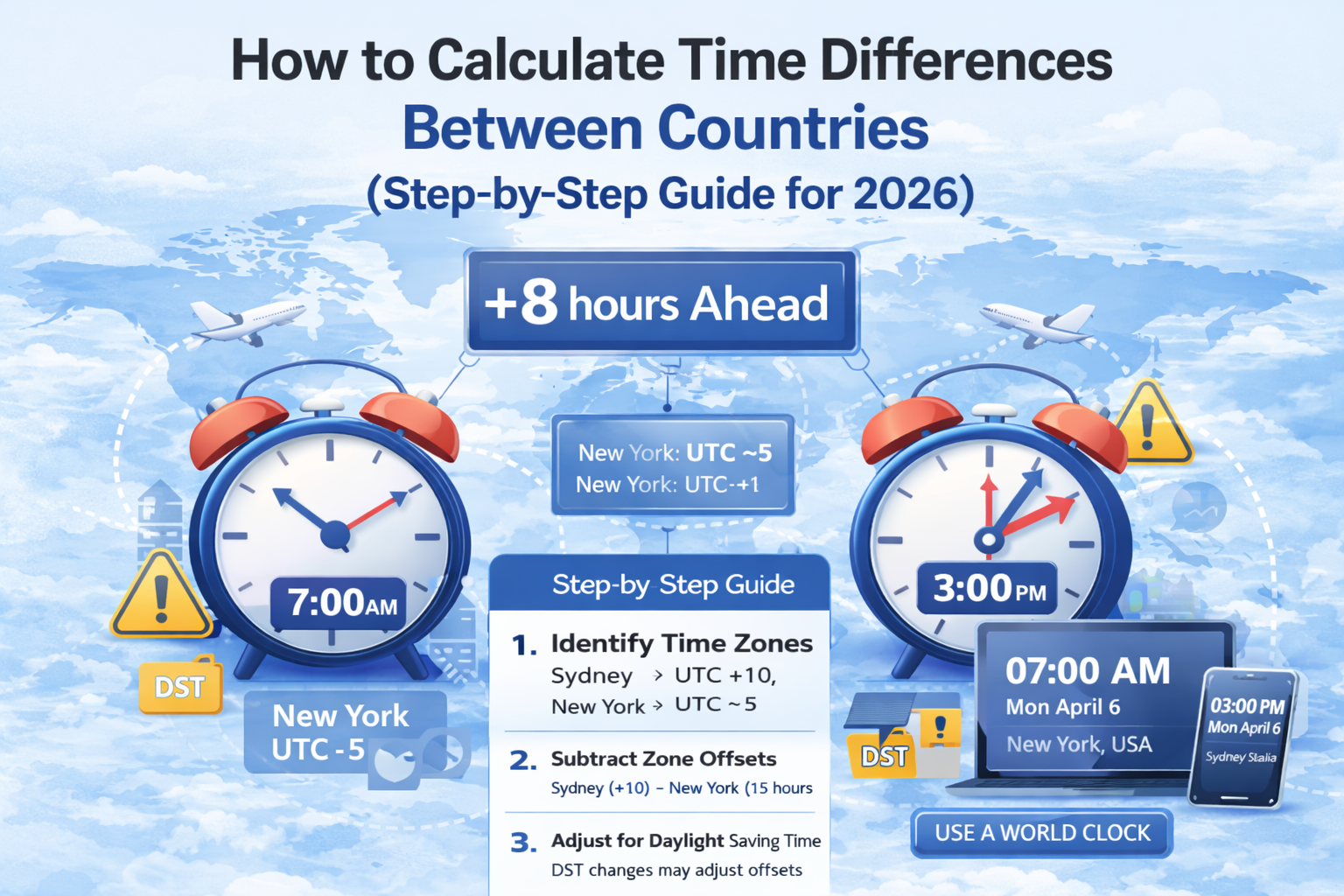
    Step 1: Identify Each Location’s Time Zone

    First, determine the UTC offset for both locations.

    Example:

    Sydney → UTC +10
    New York → UTC −5


    Step 2: Subtract the Time Zone Offsets

    Next, subtract the offsets to find the difference.

    Sydney (+10) minus New York (−5)

    10 − (−5) = 15 hours

    Sydney is therefore 15 hours ahead of New York.


    Step 3: Adjust for Daylight Saving Time

    Many countries change their clocks during part of the year due to Daylight Saving Time (DST).

    For example:

    • New York becomes UTC −4 during DST
    • Sydney may become UTC +11 during DST

    This means the time difference may change depending on the time of year.


    Examples of Time Differences Between Major Cities

    Here are some common global time differences people search for:

    CityTime ZoneDifference from London
    New YorkUTC −55 hours behind
    Los AngelesUTC −88 hours behind
    SydneyUTC +1010 hours ahead
    TokyoUTC +99 hours ahead
    DubaiUTC +44 hours ahead

    Because some locations observe daylight saving time and others do not, the exact difference can change during the year.


    Why Time Zones Can Be Confusing

    Although time zones seem simple, they can be confusing for several reasons.

    1. Some Countries Use Half-Hour Time Zones

    Not all time zones follow exact one-hour increments.

    Examples include:

    • India → UTC +5:30
    • Iran → UTC +3:30
    • Nepal → UTC +5:45

    These unusual offsets make manual calculations slightly more complicated.


    2. Daylight Saving Time Changes the Clock

    Many countries shift their clocks forward or backward once or twice each year.

    For example:

    • The United States changes clocks in March and November.
    • Most European countries change clocks in March and October.

    However, some countries do not observe DST at all, which can temporarily change the time difference between locations.


    3. Some Countries Use Multiple Time Zones

    Large countries may have several time zones.

    Examples include:

    This means you must know the exact city or region to calculate the correct time.


    The Easiest Way to Check Time Differences

    Instead of calculating manually every time, many people use online tools to instantly see the correct time anywhere in the world.

    Online world clock websites allow you to:

    • Check the current local time in any city
    • Compare time zones instantly
    • Avoid daylight saving errors
    • Plan international meetings more easily

    This is especially helpful for remote teams, international businesses, and travelers.


    When Time Differences Matter Most

    Knowing the correct time difference is particularly important in several situations.

    International Business

    Global companies often work with clients or partners in multiple countries. Scheduling meetings at the wrong time can cause delays or missed opportunities.

    Remote Work

    Remote teams frequently collaborate across continents. Understanding time zones helps ensure everyone joins meetings at the correct time.

    Travel Planning

    When traveling internationally, knowing the time difference helps you adjust your schedule and avoid jet lag confusion.

    Family Communication

    Many families live in different countries. Knowing the correct time difference makes it easier to plan calls and stay connected.


    Tips for Managing Time Zones More Easily

    Here are a few simple strategies to avoid time zone confusion.

    Use UTC as a reference point
    Many global systems rely on UTC to standardize time.

    Use online time tools
    World clock websites help you quickly compare multiple cities.

    Double-check daylight saving changes
    DST adjustments can temporarily shift time differences.

    Schedule meetings using shared calendars
    Modern calendar tools automatically convert time zones for participants.


    Final Thoughts

    Time differences between countries may seem complicated at first, but they follow a logical system based on Earth’s rotation and the global time zone structure.

    By understanding UTC offsets and daylight saving changes, you can quickly calculate time differences anywhere in the world.

    For the most accurate results, many people rely on online world clock tools that display real-time local time for cities across the globe.

    Whether you’re scheduling a meeting, planning travel, or simply staying connected with people in other countries, understanding time differences helps ensure you always know the right time.


© 2026 Time Now Online. All rights reserved.