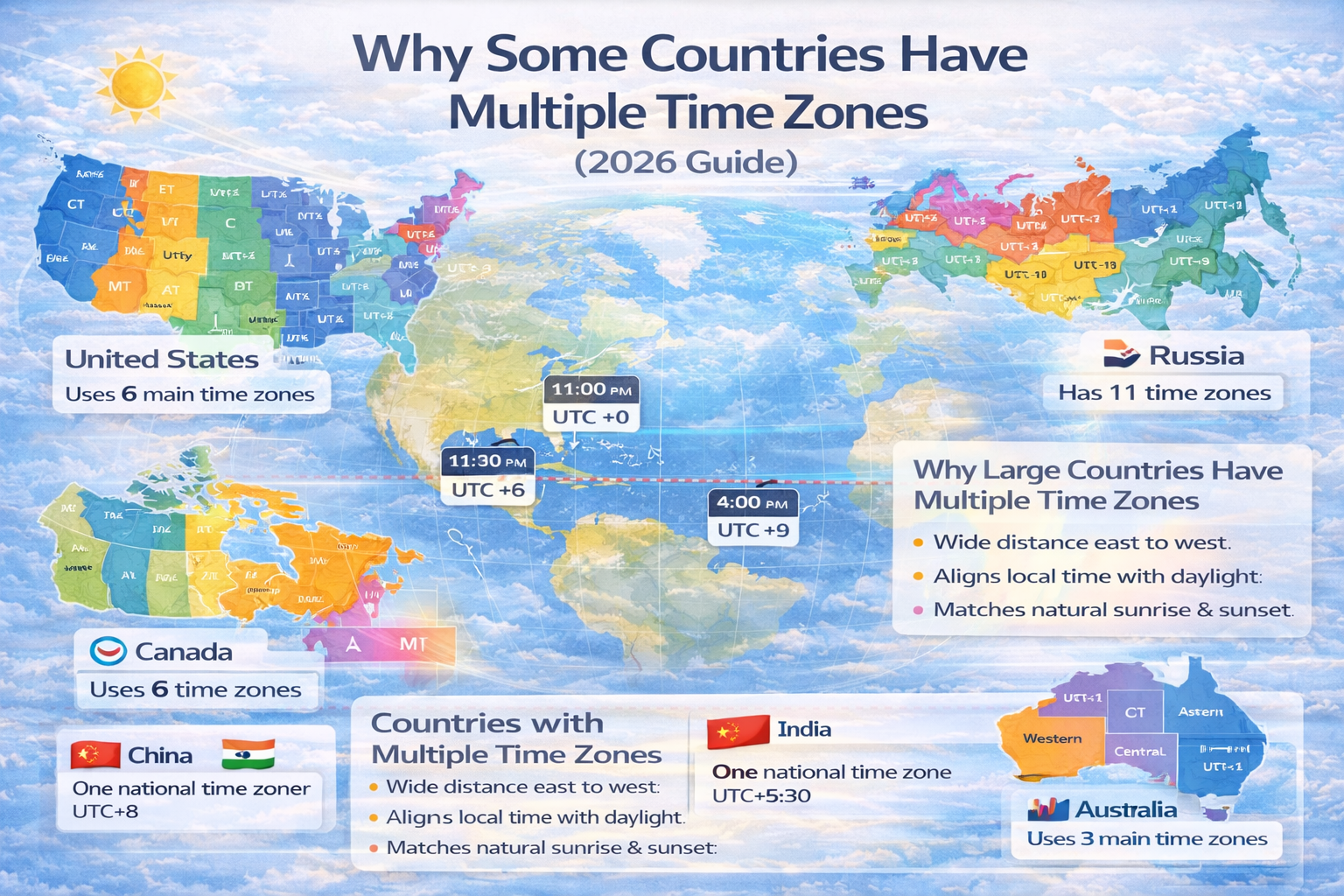
When looking at a world map, you might notice that some countries operate under a single time zone while others use several. Large nations like the United States and Russia span thousands of kilometers from east to west, making it impractical for the entire country to follow the same local time.
This is why some countries divide their territory into multiple time zones, allowing different regions to keep time that matches their position relative to the sun.
In this guide, we’ll explore why multiple time zones exist, which countries use them, and how they affect daily life and global communication.
Why Time Zones Exist
Time zones exist because the Earth rotates once every 24 hours. As the planet turns, different parts of the world experience daylight and night at different times.
To organize time globally, the Earth was divided into 24 main time zones, each roughly representing one hour of time difference.
Each time zone covers approximately 15 degrees of longitude, since the Earth rotates 360 degrees in 24 hours.
360 ÷ 24 = 15 degrees per hour.
This system ensures that local noon occurs when the sun is near its highest point in the sky.
Why Some Countries Need Multiple Time Zones
Countries that stretch across a wide distance from east to west may experience sunrise and sunset at very different times.
If the entire country used a single time zone, some regions would have extremely early sunrises or very late sunsets.
To solve this issue, governments divide their territory into multiple time zones.
This allows people in different regions to follow a schedule that better matches natural daylight.
Countries With Multiple Time Zones
Several large countries use more than one time zone to accommodate their geographic size.
United States
The United States uses six main time zones, including:
- Eastern Time (ET)
- Central Time (CT)
- Mountain Time (MT)
- Pacific Time (PT)
- Alaska Time
- Hawaii-Aleutian Time
Because the country stretches across a large portion of North America, different states follow different local times.
Russia
Russia has the largest number of time zones in the world, spanning 11 different time zones.
This massive country extends across both Europe and Asia, making a single national time impossible.
Traveling from western Russia to eastern Russia can involve many hours of time difference.
Canada
Canada also uses multiple time zones due to its large size.
These include:
- Pacific Time
- Mountain Time
- Central Time
- Eastern Time
- Atlantic Time
- Newfoundland Time
Some of these zones even include half-hour differences, such as Newfoundland Time.
Australia
Australia uses three main time zones:
- Australian Eastern Standard Time (AEST)
- Australian Central Standard Time (ACST)
- Australian Western Standard Time (AWST)
Some Australian states also observe Daylight Saving Time, while others do not, which can temporarily change time differences within the country.
Countries With Only One Time Zone
Interestingly, some very large countries choose to use only one official time zone.
China
Despite spanning roughly the same width as the United States, China uses a single time zone known as China Standard Time (UTC+8).
This means that sunrise in western China can occur much later than in eastern regions.
The decision was made to keep the country on a unified national schedule.
India
India also uses a single national time zone, called Indian Standard Time (UTC+5:30).
Even though India covers a wide geographic area, the government chose to maintain one standard time across the entire country.
Challenges of Multiple Time Zones
While multiple time zones help align local schedules with daylight, they can also create challenges.
These include:
- Confusion when scheduling meetings across regions
- Transportation coordination across time zones
- Differences in television broadcasts and national events
Businesses and organizations often rely on UTC time or scheduling tools to avoid confusion.
How Time Zones Affect Travel
Traveling across a country with multiple time zones can result in noticeable clock changes.
For example:
A flight from New York to Los Angeles crosses three time zones.
Even though the flight takes around six hours, travelers may arrive with the clock showing a time difference of only three hours.
This is because local time changes along the journey.
Why Understanding Time Zones Matters
Understanding how time zones work helps people coordinate activities across different regions of the world.
- International business meetings
- Flight schedules
- Global events
- Online communication
- Remote work collaboration
Because of this, many people rely on online world clock tools to quickly check the correct time in different locations.
Final Thoughts
Multiple time zones exist primarily because some countries cover vast geographic areas. Dividing these regions into different time zones allows local schedules to align more closely with daylight hours.
While this system can sometimes create confusion, it plays an essential role in helping people coordinate time across different parts of the world.
By understanding how time zones work, travelers, businesses, and remote teams can better manage schedules and communicate more effectively across global regions.