
Tag: time accuracy

  • How Atomic Clocks Keep the World’s Time Accurate (2026 Guide)

    How Atomic Clocks Keep the World’s Time Accurate (2026 Guide)

    When you check the time on your phone, computer, or a world clock website, you might assume the time simply comes from a regular clock somewhere. In reality, the global time system relies on some of the most precise machines ever created: atomic clocks.

    Atomic clocks are responsible for maintaining the official time standard used around the world, ensuring that millions of systems stay synchronized to the exact second. From GPS satellites to financial markets and international communication networks, atomic clocks quietly keep everything running on time.

    In this guide, we’ll explain how atomic clocks work, why they are so accurate, and how they keep global time synchronized.


    What Is an Atomic Clock?

    An atomic clock is a highly precise device that measures time using the natural vibrations of atoms.

    Unlike traditional clocks that rely on gears, springs, or electronic oscillators, atomic clocks track the frequency of energy transitions in atoms. These transitions occur at an extremely stable and predictable rate, making them ideal for measuring time.

    Most modern atomic clocks use cesium atoms, which vibrate at a very specific frequency when exposed to microwave radiation.

    In fact, the official definition of one second is based on this atomic vibration.

    One second equals:

    9,192,631,770 oscillations of a cesium-133 atom.

    This incredibly precise measurement forms the foundation of the global timekeeping system.


    Why Atomic Clocks Are So Accurate

    Atomic clocks are considered the most accurate timekeeping devices ever created.

    Some of the newest atomic clocks are so precise that they would lose less than one second over millions of years.

    This level of accuracy is possible because atomic vibrations remain extremely stable under controlled laboratory conditions.

    Compared to other clocks:

    Clock TypeAccuracy
    Mechanical clockmay drift seconds per day
    Quartz clockmay drift seconds per month
    Atomic clockaccurate to billionths of a second

    Because of this precision, atomic clocks serve as the global reference for official time.


    Coordinated Universal Time (UTC)

    The world’s official time standard is known as Coordinated Universal Time (UTC).

    UTC is maintained using a network of atomic clocks located in laboratories around the world. These clocks work together to calculate the most accurate global time.

    International organizations monitor these clocks and combine their measurements to produce a single unified time standard.

    Every time zone in the world is ultimately based on UTC offsets, such as:

    This system allows clocks worldwide to remain synchronized.


    How Atomic Clocks Synchronize the World

    Atomic clocks play a crucial role in keeping global systems synchronized.

    Their signals are used to coordinate time across many technologies.

    GPS Satellites

    Global Positioning System satellites rely on extremely precise timing to calculate location. Even tiny timing errors could cause major navigation mistakes.

    Atomic clocks onboard GPS satellites ensure accurate positioning.

    Internet Time Servers

    Many computers and smartphones synchronize their clocks using Network Time Protocol (NTP) servers, which ultimately reference atomic clock systems.

    Financial Markets

    Stock exchanges and trading platforms require extremely accurate time stamps for transactions.

    Atomic clocks help ensure trades are recorded precisely.

    Telecommunications Networks

    Communication systems depend on synchronized timing to transmit signals correctly.

    Without atomic clocks, modern communication networks would quickly fall out of sync.


    The Global Network of Atomic Clocks

    Instead of relying on a single clock, the global time system uses hundreds of atomic clocks around the world.

    These clocks are located in national time laboratories and research institutes.

    Some well-known organizations involved in maintaining global time include:

    • National Institute of Standards and Technology (NIST) – United States
    • National Physical Laboratory (NPL) – United Kingdom
    • Bureau International des Poids et Mesures (BIPM) – France

    Data from these laboratories is combined to create the official UTC time standard.


    Leap Seconds and Time Adjustments

    Because the Earth’s rotation is not perfectly consistent, small adjustments must sometimes be made to keep atomic time aligned with astronomical time.

    To correct these differences, scientists occasionally add leap seconds to UTC.

    Leap seconds help ensure that:

    • Atomic time remains aligned with Earth’s rotation
    • Global clocks stay synchronized with the natural day-night cycle

    These adjustments happen very rarely but are important for maintaining long-term accuracy.


    Why Accurate Global Time Matters

    Precise timekeeping may seem simple, but it is essential for many parts of modern life.

    Atomic clocks help support:

    • Global communication networks
    • Satellite navigation systems
    • Financial trading systems
    • Scientific research
    • International transportation systems

    Without extremely accurate timekeeping, many technologies we rely on every day would not function properly.


    Final Thoughts

    Atomic clocks form the foundation of the modern timekeeping system. By measuring the stable vibrations of atoms, these clocks provide a level of accuracy that far exceeds traditional mechanical or electronic clocks.

    Through a global network of laboratories and synchronization systems, atomic clocks maintain Coordinated Universal Time (UTC) and ensure that clocks around the world remain aligned.

    Whether you’re checking the time online, navigating with GPS, or scheduling international meetings, atomic clocks are quietly working behind the scenes to keep the world running on time.
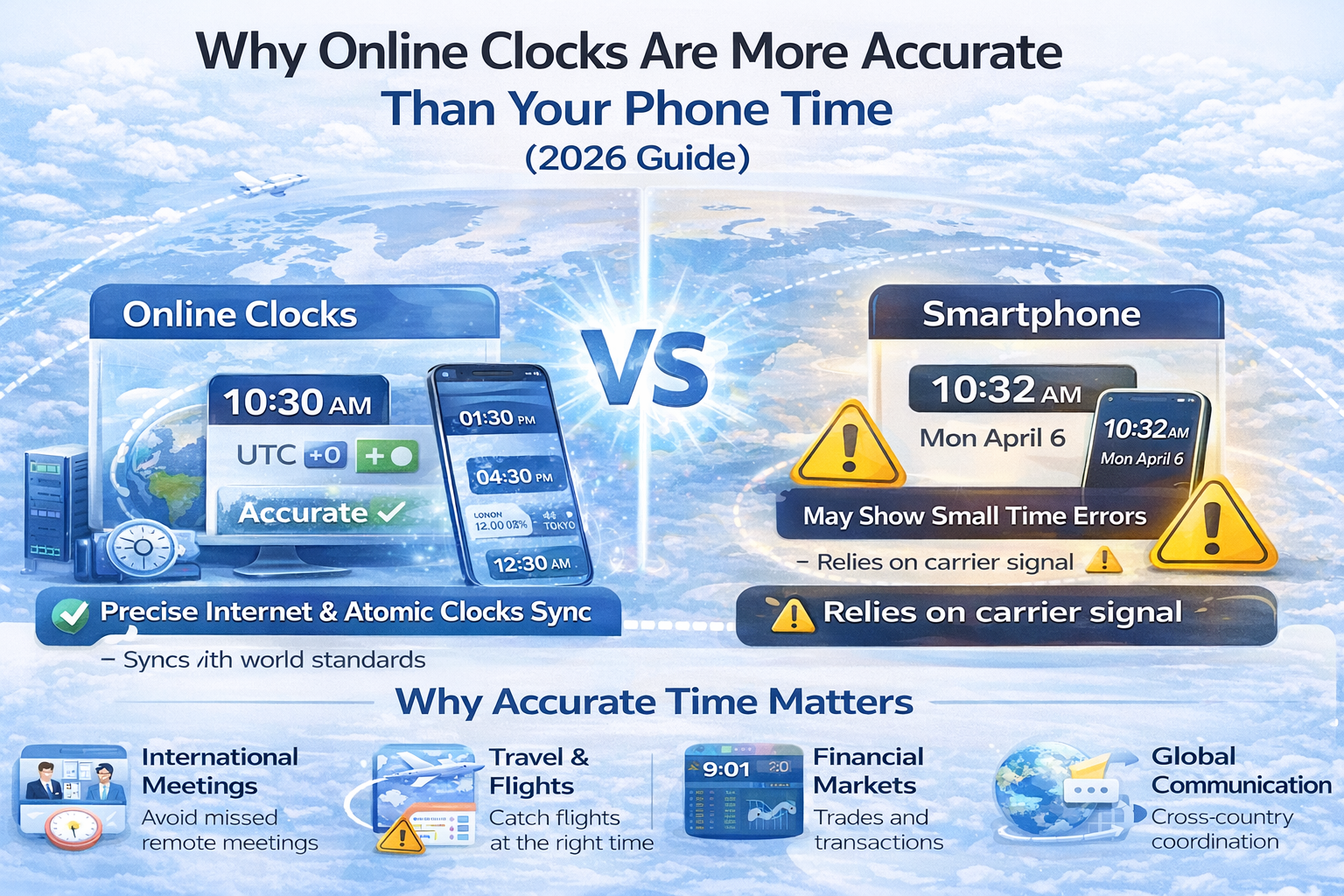
  • Why Online Clocks Are More Accurate Than Your Phone Time (2026 Guide)

    Why Online Clocks Are More Accurate Than Your Phone Time (2026 Guide)

    Many people assume that the time shown on their phone is always perfectly accurate. After all, smartphones automatically update the clock based on your location and network settings. However, there are situations where your phone time may not be as precise as you think.

    This is why many people rely on online world clock websites to check the exact current time. These tools are often synchronized with highly accurate time servers and atomic clock systems that keep global time standards consistent.

    In this guide, we’ll explain why online clocks are often more accurate than phone clocks and how you can verify the correct time anywhere in the world.


    How Smartphones Get Their Time

    Most smartphones automatically update the clock using information from mobile networks or internet time servers.

    When the automatic time setting is enabled, your device typically synchronizes with:

    • Mobile carrier time signals
    • Network Time Protocol (NTP) servers
    • Internet time services

    These systems help your phone stay synchronized with official time standards. However, they are not always perfect.


    Why Your Phone Time Can Sometimes Be Wrong

    Even though smartphones are designed to update automatically, several factors can cause small time errors.

    If your phone’s time zone is set incorrectly, the displayed time will also be wrong.

    This can happen when:

    1. Incorrect Time Zone Settings

    • Traveling between countries
    • Changing SIM cards
    • Turning off automatic time settings

    Even a small mistake in the time zone setting can shift the clock by several hours.


    2. Network Synchronization Delays

    Your phone usually synchronizes time with your mobile carrier or internet network. If the connection is weak or delayed, the time update may not happen immediately.

    This can result in minor differences between your phone’s clock and the official global time.


    3. Manual Time Changes

    Some users disable automatic time updates and manually adjust their device clock.

    While this may seem harmless, manual adjustments can cause the device time to slowly drift away from the correct global time.


    4. Software or System Errors

    Occasionally, phone software updates or system glitches can affect the time display.

    Although this is rare, it can cause your device to show a slightly incorrect time until the system resynchronizes.


    Why Online Clocks Are Often More Accurate

    Online world clock websites typically synchronize their time with atomic clock systems through precise internet time protocols.

    Atomic clocks are considered the most accurate timekeeping devices in the world, capable of measuring time with incredible precision.

    Because of this synchronization, many online clocks display the exact official time based on global standards such as Coordinated Universal Time (UTC).

    This means you can quickly verify whether your device clock is correct.


    How to Check Accurate Time Online

    Checking the correct time online is very simple.

    You can use a reliable world clock website to:

    • See the current time in any country or city
    • Compare time zones instantly
    • Verify the accuracy of your device clock
    • Avoid time zone mistakes when scheduling meetings

    These tools are particularly useful for travelers, remote workers, and international businesses.


    When Accurate Time Matters Most

    For many everyday activities, a small difference of a few seconds may not matter. However, in certain situations accurate time is extremely important.

    International Meetings

    When working across time zones, even a small mistake in time calculations can cause missed meetings or confusion.

    Travel and Flights

    Airlines operate on strict schedules. Knowing the correct local time helps travelers avoid delays and missed departures.

    Financial Markets

    Stock markets and financial trading platforms rely on precise time synchronization to process transactions accurately.

    Global Communication

    For businesses and teams working remotely, knowing the correct time in different regions helps maintain smooth communication.


    Tips to Keep Your Device Time Accurate

    Here are a few simple ways to ensure your device clock remains accurate.

    Enable automatic time settings
    Most smartphones have an option to automatically update time using network signals.

    Allow automatic time zone updates
    This ensures the device adjusts the clock when traveling between regions.

    Use reliable world clock tools
    Checking online time sources can confirm whether your device time is correct.

    Restart your device occasionally
    This can help resynchronize the system clock with network time servers.


    Final Thoughts

    While smartphones are generally reliable, they are not always perfectly accurate. Network delays, incorrect settings, or software issues can occasionally cause small time differences.

    Online world clock tools provide a quick and reliable way to verify the correct time anywhere in the world. Because they synchronize with official time servers and atomic clocks, they are often the most accurate reference for global time.

    If you ever need to confirm the exact current time, checking a trusted online world clock is one of the simplest and most reliable solutions.


© 2026 Time Now Online. All rights reserved.