Tag: time zone history

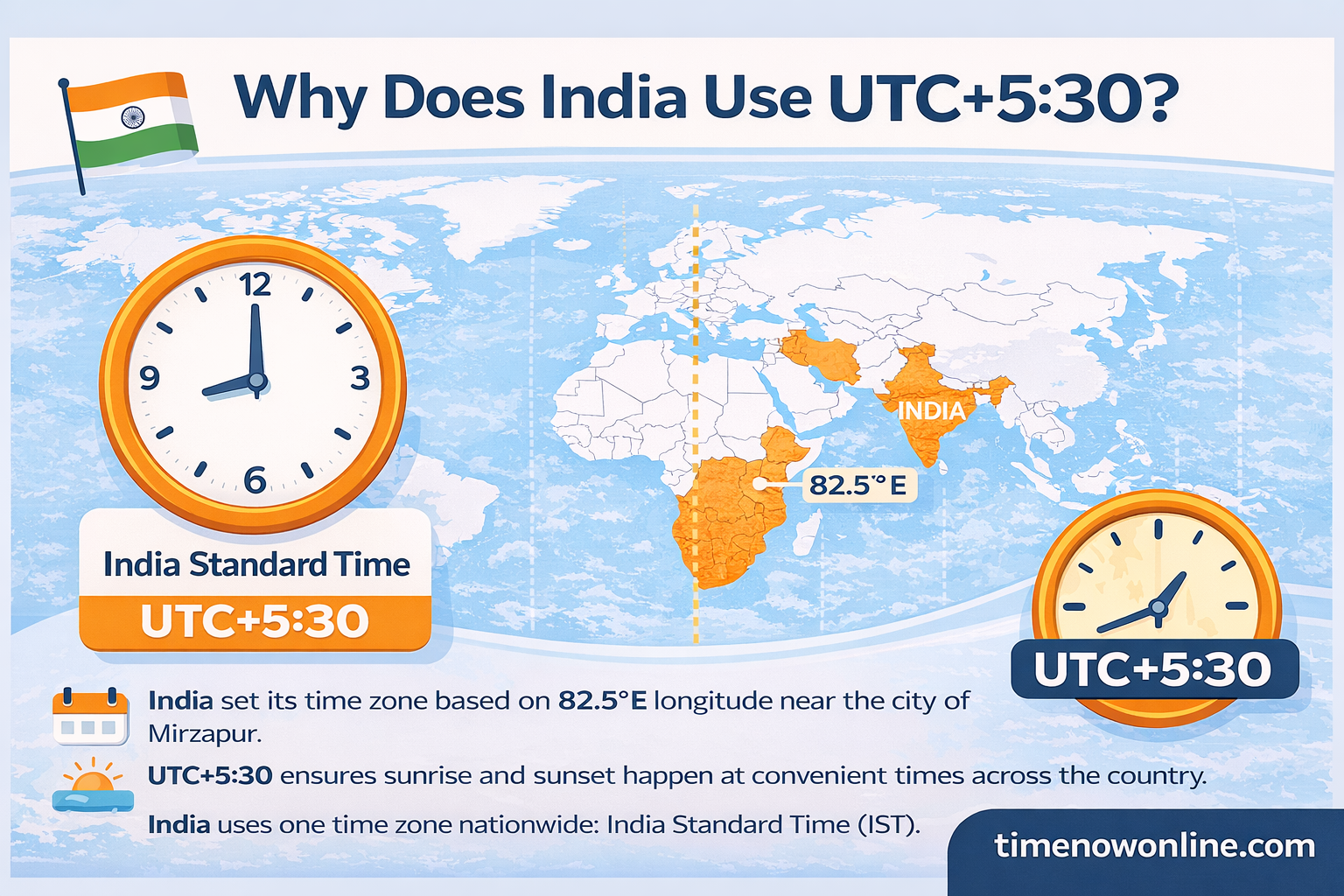
  • Why Does India Use UTC+5:30?

    Why Does India Use UTC+5:30?

    India uses Indian Standard Time (IST), which is 5 hours and 30 minutes ahead of Coordinated Universal Time (UTC+5:30). Unlike many countries that use whole-hour time zones such as UTC+5 or UTC+6, India’s time zone includes a 30-minute offset, which often surprises people around the world.

    But there is a practical and historical reason behind this. India’s unique time zone was chosen to better match the country’s geography and daily sunlight patterns.


    Understanding UTC and Time Zones

    To understand why India uses UTC+5:30, we first need to understand how time zones work.

    The Earth is divided into 24 main time zones, each roughly covering 15 degrees of longitude. This is because the Earth rotates 360 degrees in 24 hours, which means every 15 degrees corresponds to about one hour of time difference.

    The global reference point for time is Coordinated Universal Time (UTC), which is based on atomic clocks and serves as the standard for all time zones.

    Countries set their local time by choosing a UTC offset, such as:

    India’s time zone is UTC+5:30.


    Why India Chose UTC+5:30

    India’s time zone was designed to better align with the country’s geographic location.

    India stretches across about 30 degrees of longitude, meaning the eastern and western parts of the country experience sunrise and sunset at noticeably different times. If India used a standard hourly time zone like UTC+5 or UTC+6, sunrise and sunset would feel unnatural in many parts of the country.

    The solution was to adopt a half-hour offset, placing the official time exactly between the two possible hourly zones.

    This helps ensure that:

    • mornings begin with daylight in most regions
    • work hours align better with daylight
    • daily life follows natural daylight cycles

    The Origin of Indian Standard Time

    Before India adopted a single national time, several cities used their own local time.

    During the late 19th century under British rule, major cities operated on separate time systems, including:

    • Bombay Time
    • Calcutta Time
    • Madras Time

    This created confusion, especially for railway schedules and communication.

    To simplify timekeeping across the country, Indian Standard Time (IST) was officially adopted in 1906.

    The reference longitude chosen was 82.5° East, which passes near the city of Mirzapur in Uttar Pradesh. This longitude corresponds exactly to UTC+5:30.


    Why India Does Not Use Daylight Saving Time

    Many countries adjust their clocks during summer months using Daylight Saving Time (DST) to extend evening daylight.

    However, India does not observe daylight saving time.

    There are several reasons for this:

    1. India’s location near the equator means daylight hours remain relatively consistent throughout the year.
    2. The benefits of daylight saving would be minimal compared to countries at higher latitudes.
    3. Maintaining a single stable time zone simplifies national coordination.

    Because of this, IST remains the same all year round.


    Cities That Use Indian Standard Time

    India uses one single time zone nationwide, meaning every city follows IST.

    Major cities using IST include:

    You can check the current time in these cities on our website.


    Other Countries With Half-Hour Time Zones

    India is not the only country with a half-hour time zone.

    Several regions around the world use similar offsets to better match local geography.

    Examples include:

    • Iran – UTC+3:30
    • Afghanistan – UTC+4:30
    • Myanmar – UTC+6:30
    • Australia (Northern Territory) – UTC+9:30
    • Newfoundland (Canada) – UTC−3:30

    There are even 45-minute time zones, such as Nepal (UTC+5:45).

    These unusual offsets exist because countries sometimes prioritize practical daylight alignment over perfectly rounded time zones.


    Advantages of India’s Time Zone

    India’s use of UTC+5:30 offers several benefits.

    1. Better Alignment With Daylight

    The half-hour offset helps ensure sunrise and sunset occur at reasonable times for most of the country.

    2. Simplified National Coordination

    Using a single time zone keeps schedules consistent across the entire country.

    3. Efficient Transportation and Communication

    Railways, airlines, and businesses can operate with one official national time.


    Challenges of a Single Time Zone

    Although IST works well overall, there have been discussions about introducing multiple time zones in India.

    Eastern regions of India experience sunrise much earlier than western regions. In some areas, the sun rises before 5 AM during certain seasons.

    Some experts suggest splitting India into two time zones to improve productivity and reduce electricity use.

    However, for now, India continues to use one standard time zone nationwide.


    Frequently Asked Questions

    What does IST stand for?

    IST stands for Indian Standard Time.

    What is the UTC offset for India?

    India’s time zone is UTC+5:30.

    Does India observe daylight saving time?

    No. India uses the same time throughout the year.

    Why is India not UTC+5 or UTC+6?

    India chose UTC+5:30 to better match the country’s geographic position.


    Final Thoughts

    India’s use of UTC+5:30 is the result of both geography and history. By choosing a half-hour offset based on the 82.5° East longitude, India created a time system that better fits the country’s natural daylight cycle.

    Although unusual compared to standard hourly time zones, IST has worked effectively for over a century and continues to provide a consistent time reference across the entire country.
  • The History of Time Zones: How the World Standardized Time (2026 Guide)

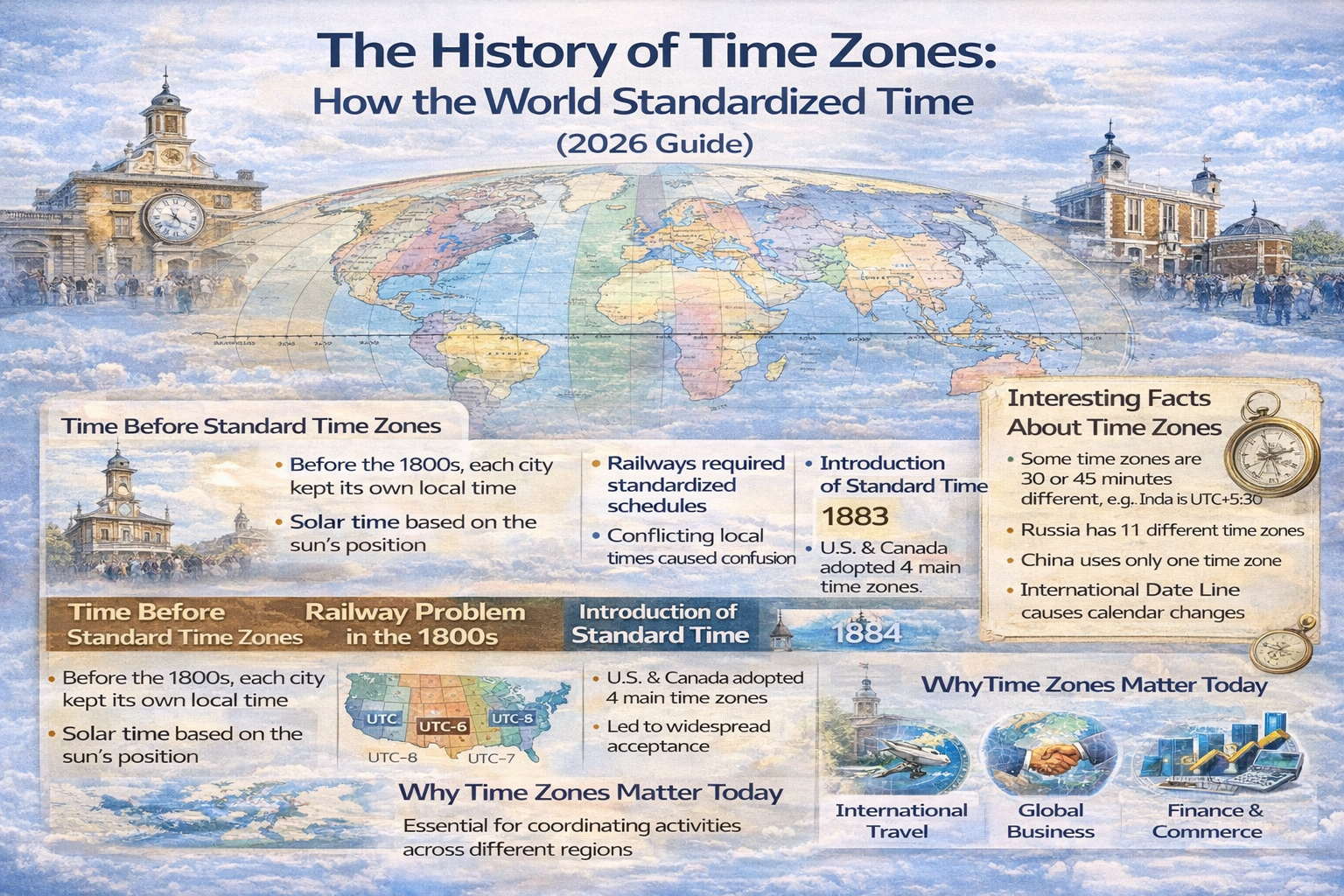
    The History of Time Zones: How the World Standardized Time (2026 Guide)

    Today, checking the time anywhere in the world is simple. With smartphones, online clocks, and digital devices, we can instantly know the time in any country or city. However, this global system of time zones did not always exist.

    Before the late 19th century, every city kept its own local time, based on the position of the sun in the sky. This meant that time could vary from one town to the next, even if they were only a short distance apart.

    The modern time zone system was created to solve these problems and bring consistency to global communication, travel, and commerce.


    Time Before Standard Time Zones

    Before time zones were introduced, people relied on solar time.

    Solar time was determined by the position of the sun. When the sun reached its highest point in the sky, it was considered local noon.

    Because the Earth rotates, solar noon occurs at slightly different times depending on a location’s longitude.

    This meant that neighboring cities could have clocks that differed by several minutes.

    While this system worked reasonably well for small communities, it became problematic as transportation and communication expanded.


    The Railway Problem

    The rapid expansion of railway systems during the 1800s created major challenges for timekeeping.

    Trains began connecting cities over long distances, and scheduling became extremely difficult when each town used its own local time.

    For example:

    • A train leaving one city might arrive in another where the local time was different.
    • Railway schedules became confusing and difficult to coordinate.

    This situation led to frequent scheduling errors and made travel planning complicated.

    Railway companies needed a standardized time system.


    The Introduction of Standard Time

    In 1883, railway companies in the United States and Canada introduced standardized time zones to solve scheduling problems.

    They divided the continent into four main time zones:

    • Eastern Time
    • Central Time
    • Mountain Time
    • Pacific Time

    Each region used the same clock time, making train schedules easier to manage.

    This system proved so effective that it quickly gained widespread acceptance.


    The International Meridian Conference (1884)

    A major milestone in global timekeeping occurred in 1884, when representatives from 25 countries met in Washington, D.C. for the International Meridian Conference.

    During this meeting, several important decisions were made:

    • The Prime Meridian would be located at Greenwich, England
    • Greenwich Mean Time (GMT) would serve as the global reference time
    • The world would be divided into time zones based on longitude

    This conference established the foundation for the modern global timekeeping system.


    The Development of Global Time Zones

    Following the conference, countries gradually adopted standardized time zones.

    The Earth was divided into 24 primary time zones, each roughly one hour apart.

    Each zone represents approximately 15 degrees of longitude, reflecting how far the Earth rotates in one hour.

    This system allows local time to align more closely with daylight patterns.


    The Transition from GMT to UTC

    For many years, Greenwich Mean Time (GMT) served as the global time standard.

    However, as technology advanced, scientists developed more precise methods of measuring time.

    Today, the official global time standard is Coordinated Universal Time (UTC).

    UTC is maintained using atomic clocks, which measure time based on the vibrations of atoms. These clocks are incredibly accurate and help keep global systems synchronized.


    How Time Zones Affect the Modern World

    Time zones play a critical role in modern life. They allow people across the globe to coordinate activities despite living in different regions.

    Time zones influence:

    • International travel schedules
    • Global business operations
    • Satellite navigation systems
    • Internet communications
    • Worldwide financial markets

    Without a standardized system of time zones, coordinating these activities would be extremely difficult.


    Interesting Facts About Time Zones

    Several unique facts highlight how complex global timekeeping can be.

    • Some countries use half-hour or 45-minute time zones, such as India and Nepal.
    • Russia spans 11 different time zones, the most of any country.
    • China uses only one time zone, despite being geographically very large.
    • The International Date Line helps maintain calendar consistency when traveling across the Pacific Ocean.

    These variations show that time zones are both a scientific system and a political decision.


    Final Thoughts

    The global time zone system was created to solve the challenges of transportation, communication, and international coordination. What began as a solution for railway scheduling in the 19th century eventually became the worldwide standard for organizing time.

    Today, thanks to time zones and modern atomic clocks, people across the world can coordinate activities with incredible precision.

    Understanding the history of time zones helps us appreciate the complex system that keeps the world running on time.


© 2026 Time Now Online. All rights reserved.