Tag: time zones

  • How Time Zones Affect International Meetings (And How to Schedule Them Easily)

    How Time Zones Affect International Meetings (And How to Schedule Them Easily)

    In today’s connected world, people regularly work, communicate, and collaborate across different countries. Whether you’re planning a business meeting, joining an online class, or coordinating with friends abroad, time zones can quickly become confusing.

    Understanding how global time differences work can help you avoid missed calls, scheduling mistakes, and unnecessary delays.

    In this guide, we explain how time zones affect international meetings and how you can schedule them more easily.


    Why Time Zones Make Scheduling Difficult

    The Earth is divided into multiple time zones so that local time matches the position of the sun. While this system helps daily life run smoothly in each region, it creates challenges when people from different parts of the world try to coordinate schedules.

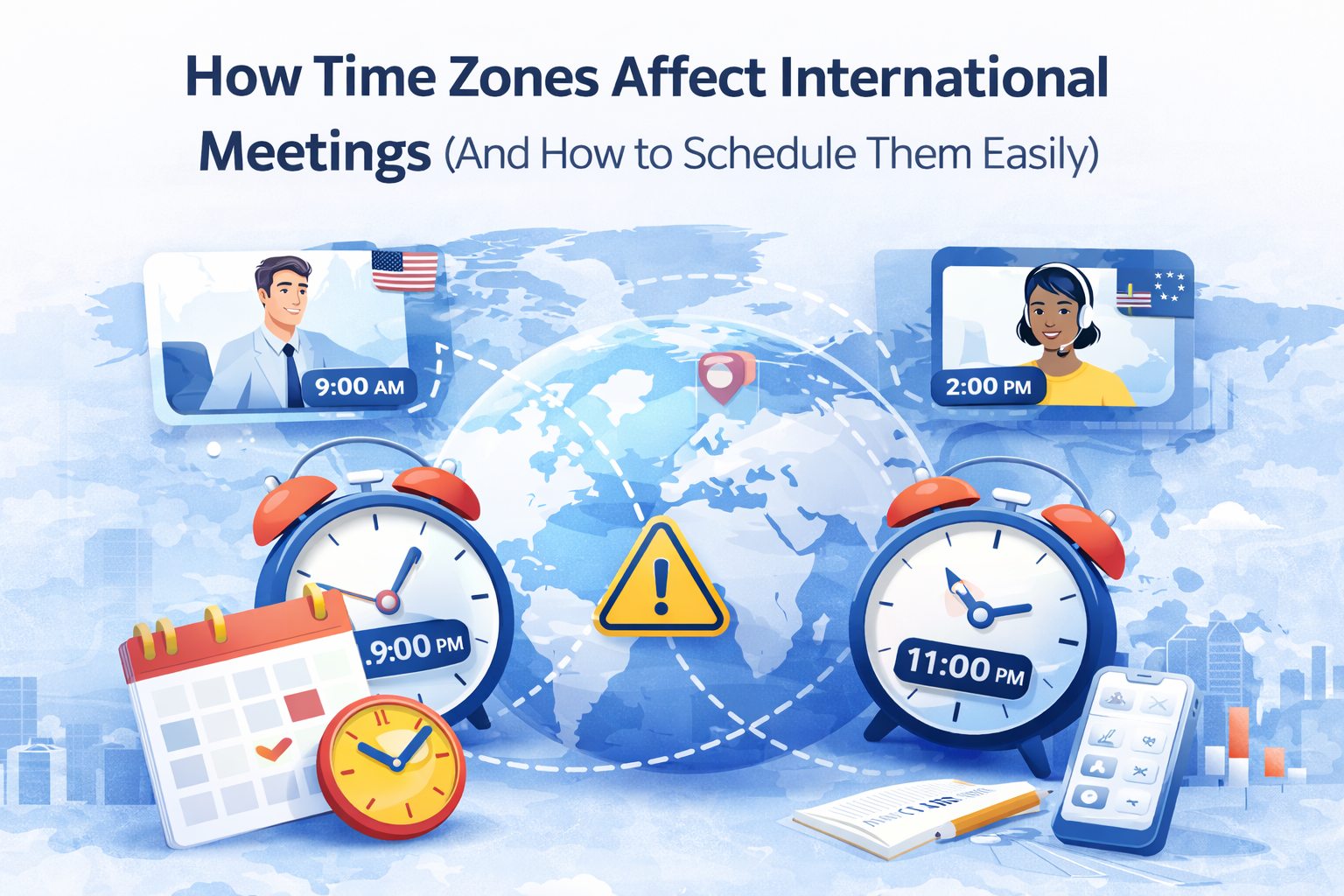
    For example, when it is 9:00 AM in New York, it may already be 2:00 PM in London and 11:00 PM in Sydney. Without checking the correct time difference, scheduling a meeting can easily lead to confusion.

    This is especially common in remote work environments where teams operate across several continents.


    The Challenge of Daylight Saving Time

    Another factor that complicates international meetings is Daylight Saving Time (DST). Some countries adjust their clocks forward or backward during certain parts of the year, while others do not.

    Because different countries change their clocks on different dates, the time difference between two locations can temporarily shift for several weeks.

    For example, a meeting that normally happens at the same time each week may suddenly appear one hour earlier or later for some participants.


    How to Schedule Meetings Across Time Zones

    Fortunately, there are simple ways to avoid scheduling problems when working across time zones.

    First, always confirm the local time for each location involved in the meeting. This ensures everyone understands exactly when the meeting will occur in their region.

    Second, try to schedule meetings during overlapping working hours. This helps avoid situations where one person must join very early in the morning or late at night.

    Finally, using a reliable world clock or time-checking website can help you quickly compare times across different cities and countries.


    Why Checking Accurate Local Time Matters

    Even a small mistake in time conversion can cause missed appointments or delays in important conversations. This is why many professionals rely on accurate online time tools when planning international meetings.

    With a reliable time website, you can instantly check the current time in cities and countries around the world. This makes scheduling easier and helps ensure everyone joins the meeting at the correct time.

    Final Thoughts

    As global communication becomes more common, understanding time zones is more important than ever. Whether you’re organizing a business meeting or coordinating with friends overseas, knowing the correct local time can save you from unnecessary confusion.

    By checking accurate time sources and planning ahead, you can schedule international meetings smoothly and avoid common time zone mistakes.
  • Why Time Zones Still Confuse Millions in 2026 (And How to Avoid Costly Mistakes)

    Why Time Zones Still Confuse Millions in 2026 (And How to Avoid Costly Mistakes)

    You might think time zones are simple.

    After all, every country has a time… right?

    Not exactly.

    In 2026, time zones are still one of the biggest causes of missed meetings, flight mistakes, trading errors, and scheduling disasters.

    The problem isn’t knowing the time.

    The problem is misunderstanding how time zones actually work.


    1️⃣ Not Every Country Has One Time Zone

    Many people assume:

    USA time
    Australia time
    Europe time

    But that doesn’t exist.

    The United States has multiple time zones:

    • Eastern
    • Central
    • Mountain
    • Pacific
    • Alaska
    • Hawaii

    Australia also has:

    • Eastern
    • Central
    • Western

    If you schedule something at “8 PM USA time,” you’re already creating confusion.


    2️⃣ Daylight Saving Time Changes Everything

    One of the biggest time zone traps?

    Daylight Saving Time (DST).

    Not all countries observe it.
    Not all countries change clocks on the same date.

    Example:

    • The US may change clocks in March.
    • Another country might change in April.
    • Some countries never change.

    For weeks at a time, your usual time difference might be wrong.

    That’s when mistakes happen.


    3️⃣ Online Meetings & Global Work

    Remote work is normal now.

    But here’s what still causes issues:

    • Inviting someone without specifying time zone
    • Assuming calendar auto-conversion is correct
    • Forgetting seasonal clock changes

    A 1-hour error can:

    • Damage professionalism
    • Lose client trust
    • Miss sales calls

    4️⃣ Flights & Travel Mistakes

    Airline tickets show departure and arrival times in local time.

    If you misread time zones:

    • You might arrive late
    • You might book hotel check-in wrong
    • You might miss transport

    Time zone misunderstanding isn’t small — it can cost money.


    5️⃣ Global Markets & Trading

    Financial markets open and close based on local exchange time.

    New York time is not London time.
    Tokyo time is not Sydney time.

    Even a small time miscalculation can affect:

    • Trading decisions
    • Earnings reports
    • Market openings

    Precision matters.


    How To Avoid Time Zone Mistakes

    Here’s what actually works:

    ✔ Always specify city + time zone
    ✔ Use a reliable world clock
    ✔ Double-check during daylight saving periods
    ✔ Confirm meeting times in writing
    ✔ Never assume “same as last month”


    Final Thoughts

    Time itself isn’t complicated.

    But time zones are.

    In 2026, the world is more connected than ever — yet time zone confusion still causes avoidable problems.

    Understanding how time zones really work gives you an advantage.

    Because when timing is right, everything else works better.


© 2026 Time Now Online. All rights reserved.