Most people assume that every country’s time zone changes in one-hour increments. For example, when you move from one time zone to another, the clock usually shifts forward or backward by exactly one hour.
However, this is not always the case.
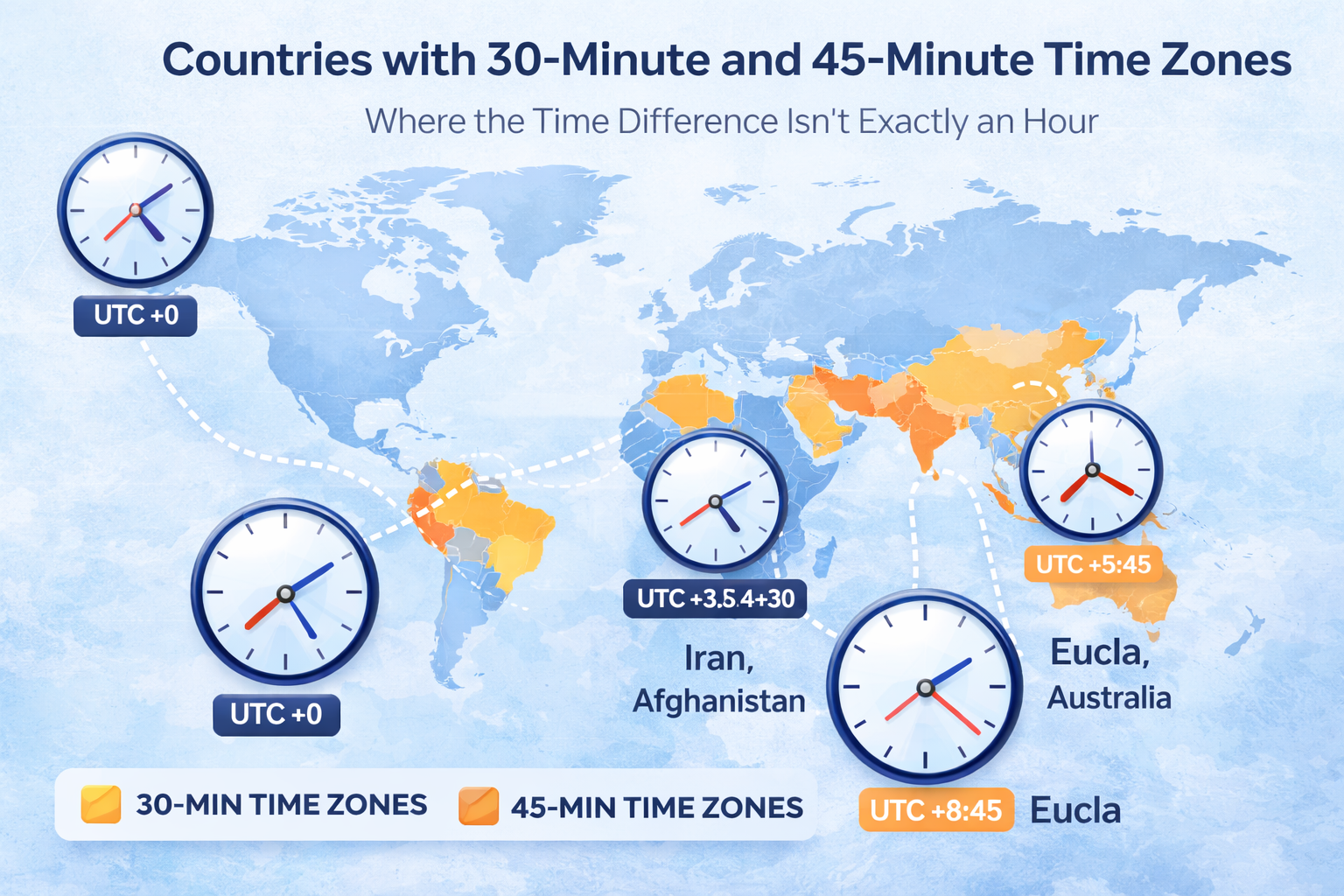
Around the world, several countries use 30-minute or even 45-minute time zones. These unusual offsets often surprise travelers, remote workers, and international businesses.
Understanding these unique time zones can help you avoid confusion when scheduling meetings, flights, or international calls.
Why Time Zones Exist
Time zones were created in the late 19th century to standardize time across large regions. Before time zones existed, each city used its own local solar time, which made transportation and communication difficult.
Today, the world uses Coordinated Universal Time (UTC) as the global reference point. Every time zone is expressed as an offset from UTC.
Examples include:
But not every region follows this simple pattern.
Countries with 30-Minute Time Zones
Some countries have chosen time zones that are 30 minutes different from UTC. This usually reflects geographical positioning or historical decisions.
Examples include:
India
India uses Indian Standard Time (IST), which is:
UTC +5:30
This system was chosen to create a single time standard across the entire country, even though India spans a wide east-west distance.
Iran
Iran uses:
UTC +3:30
This offset helps align daylight hours more closely with daily life.
Afghanistan
Afghanistan operates on:
UTC +4:30
This unique time zone reflects its location between neighboring countries with different time standards.
Countries with 45-Minute Time Zones
Even more unusual are 45-minute offsets. Only a few places in the world use them.
Nepal
Nepal follows:
UTC +5:45
This is one of the most distinctive time zones globally. It was introduced to create a time standard based on the country’s capital, Kathmandu.
Australian Territory (Eucla Area)
A small region in Western Australia uses:
UTC +8:45
This unofficial time zone is commonly used locally even though it is not widely recognized internationally.
Why These Time Zones Still Exist
You might wonder why these unusual time zones were never adjusted to standard hour increments.
There are several reasons:
Geographical accuracy
Some regions are located exactly between major time zones.
Political decisions
Governments sometimes adopt unique time zones to distinguish themselves from neighboring countries.
Practical lifestyle alignment
Time zones may be chosen to better match sunrise and sunset patterns.
How These Time Zones Affect Global Communication
For people working across borders, half-hour or 45-minute offsets can create scheduling challenges.
For example:
Even digital calendars occasionally struggle with these unusual offsets.
This is why many professionals rely on accurate online world clock tools to confirm time differences.
How to Check Accurate Time Anywhere in the World
If you are planning international meetings, flights, or online events, the easiest way to avoid mistakes is to check the current time using a reliable world clock.
Using an accurate global time reference allows you to:
- Avoid scheduling mistakes
- Plan international calls more easily
- Understand time differences between countries
- Track daylight saving changes
You can quickly check the current time in cities and countries worldwide using the global clock tools available on TimeNowOnline.
Final Thoughts
While most time zones follow simple one-hour increments, the world still includes several unique half-hour and 45-minute time zones.
These unusual systems reflect history, geography, and national decisions that continue to shape how time is measured globally.
Understanding them can help you navigate international schedules more confidently and avoid unexpected time conversion mistakes.