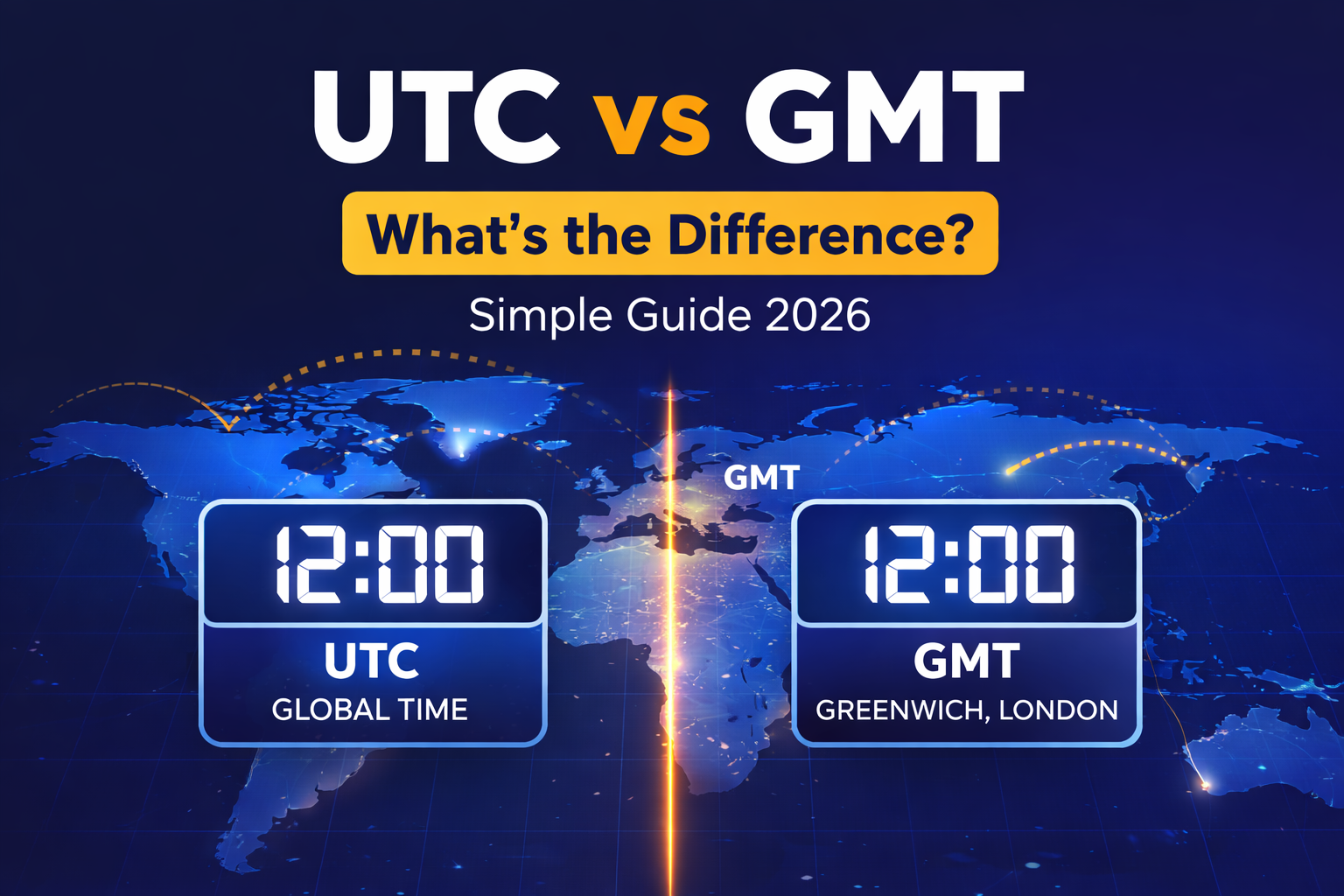
If you’ve ever searched for time online, you’ve probably seen both UTC and GMT — and wondered:
👉 Are they the same thing?
You’re not alone.
This guide explains the difference between UTC and GMT in the simplest way possible, so you can understand global time without confusion.
What Is UTC?
UTC (Coordinated Universal Time) is the official global time standard used worldwide.
- It does NOT change for daylight saving
- It is used by:
- Airlines ✈️
- Computers 💻
- International businesses 🌍
👉 Think of UTC as:
The “master clock” of the world
What Is GMT?
GMT (Greenwich Mean Time) is based on the time at:
- It was the original global time system
- Still used in some countries (like the UK in winter)
👉 Think of GMT as:
The “old version” of global time
UTC vs GMT: Key Differences
| Feature | UTC | GMT |
|---|---|---|
| Type | Modern global standard | Traditional time system |
| Daylight Saving | No | Yes (in some regions) |
| Accuracy | Atomic clock | Solar time |
| Usage | Worldwide systems | Mostly UK & references |
👉 In most cases:
UTC = GMT (but UTC is more precise)
Why Do Both Still Exist?
Because:
- GMT is still used in everyday language
- UTC is used in technology + global systems
👉 That’s why you see both online
Examples
- London (winter): GMT = UTC
- London (summer): GMT becomes BST (UTC+1)
- Sydney: UTC+10 or UTC+11 (daylight saving)
When Should You Use UTC?
Use UTC when:
- Scheduling international meetings
- Running ecommerce stores globally
- Working with APIs or systems
👉 It avoids confusion across time zones
Related Tools You Can Use
👉 These tools help you avoid costly timing mistakes
Final Thoughts
👉 UTC and GMT are almost the same — but UTC is the modern standard
If you’re working globally (especially in ecommerce), always rely on UTC for accuracy.