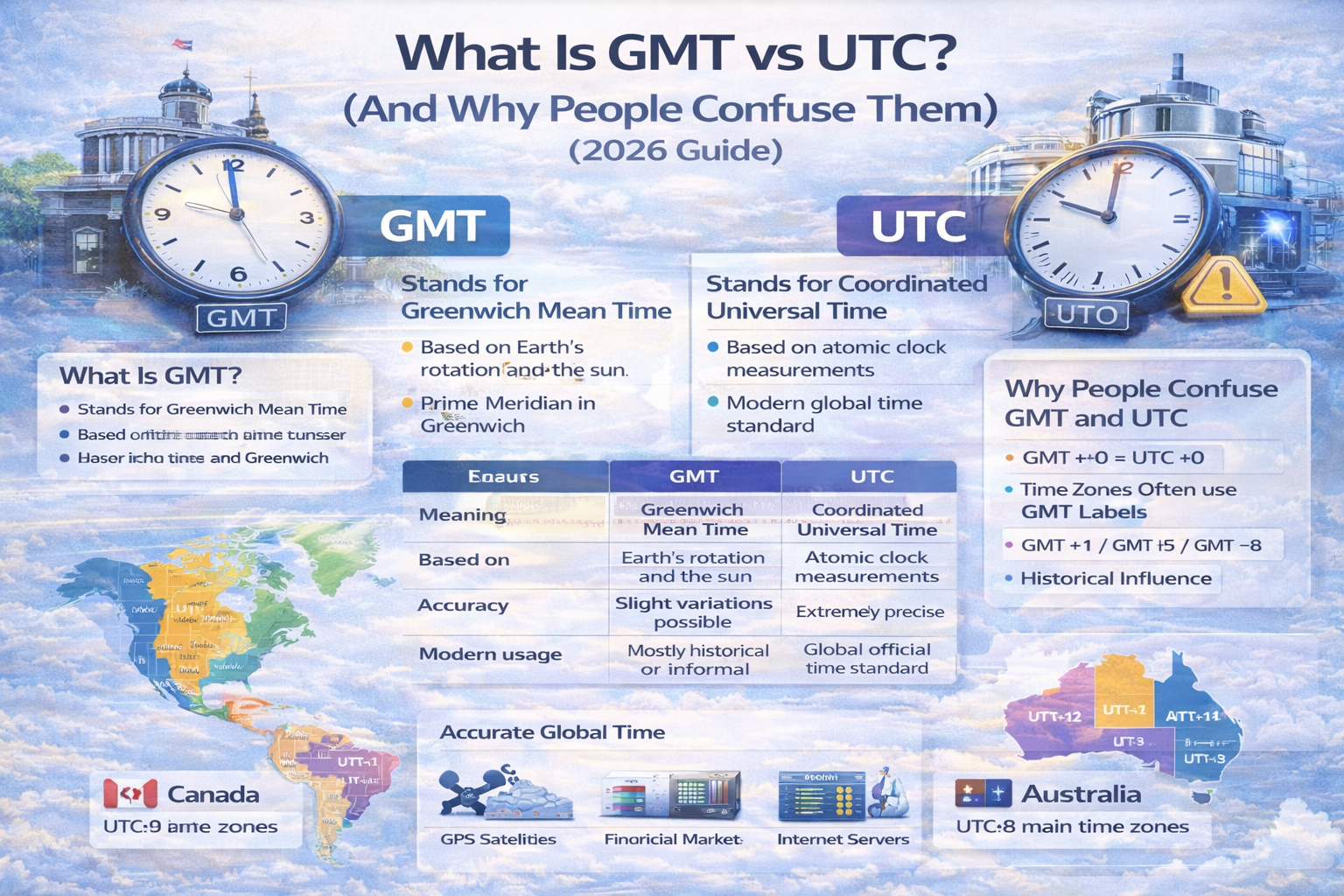
If you have ever checked world time online, scheduled an international meeting, or looked at time zone settings on a device, you may have seen the terms GMT and UTC. Many people assume they mean exactly the same thing, and in everyday use they often appear interchangeable.
However, GMT and UTC are not technically the same. They come from different systems used to measure time, and each plays a unique role in global timekeeping.
In this guide, we’ll explain what GMT and UTC mean, how they are different, and why they are often confused.
What Is GMT?
GMT stands for Greenwich Mean Time.
It is a time standard that originated in Greenwich, London, at the Royal Observatory. The location sits on the Prime Meridian, which is the line of longitude at 0° used to measure distance east and west around the Earth.
GMT was introduced in the 19th century when railways and international travel required a consistent time system.
Greenwich Mean Time is based on the Earth’s rotation and the position of the sun. When the sun reaches its highest point above the Prime Meridian, it is considered noon in GMT.
For many years, GMT served as the global reference time for navigation, science, and international communication.
What Is UTC?
UTC stands for Coordinated Universal Time.
It is the modern global time standard used today. Unlike GMT, which is based on Earth’s rotation, UTC is maintained using highly precise atomic clocks.
Atomic clocks measure time using the vibrations of atoms, allowing scientists to track time with incredible accuracy.
Because Earth’s rotation is not perfectly consistent, UTC occasionally adds leap seconds to stay aligned with the planet’s natural day-night cycle.
Today, nearly all digital systems rely on UTC as the official global time reference.
Key Differences Between GMT and UTC
Although GMT and UTC are closely related, they come from different methods of measuring time.
| Feature | GMT | UTC |
|---|---|---|
| Meaning | Greenwich Mean Time | Coordinated Universal Time |
| Based on | Earth’s rotation and the sun | Atomic clock measurements |
| Accuracy | Slight variations possible | Extremely precise |
| Modern usage | Mostly historical or informal | Global official time standard |
In most daily situations, the difference between GMT and UTC is extremely small, which is why they are often used interchangeably.
Why People Confuse GMT and UTC
There are several reasons why people frequently mix up these two time standards.
They Represent the Same Time Offset
Both GMT and UTC represent 0 hours offset from the global reference point. This means that:
GMT +0 = UTC +0
Because of this, the time shown in GMT and UTC is usually the same.
Time Zones Often Use GMT Labels
Many devices and operating systems still use GMT labels when displaying time zones.
For example:
- GMT +1
- GMT +5
- GMT −8
Even though the system behind these clocks is actually based on UTC, the older GMT terminology remains widely used.
Historical Influence
GMT was the primary international time standard for decades before UTC was introduced.
Because of its historical importance, the term GMT remains common in everyday language.
How GMT and UTC Are Used Today
In modern systems, UTC is the official global time reference.
It is used by:
- GPS satellites
- Internet time servers
- Aviation systems
- Financial markets
- Scientific research institutions
GMT is still used in some contexts, particularly when referring to time zones in the United Kingdom during winter months.
Why Accurate Global Time Matters
Precise timekeeping is essential for many technologies and systems we rely on daily.
Accurate global time helps coordinate:
- International flights
- Global financial transactions
- Satellite navigation systems
- Online communication networks
- Remote work across time zones
Without a standardized system like UTC, global coordination would be much more difficult.
Final Thoughts
Although GMT and UTC are often used interchangeably, they come from different timekeeping systems. GMT is based on Earth’s rotation and the position of the sun, while UTC relies on highly accurate atomic clocks.
Today, UTC serves as the official global time standard used by most modern technologies and international systems.
Understanding the difference between these two terms can help avoid confusion when working with global time zones and international schedules.