Tag: world time

  • What Is Daylight Saving Time? Why Clocks Change Around the World

    What Is Daylight Saving Time? Why Clocks Change Around the World

    Daylight Saving Time (DST) is a system used in some countries where clocks are adjusted forward or backward during certain times of the year.

    Typically, clocks are moved forward by one hour in spring and back by one hour in autumn (fall). This adjustment is intended to make better use of daylight during the longer days of the year.

    The idea behind daylight saving time is simple: shifting the clock allows people to enjoy more daylight in the evening hours.


    Why Daylight Saving Time Exists

    Daylight saving time was introduced to make better use of natural daylight. When clocks move forward in spring, sunrise and sunset occur later in the day.

    This means people have more daylight after work or school.

    Historically, the system was believed to help:

    • reduce electricity use
    • increase productivity
    • allow more daylight activities
    • improve coordination of schedules

    Although energy savings were once a major reason for DST, modern studies show the impact may be smaller than originally expected.


    How Daylight Saving Time Works

    In most countries that use DST, the schedule follows this pattern:

    SeasonClock Change
    SpringClocks move forward 1 hour
    Autumn / FallClocks move back 1 hour

    People often remember this using the phrase:

    “Spring forward, fall back.”

    For example:

    • If the time is 2:00 AM, the clock moves forward to 3:00 AM during the spring change.
    • In autumn, 2:00 AM becomes 1:00 AM when clocks move backward.

    Countries That Use Daylight Saving Time

    Daylight saving time is used mainly in regions where seasonal daylight varies significantly.

    Countries and regions that commonly observe DST include:

    However, many countries around the world do not use daylight saving time.


    Why Some Countries Do Not Use DST

    Many countries, especially those near the equator, do not observe daylight saving time because daylight hours remain fairly consistent throughout the year.

    Examples include:

    For these countries, adjusting clocks provides little benefit.


    How DST Affects Time Zones

    Daylight saving time temporarily changes the relationship between local time and Coordinated Universal Time (UTC).

    For example:

    LocationStandard TimeDST Time
    New YorkUTC−5UTC−4
    LondonUTC+0UTC+1
    BerlinUTC+1UTC+2

    This shift can sometimes create confusion when scheduling international meetings or travel.


    Common Challenges With Daylight Saving Time

    Although DST has benefits, it also creates challenges.

    Some common issues include:

    • disrupted sleep schedules
    • confusion with international time differences
    • technology and scheduling adjustments
    • debates about whether DST should continue

    Because of these concerns, several countries have considered eliminating daylight saving time.


    Checking Time During Daylight Saving Changes

    When daylight saving time begins or ends, local clocks change, which can affect global time differences.

    You can easily check the current local time and time zone changes using timenowonline.com, which provides accurate time information for cities and countries worldwide.


    Final Thoughts

    Daylight saving time is a system designed to make better use of daylight during certain months of the year. By shifting clocks forward in spring and back in autumn, some countries aim to maximize daylight hours in the evening.

    While the system continues to be debated, daylight saving time remains an important part of timekeeping in several regions around the world.

    Understanding how DST works can help travelers, businesses, and global teams coordinate time more effectively.
  • How UTC Controls Global Time Zones

    How UTC Controls Global Time Zones

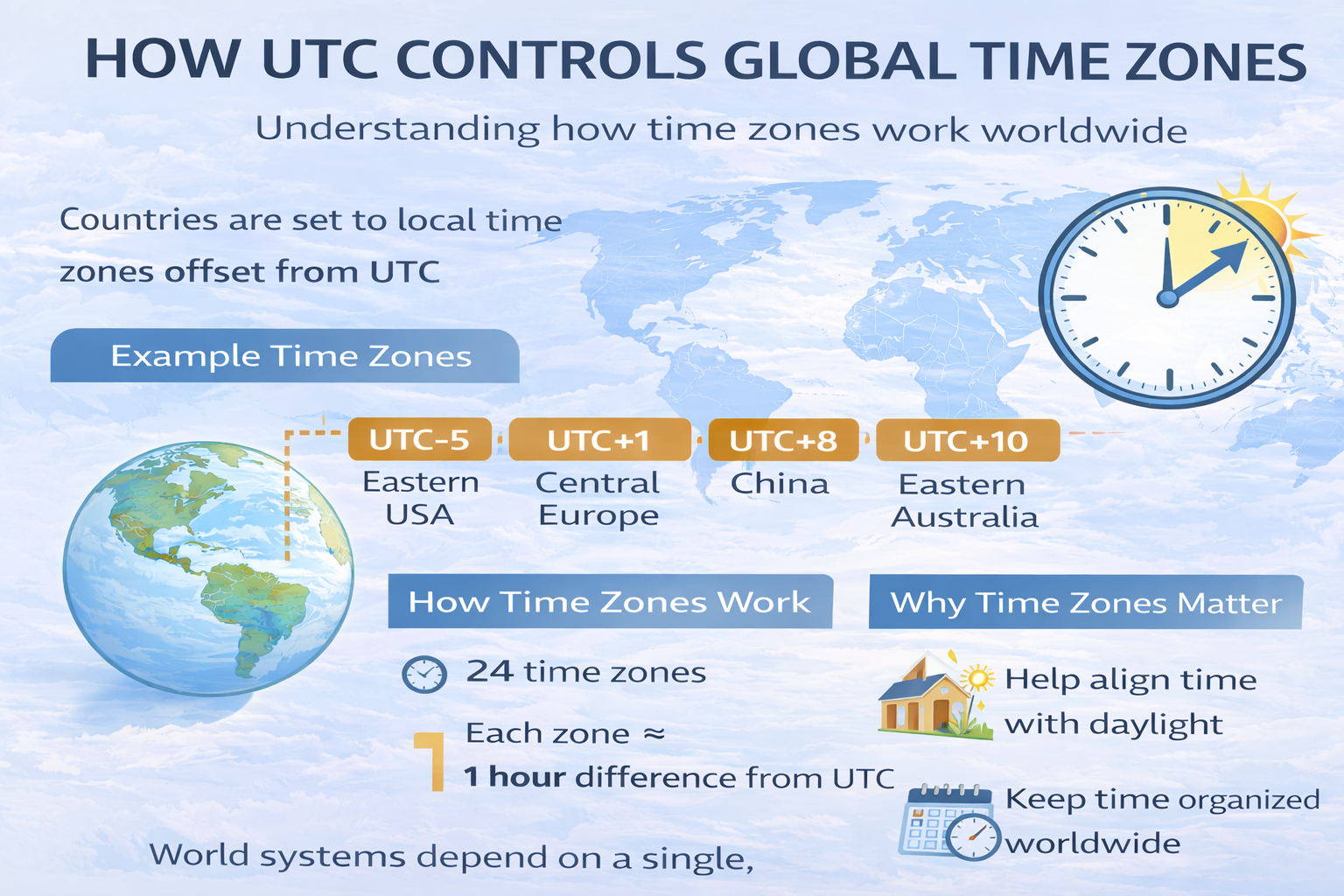
    How Time Zones Work

    The Earth is divided into 24 primary time zones based on longitude.

    Each zone represents roughly one hour difference from UTC.

    Examples:

    Time ZoneLocation
    UTC−5Eastern United States
    UTC+1Central
    UTC+8China
    UTC+10Eastern Australia

    This structure keeps time organized across the globe.

    Why Time Zones Matter

    Time zones allow different parts of the world to keep time that matches daylight hours.

    Without them, sunrise and sunset would occur at inconvenient times.

    UTC acts as the central reference point that keeps all time zones aligned.

  • Why the World Uses UTC

    Why the World Uses UTC

    The Need for a Universal Time System

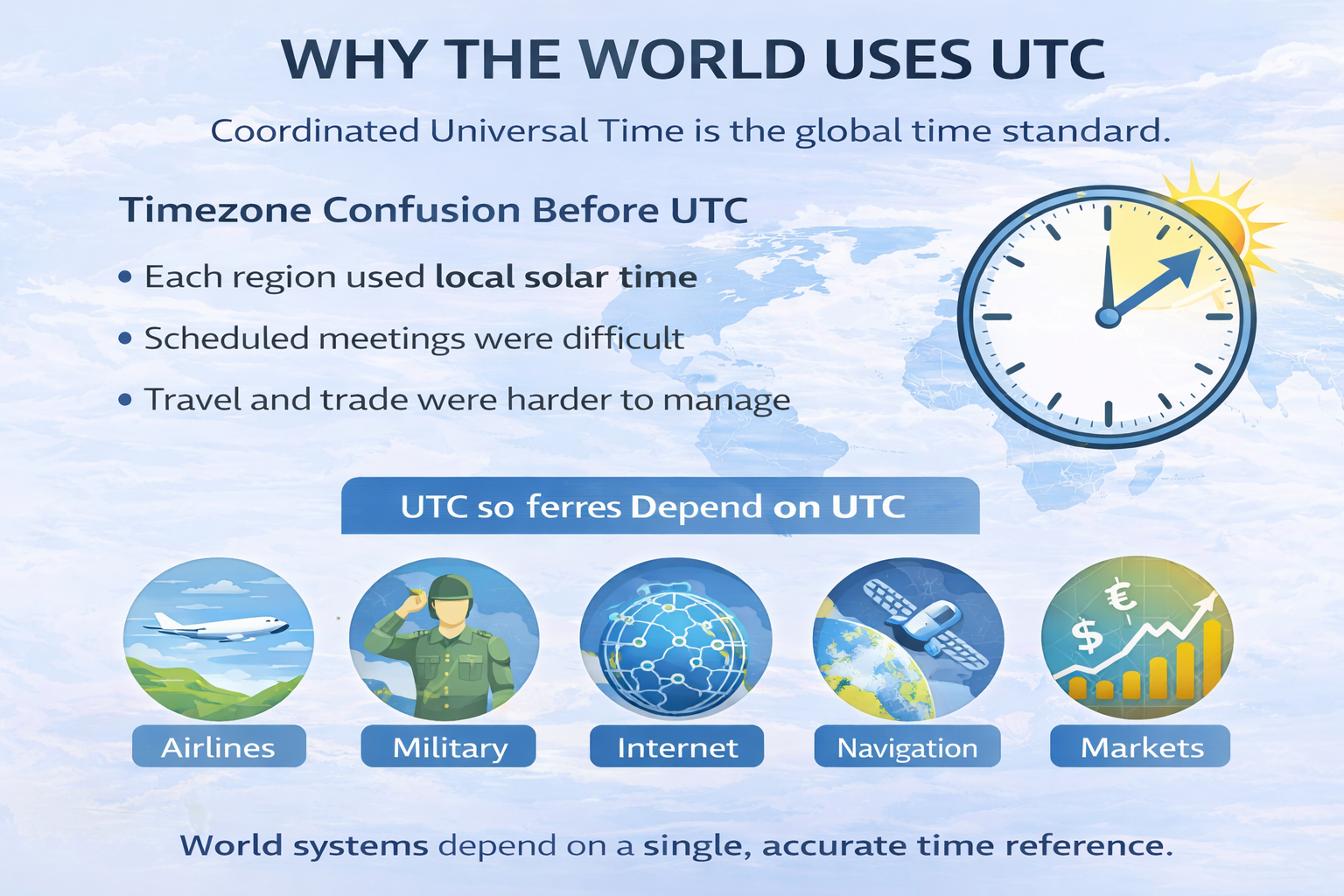
    Before a standardized system existed, every region used local solar time, which caused confusion when railways and international travel developed.

    To solve this problem, the world adopted a universal time reference.

    Today, that system is Coordinated Universal Time.

    Why UTC Is Used Worldwide

    UTC allows global systems to operate smoothly.

    It is used by:

    • airlines
    • military operations
    • satellite navigation
    • internet servers
    • global financial markets

    By using UTC as a reference point, countries can coordinate schedules and communication across time zones.

  • UTC vs GMT: What’s the Difference?

    UTC vs GMT: What’s the Difference?

    UTC vs GMT

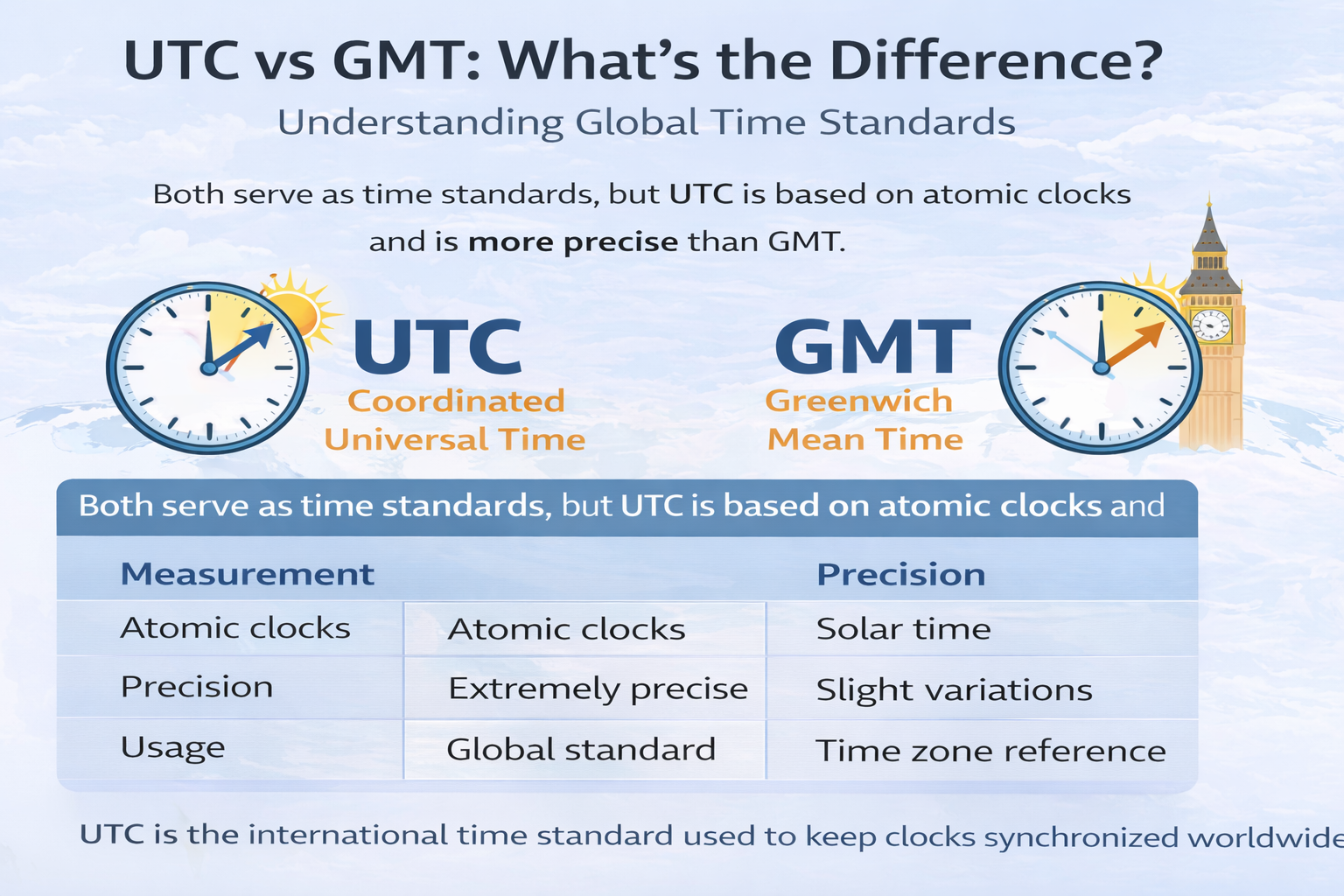
    Many people believe UTC and GMT are exactly the same, but there are important differences.

    GMT

    Greenwich Mean Time is based on the Earth’s rotation and the position of the sun over Greenwich, England.

    UTC

    Coordinated Universal Time is based on atomic clocks, making it far more precise.

    Key Differences

    FeatureUTCGMT
    MeasurementAtomic clocksSolar time
    PrecisionExtremely preciseSlight variations
    UsageGlobal standardTime zone reference

    Despite these differences, many countries still use GMT terminology when referring to their time zone.

  • What Is UTC Time? A Simple Guide to the World’s Time Standard

    What Is UTC Time? A Simple Guide to the World’s Time Standard

    What Is UTC Time?

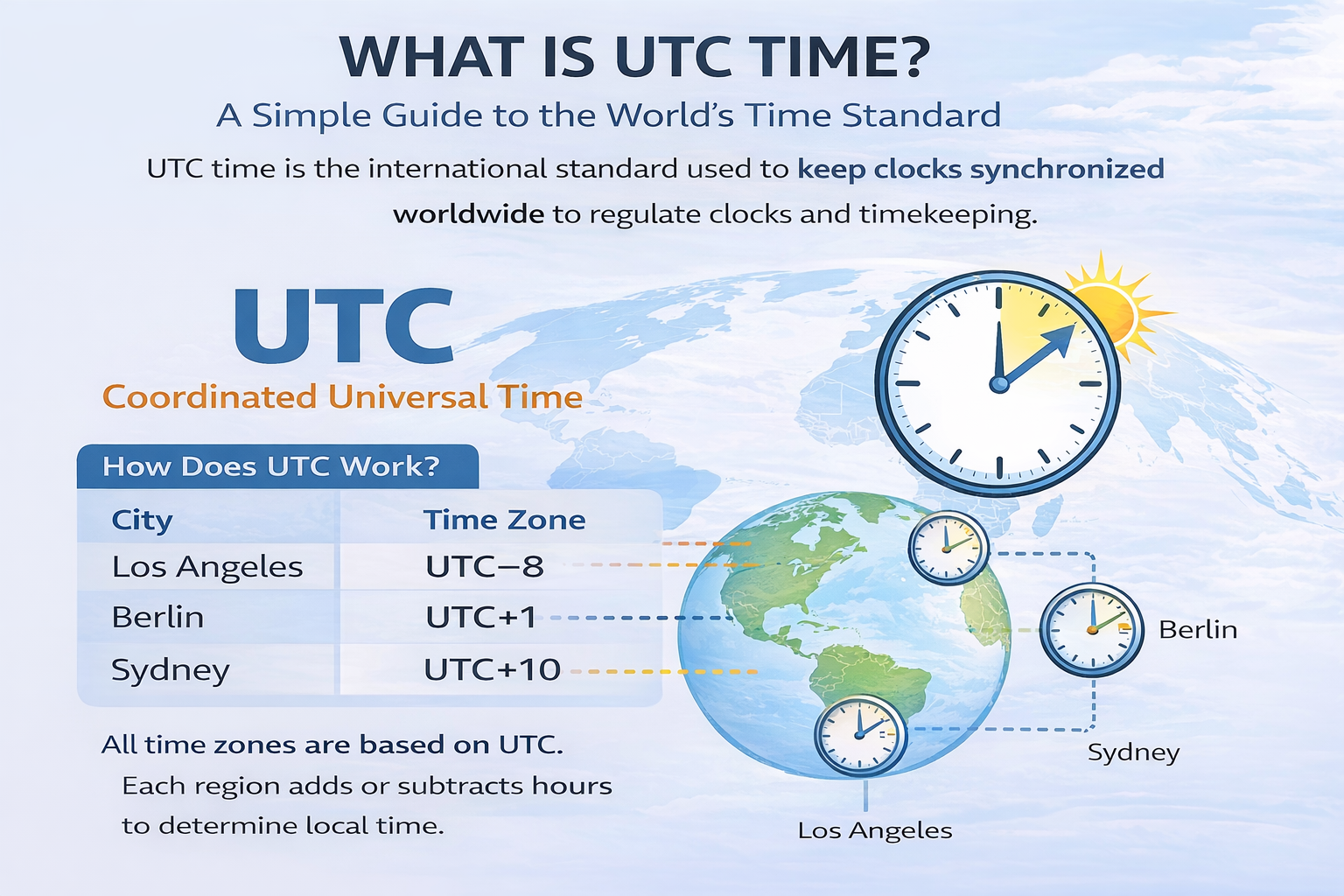
    UTC time is the international standard used to keep clocks synchronized around the world.

    All time zones are based on UTC. Each region adds or subtracts hours to determine local time.

    Examples:

    CityTime Zone
    Los AngelesUTC−8
    BerlinUTC+1
    SydneyUTC+10

    UTC itself does not change for daylight saving time.

    This makes it a stable reference for global coordination.

    Why UTC Replaced GMT

    Before UTC, the world used Greenwich Mean Time (GMT).

    GMT was based on the position of the sun over the Royal Observatory in Greenwich, England.

    However, modern timekeeping requires more precise measurement, which is why UTC replaced GMT as the official global standard.

  • Why Do Some Countries Change Clocks for Daylight Saving Time? (2026 Guide)

    Why Do Some Countries Change Clocks for Daylight Saving Time? (2026 Guide)

    Twice a year, millions of people adjust their clocks forward or backward because of Daylight Saving Time (DST). While some countries follow this system regularly, others choose not to change their clocks at all.

    Daylight Saving Time can be confusing, especially when coordinating international meetings, travel schedules, or global business operations.

    In this guide, we’ll explain why some countries change their clocks, how the system works, and why not all nations follow it.


    What Is Daylight Saving Time?

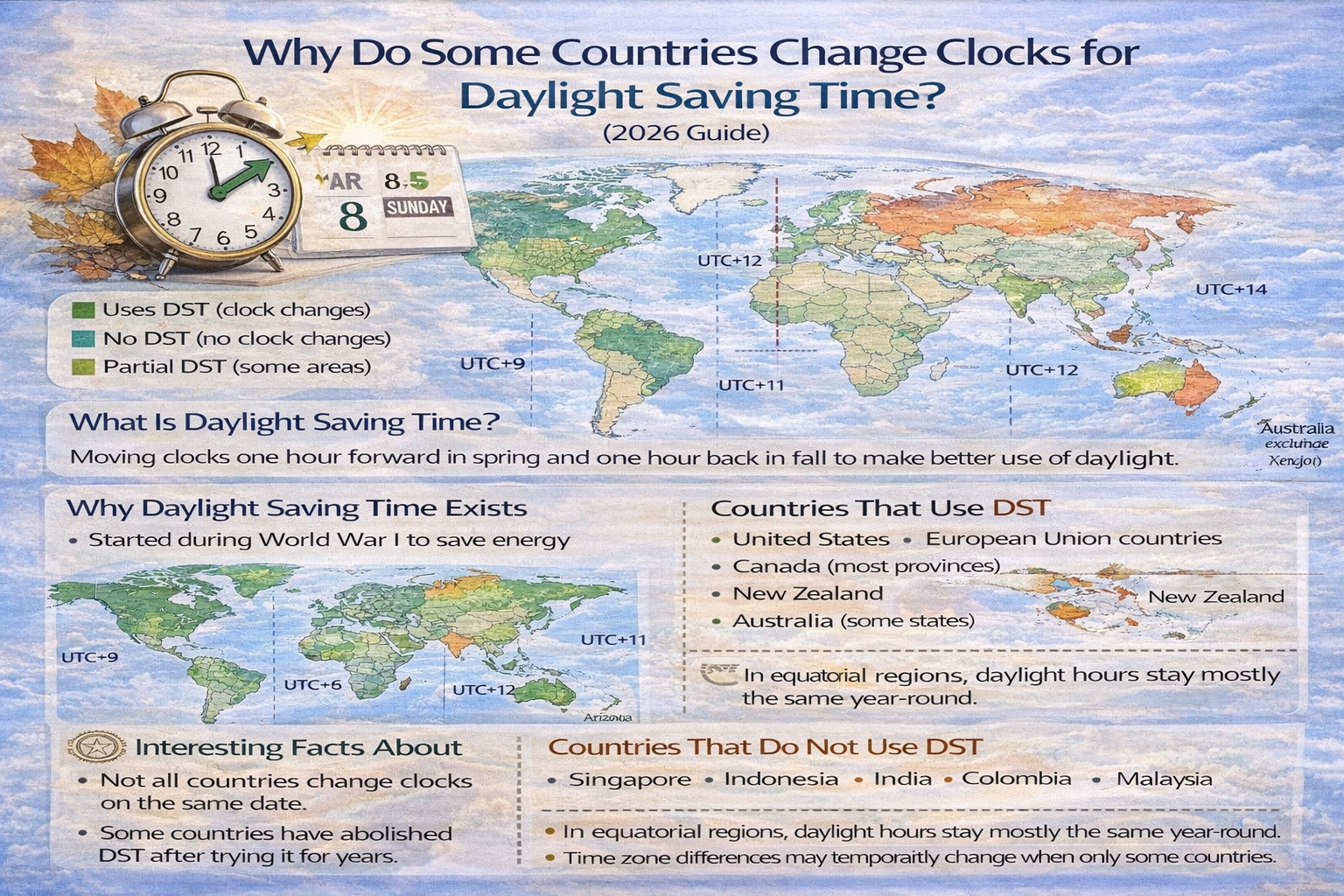
    Daylight Saving Time is the practice of moving clocks forward by one hour during warmer months to extend evening daylight.

    When DST begins:

    • Clocks move forward one hour (often called “spring forward”).

    When DST ends:

    • Clocks move back one hour (“fall back”).

    The goal is to make better use of natural daylight and reduce the need for artificial lighting.


    Why Daylight Saving Time Was Introduced

    The idea of adjusting clocks to use daylight more efficiently dates back several centuries.

    However, DST became widely adopted during the early 20th century, particularly during World War I and World War II.

    Governments believed that shifting clocks could help:

    • Save electricity
    • Reduce fuel consumption
    • Increase productivity during daylight hours

    Although the original purpose was energy conservation, the effectiveness of DST is still debated today.


    Countries That Use Daylight Saving Time

    Several regions continue to use Daylight Saving Time each year.

    These include:

    • United States
    • Canada (most provinces)
    • European Union countries
    • Australia (some states)
    • New Zealand

    However, even within these countries, some areas may choose not to follow DST.

    For example:

    • Hawaii does not observe DST.
    • Arizona also remains on standard time year-round (except the Navajo Nation).

    Countries That Do Not Use DST

    Most countries around the world do not use Daylight Saving Time.

    Many nations near the equator experience relatively consistent daylight throughout the year, so adjusting clocks provides little benefit.

    Examples include:

    • Singapore
    • Indonesia
    • India
    • Malaysia
    • Colombia
    • Kenya

    Because daylight hours remain fairly stable, changing the clock is unnecessary.


    Why Some Countries Are Ending DST

    In recent years, several governments have debated removing Daylight Saving Time.

    Critics argue that DST can cause problems such as:

    • Sleep disruption
    • Increased fatigue
    • Temporary productivity loss
    • Confusion with international scheduling

    Some countries are considering permanent standard time or permanent daylight time instead.


    How DST Affects Global Time Differences

    Daylight Saving Time can temporarily change time differences between countries.

    For example:

    If the United States switches to DST before Europe does, the time difference between the two regions may shift for a short period.

    This can make scheduling international meetings more complicated.

    Many global organizations rely on UTC time to avoid confusion during these transitions.


    Interesting Facts About Daylight Saving Time

    Several interesting facts highlight how complex DST can be.

    • Not all countries change clocks on the same date.
    • Some countries have abolished DST after trying it for several years.
    • Regions near the equator rarely use DST because daylight hours stay consistent.
    • Time zone differences may temporarily change when only some countries adjust their clocks.

    Final Thoughts

    Daylight Saving Time remains a widely used system in parts of the world, but it is far from universal. While some countries believe the system improves energy efficiency and productivity, others find the clock changes unnecessary.

    Understanding how DST works can help travelers, businesses, and remote teams avoid confusion when working across different time zones.

    As global communication continues to grow, clear timekeeping systems remain essential for coordinating schedules worldwide.

  • What Time Is It Around the World Right Now? (2026 Guide)

    What Time Is It Around the World Right Now? (2026 Guide)

    One of the most common questions people search online every day is simple: What time is it?. With people traveling, working remotely, and communicating across continents, knowing the exact time in different parts of the world has become more important than ever.

    Whether you’re scheduling an international meeting, planning travel, or calling someone overseas, understanding global time helps avoid confusion and missed appointments.

    In this guide, we’ll explore how to check world time instantly, why time differs across countries, and how time zones keep the planet synchronized.


    Why Time Is Different Around the World

    The Earth rotates once every 24 hours, creating the cycle of day and night.

    Because the planet is spherical, different parts of the world experience sunlight at different times. To organize this natural pattern, the Earth is divided into time zones.

    Each time zone usually represents one hour of difference from the next.

    For example:

    CityTime Zone
    LondonUTC +0
    New YorkUTC −5
    TokyoUTC +9
    SydneyUTC +10

    These offsets show how far ahead or behind a location is compared to the global time reference.


    The Global Time Standard: UTC

    The world’s official time reference is Coordinated Universal Time (UTC).

    UTC is maintained using atomic clocks, which measure time with incredible accuracy.

    Every time zone is calculated using a UTC offset, such as:

    • UTC +1
    • UTC −3
    • UTC +10

    This system allows clocks around the world to stay synchronized.


    Current Time in Major Cities

    Here are examples of how time can vary between global cities.

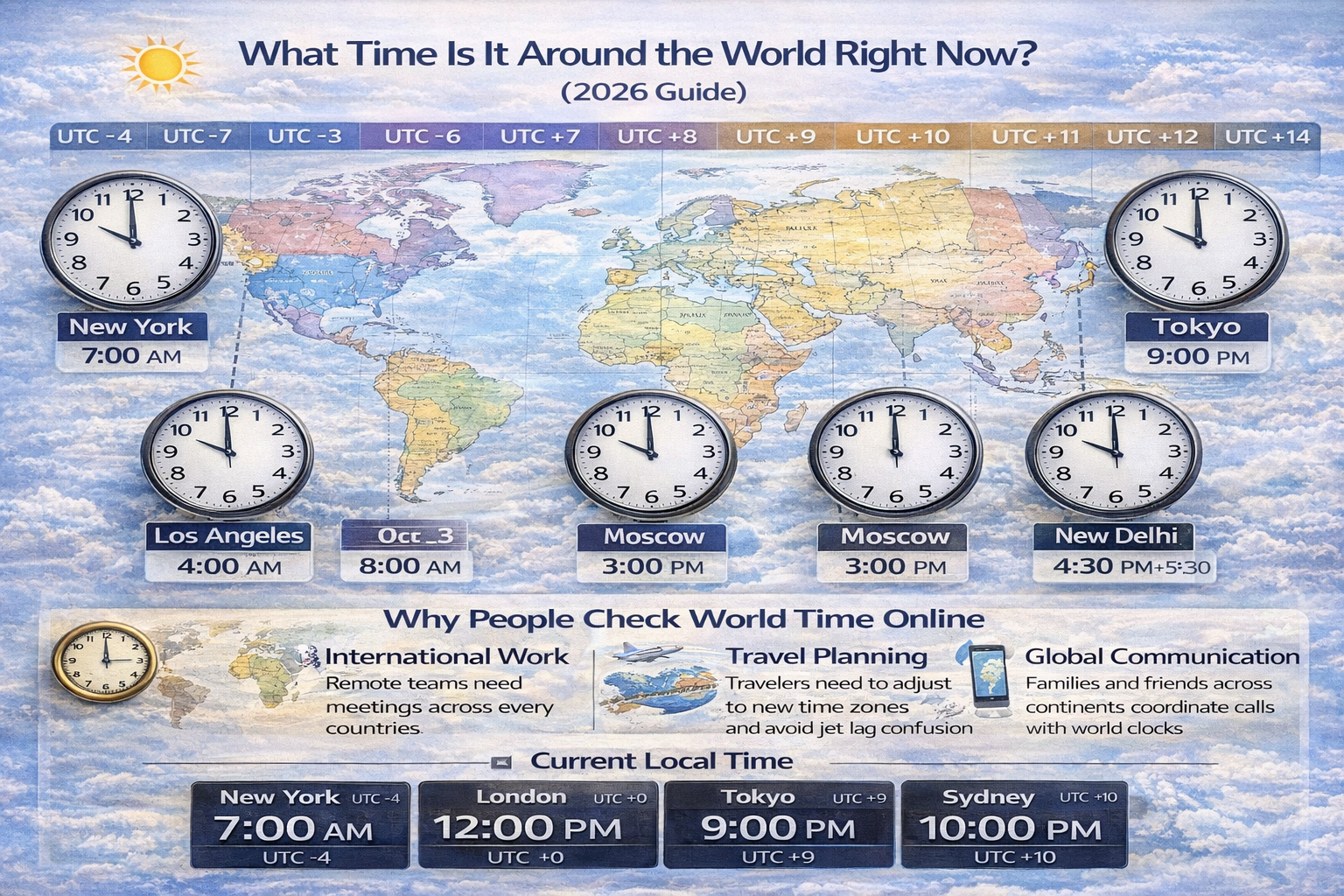
    CityLocal Time Example
    London12:00 PM
    New York7:00 AM
    Tokyo9:00 PM
    Sydney10:00 PM

    Even though these cities exist on the same planet, their clocks show different times because they are located in different time zones.


    Why People Check World Time Online

    Many people check global time online for several reasons.

    International Work

    Remote teams often collaborate across multiple countries, making time zone awareness essential.

    Travel Planning

    Knowing the time difference helps travelers adjust schedules and avoid jet lag confusion.

    Global Communication

    Families and friends living in different countries rely on world clocks to coordinate calls.

    Online Events

    Webinars, gaming events, and global broadcasts often require viewers to convert time zones.


    How to Check Accurate Global Time

    Today, checking world time is easy thanks to online tools.

    World clock websites allow you to:

    • See the current time in cities worldwide
    • Compare time zones instantly
    • Plan meetings across continents
    • Track time differences automatically

    These tools are especially useful for businesses, travelers, and remote workers.


    Interesting Facts About World Time

    • The Earth has 24 main time zones, but some regions use half-hour or 45-minute offsets.
    • Russia spans 11 time zones, the most of any country.
    • China uses one single time zone, even though it is geographically large.
    • The International Date Line separates one calendar day from the next across the Pacific Ocean.

    Why Accurate Time Matters

    Accurate timekeeping helps coordinate many systems that modern life depends on.

    These include:

    • International flights
    • Satellite navigation (GPS)
    • Financial trading systems
    • Internet communications
    • Global business operations

    Without standardized time zones and accurate clocks, coordinating activities across the world would be extremely difficult.


    Final Thoughts

    The question “What time is it?” may seem simple, but answering it globally requires an entire system of time zones, atomic clocks, and international standards.

    Thanks to modern world clock tools and synchronized time systems like UTC, we can instantly know the exact time anywhere on Earth.

    Whether you’re scheduling meetings, traveling internationally, or staying connected with people overseas, understanding global time helps keep everything running smoothly.

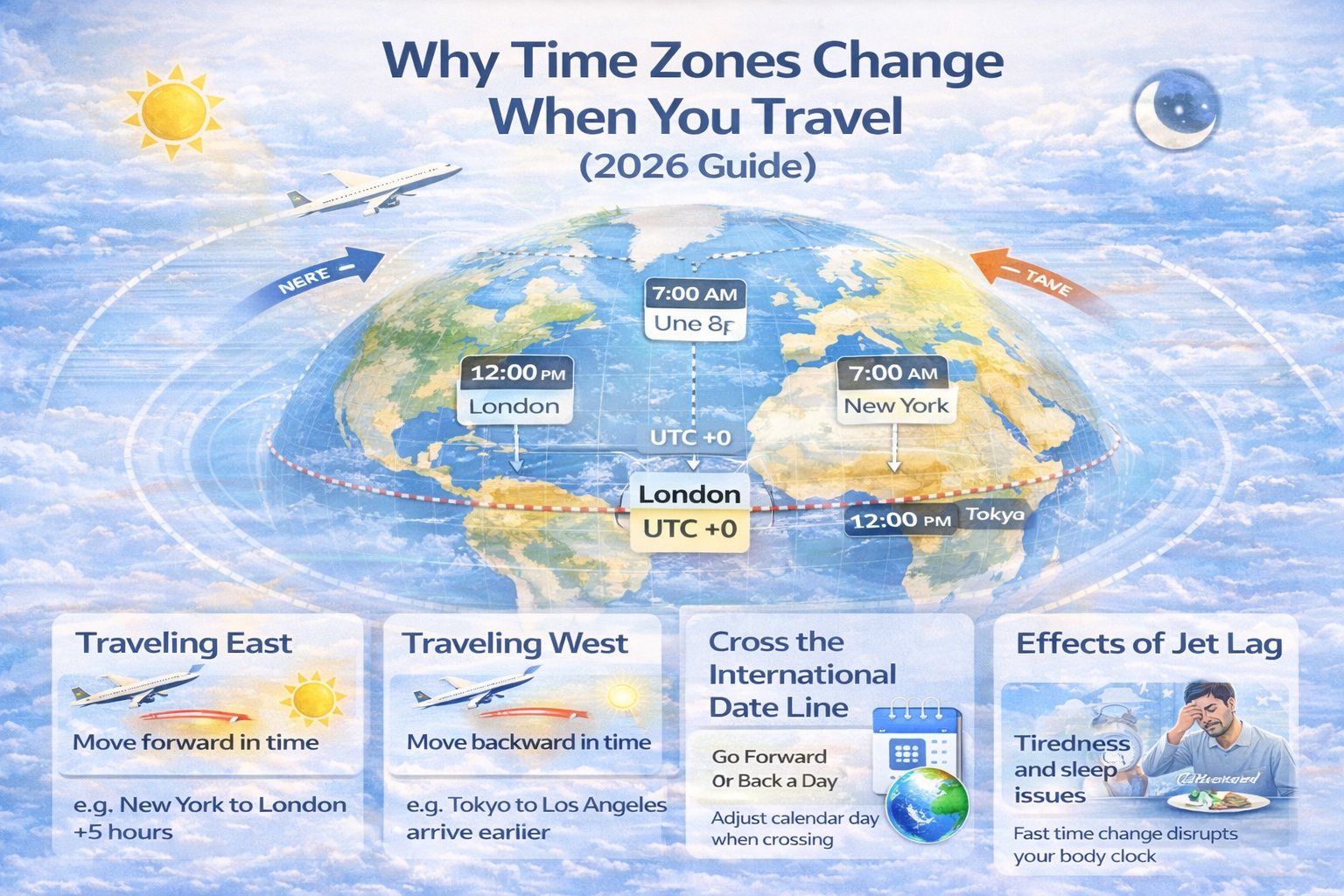
  • Why Time Zones Change When You Travel (2026 Guide)

    Why Time Zones Change When You Travel (2026 Guide)

    When traveling across countries or continents, one of the first things you may notice is that the local time changes. A flight that lasts only a few hours can result in arriving at a destination where the clock shows a completely different time.

    This happens because the Earth is divided into time zones, which allow different regions of the world to keep time according to their position relative to the sun.

    Understanding why time zones change when you travel can help you better plan trips, avoid scheduling confusion, and adjust to new local times more easily.


    Why the World Uses Time Zones

    The Earth rotates once every 24 hours, creating the cycle of day and night.

    To manage time across the globe, the world is divided into 24 main time zones, each representing roughly one hour of time difference.

    Each time zone covers about 15 degrees of longitude, because the Earth rotates 360 degrees in 24 hours.

    360 ÷ 24 = 15 degrees per hour.

    This system allows each region to have a local time that matches daylight patterns, so noon occurs when the sun is near its highest point in the sky.


    What Happens When You Cross a Time Zone

    When you travel east or west across the Earth, you may move into a different time zone.

    Each time zone shift usually changes the clock by one hour.

    For example:

    If it is 12:00 PM in London:

    This difference exists because these cities are located at different longitudes around the Earth.


    Traveling East vs Traveling West

    The direction you travel also affects how the time changes.

    Traveling East

    When you travel east, you move forward in time.

    Example:

    If you fly from New York to London, the clock moves ahead by about 5 hours.

    So if you leave New York at 6:00 PM, it may already be early morning in London when you arrive.


    Traveling West

    When traveling west, you move backward in time.

    Example:

    Flying from Tokyo to Los Angeles means the local time moves earlier.

    You may even arrive on the same calendar day you left, even after a long flight.


    What Is the International Date Line?

    One of the most interesting aspects of global timekeeping is the International Date Line.

    This imaginary line runs roughly along the 180-degree longitude in the Pacific Ocean.

    When travelers cross this line:

    • Traveling west adds one day
    • Traveling east subtracts one day

    This adjustment keeps the calendar aligned worldwide.

    For example, crossing the date line from Asia to North America can cause you to arrive on the previous day.


    How Airlines Handle Time Zones

    Airlines use the local time of departure and arrival cities when listing flight schedules.

    This means:

    • A flight may appear longer or shorter depending on time zone changes
    • Arrival times always reflect the local time of the destination

    Pilots and aviation systems often rely on UTC (Coordinated Universal Time) to avoid confusion during international flights.


    Why Time Zones Can Cause Jet Lag

    Changing time zones quickly can affect the body’s natural internal clock, also known as the circadian rhythm.

    When travelers cross multiple time zones, their sleep schedule may no longer match the local day-night cycle.

    Common jet lag symptoms include:

    • Fatigue
    • Difficulty sleeping
    • Reduced concentration
    • Digestive discomfort

    The more time zones crossed during travel, the stronger the jet lag effects may be.


    Tips for Adjusting to a New Time Zone

    Travelers can take several steps to adapt more quickly when arriving in a different time zone.

    Adjust sleep schedules before departure
    Gradually shifting bedtime can help prepare your body.

    Stay hydrated during travel
    Long flights and cabin air can cause dehydration.

    Get sunlight after arrival
    Natural light helps reset the body’s internal clock.

    Avoid heavy meals before sleep
    Eating lightly may help improve rest during the adjustment period.


    Why Understanding Time Zones Matters

    Time zones affect more than just travel. They also influence:

    • International meetings
    • Global business operations
    • Flight scheduling
    • Online events
    • Remote work coordination

    Knowing how time zones change when traveling helps avoid confusion and ensures better planning across different regions.


    Final Thoughts

    Time zones exist because the Earth rotates and different parts of the world experience daylight at different times. As travelers move across the globe, they pass through these zones, causing local time to shift forward or backward.

    Understanding how time zones work can make international travel easier and help travelers adjust more smoothly to new schedules.

    Using reliable world clock tools can also help confirm the correct time anywhere in the world.


© 2026 Time Now Online. All rights reserved.