Understanding time differences between countries is more important today than ever before. In a world where people work remotely, collaborate globally, and communicate across continents, knowing the correct time difference helps avoid missed meetings, scheduling errors, and communication delays.
Whether you’re coordinating with a business partner in another country, planning a call with family overseas, or scheduling international travel, learning how to calculate time differences can make your life much easier.
In this guide, we’ll explain how time differences work, how to calculate them step-by-step, and how to quickly check accurate global time online.
Why Time Differences Exist
Time differences exist because the Earth rotates. As the planet spins, different parts of the world experience daylight and night at different times.
To keep time organized, the world is divided into 24 primary time zones, each roughly representing one hour of time difference.
These zones are usually measured relative to Coordinated Universal Time (UTC), which acts as the global time standard.
For example:
Because of this system, when it is 12:00 PM in London, it is 7:00 AM in New York and 10:00 PM in Sydney.
Step-by-Step: How to Calculate Time Difference
Calculating the time difference between two countries is easier than most people think.
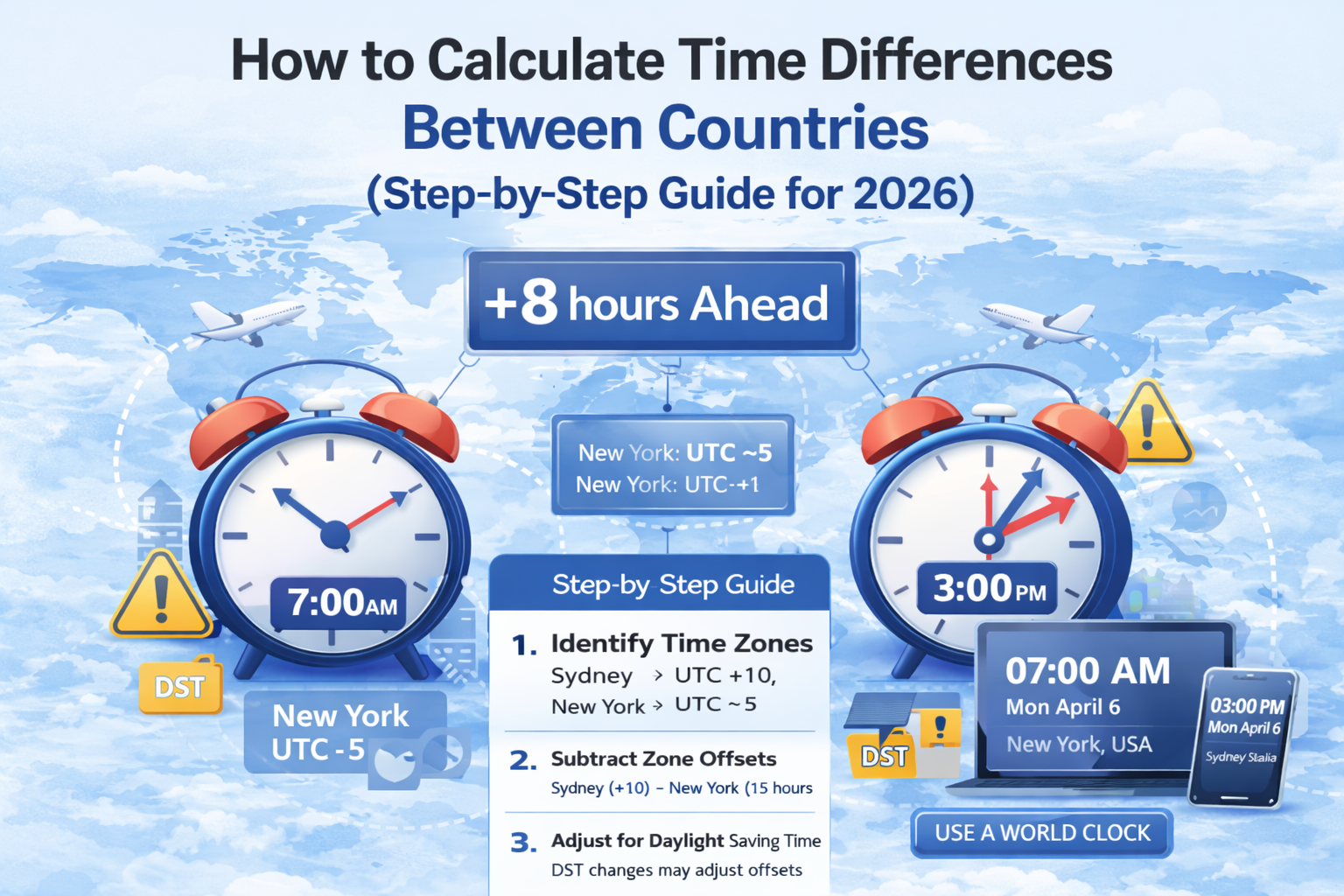
Step 1: Identify Each Location’s Time Zone
First, determine the UTC offset for both locations.
Example:
Sydney → UTC +10
New York → UTC −5
Step 2: Subtract the Time Zone Offsets
Next, subtract the offsets to find the difference.
Sydney (+10) minus New York (−5)
10 − (−5) = 15 hours
Sydney is therefore 15 hours ahead of New York.
Step 3: Adjust for Daylight Saving Time
Many countries change their clocks during part of the year due to Daylight Saving Time (DST).
For example:
- New York becomes UTC −4 during DST
- Sydney may become UTC +11 during DST
This means the time difference may change depending on the time of year.
Examples of Time Differences Between Major Cities
Here are some common global time differences people search for:
| City | Time Zone | Difference from London |
|---|---|---|
| New York | UTC −5 | 5 hours behind |
| Los Angeles | UTC −8 | 8 hours behind |
| Sydney | UTC +10 | 10 hours ahead |
| Tokyo | UTC +9 | 9 hours ahead |
| Dubai | UTC +4 | 4 hours ahead |
Because some locations observe daylight saving time and others do not, the exact difference can change during the year.
Why Time Zones Can Be Confusing
Although time zones seem simple, they can be confusing for several reasons.
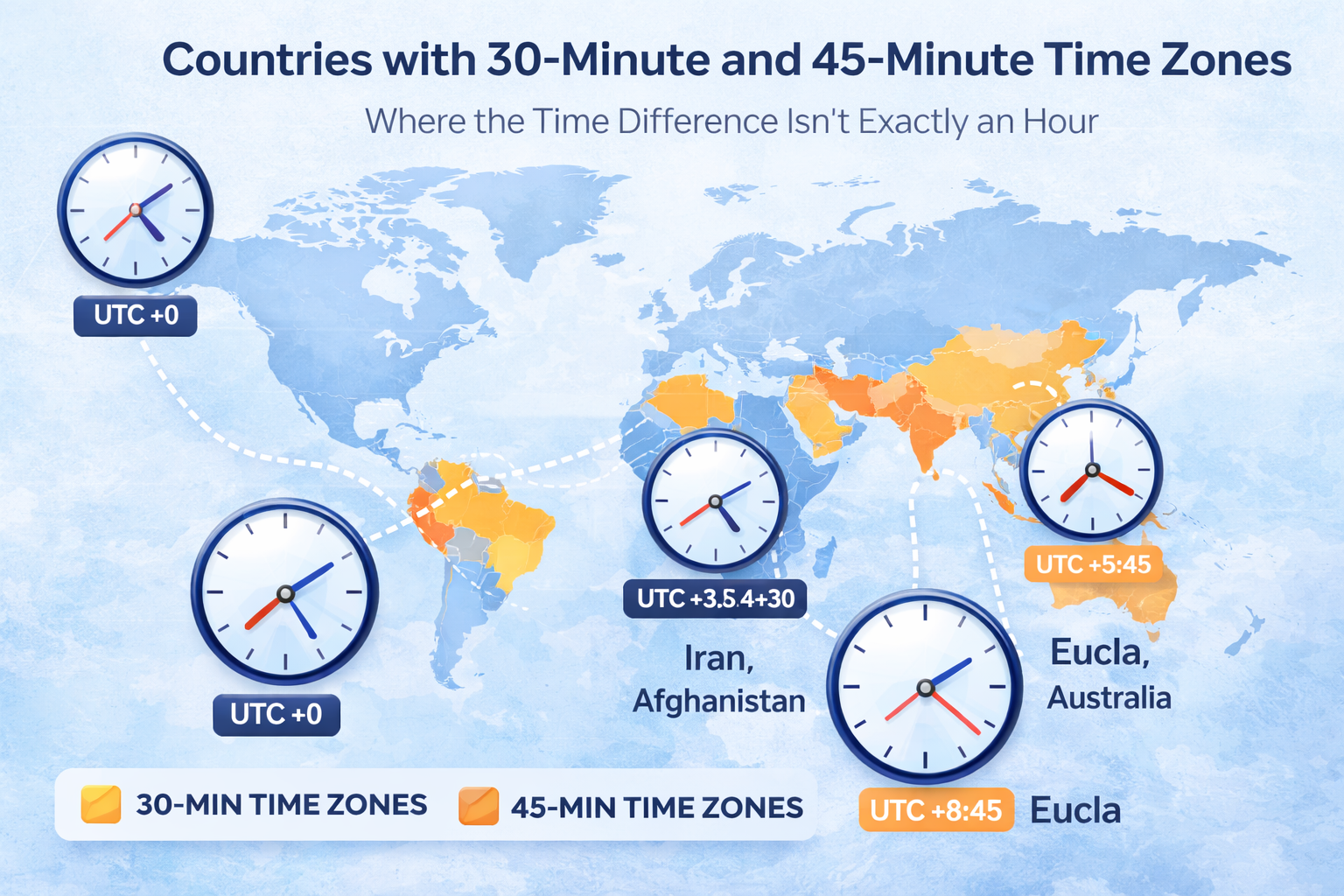
1. Some Countries Use Half-Hour Time Zones
Not all time zones follow exact one-hour increments.
Examples include:
These unusual offsets make manual calculations slightly more complicated.
2. Daylight Saving Time Changes the Clock
Many countries shift their clocks forward or backward once or twice each year.
For example:
- The United States changes clocks in March and November.
- Most European countries change clocks in March and October.
However, some countries do not observe DST at all, which can temporarily change the time difference between locations.
3. Some Countries Use Multiple Time Zones
Large countries may have several time zones.
Examples include:
- United States → 6 time zones
- Russia → 11 time zones
- Australia → 3 main time zones
This means you must know the exact city or region to calculate the correct time.
The Easiest Way to Check Time Differences
Instead of calculating manually every time, many people use online tools to instantly see the correct time anywhere in the world.
Online world clock websites allow you to:
- Check the current local time in any city
- Compare time zones instantly
- Avoid daylight saving errors
- Plan international meetings more easily
This is especially helpful for remote teams, international businesses, and travelers.
When Time Differences Matter Most
Knowing the correct time difference is particularly important in several situations.
International Business
Global companies often work with clients or partners in multiple countries. Scheduling meetings at the wrong time can cause delays or missed opportunities.
Remote Work
Remote teams frequently collaborate across continents. Understanding time zones helps ensure everyone joins meetings at the correct time.
Travel Planning
When traveling internationally, knowing the time difference helps you adjust your schedule and avoid jet lag confusion.
Family Communication
Many families live in different countries. Knowing the correct time difference makes it easier to plan calls and stay connected.
Tips for Managing Time Zones More Easily
Here are a few simple strategies to avoid time zone confusion.
Use UTC as a reference point
Many global systems rely on UTC to standardize time.
Use online time tools
World clock websites help you quickly compare multiple cities.
Double-check daylight saving changes
DST adjustments can temporarily shift time differences.
Schedule meetings using shared calendars
Modern calendar tools automatically convert time zones for participants.
Final Thoughts
Time differences between countries may seem complicated at first, but they follow a logical system based on Earth’s rotation and the global time zone structure.
By understanding UTC offsets and daylight saving changes, you can quickly calculate time differences anywhere in the world.
For the most accurate results, many people rely on online world clock tools that display real-time local time for cities across the globe.
Whether you’re scheduling a meeting, planning travel, or simply staying connected with people in other countries, understanding time differences helps ensure you always know the right time.