Tag: world time zones

  • Why Does India Use UTC+5:30?

    Why Does India Use UTC+5:30?

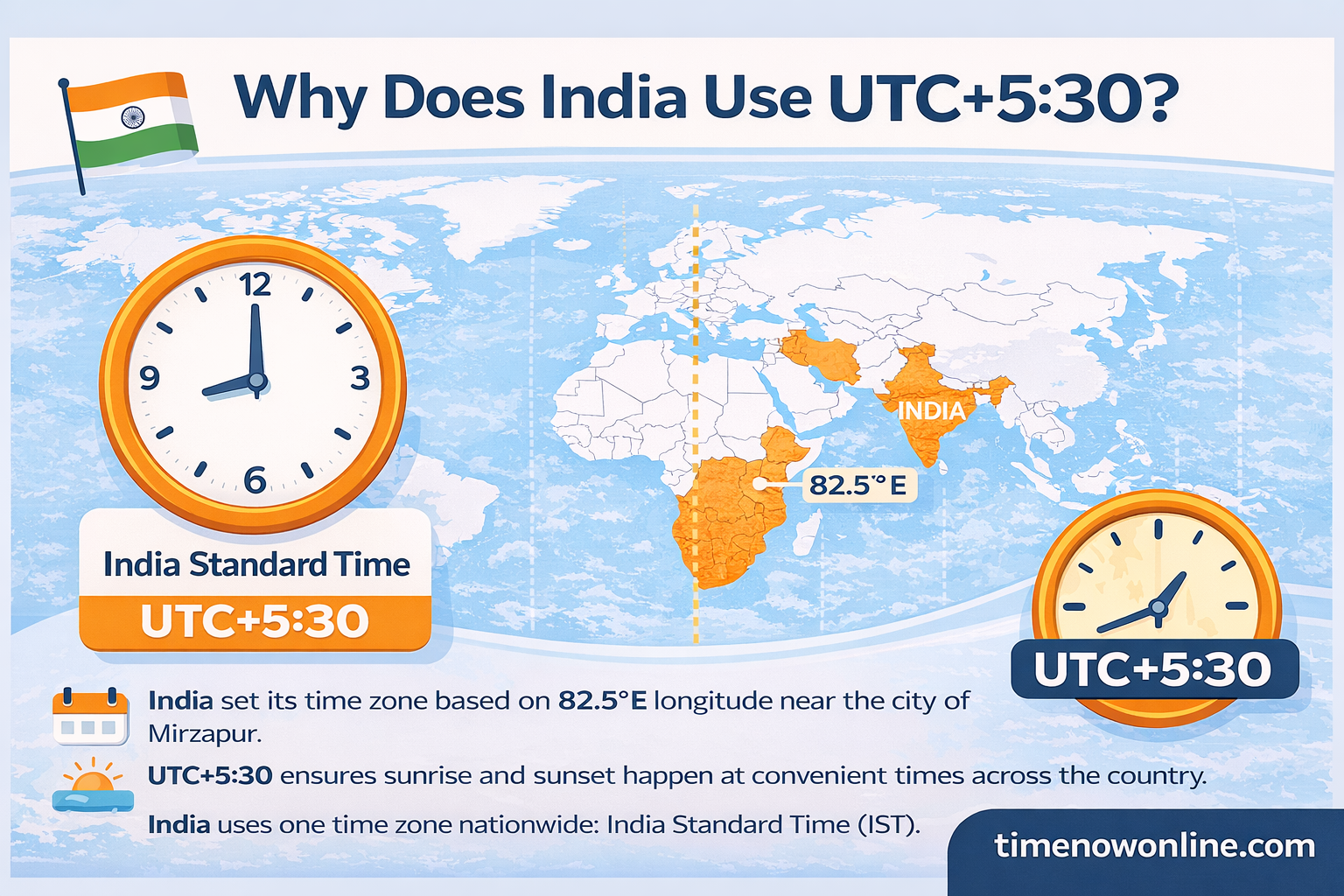
    India uses Indian Standard Time (IST), which is 5 hours and 30 minutes ahead of Coordinated Universal Time (UTC+5:30). Unlike many countries that use whole-hour time zones such as UTC+5 or UTC+6, India’s time zone includes a 30-minute offset, which often surprises people around the world.

    But there is a practical and historical reason behind this. India’s unique time zone was chosen to better match the country’s geography and daily sunlight patterns.


    Understanding UTC and Time Zones

    To understand why India uses UTC+5:30, we first need to understand how time zones work.

    The Earth is divided into 24 main time zones, each roughly covering 15 degrees of longitude. This is because the Earth rotates 360 degrees in 24 hours, which means every 15 degrees corresponds to about one hour of time difference.

    The global reference point for time is Coordinated Universal Time (UTC), which is based on atomic clocks and serves as the standard for all time zones.

    Countries set their local time by choosing a UTC offset, such as:

    India’s time zone is UTC+5:30.


    Why India Chose UTC+5:30

    India’s time zone was designed to better align with the country’s geographic location.

    India stretches across about 30 degrees of longitude, meaning the eastern and western parts of the country experience sunrise and sunset at noticeably different times. If India used a standard hourly time zone like UTC+5 or UTC+6, sunrise and sunset would feel unnatural in many parts of the country.

    The solution was to adopt a half-hour offset, placing the official time exactly between the two possible hourly zones.

    This helps ensure that:

    • mornings begin with daylight in most regions
    • work hours align better with daylight
    • daily life follows natural daylight cycles

    The Origin of Indian Standard Time

    Before India adopted a single national time, several cities used their own local time.

    During the late 19th century under British rule, major cities operated on separate time systems, including:

    • Bombay Time
    • Calcutta Time
    • Madras Time

    This created confusion, especially for railway schedules and communication.

    To simplify timekeeping across the country, Indian Standard Time (IST) was officially adopted in 1906.

    The reference longitude chosen was 82.5° East, which passes near the city of Mirzapur in Uttar Pradesh. This longitude corresponds exactly to UTC+5:30.


    Why India Does Not Use Daylight Saving Time

    Many countries adjust their clocks during summer months using Daylight Saving Time (DST) to extend evening daylight.

    However, India does not observe daylight saving time.

    There are several reasons for this:

    1. India’s location near the equator means daylight hours remain relatively consistent throughout the year.
    2. The benefits of daylight saving would be minimal compared to countries at higher latitudes.
    3. Maintaining a single stable time zone simplifies national coordination.

    Because of this, IST remains the same all year round.


    Cities That Use Indian Standard Time

    India uses one single time zone nationwide, meaning every city follows IST.

    Major cities using IST include:

    You can check the current time in these cities on our website.


    Other Countries With Half-Hour Time Zones

    India is not the only country with a half-hour time zone.

    Several regions around the world use similar offsets to better match local geography.

    Examples include:

    • Iran – UTC+3:30
    • Afghanistan – UTC+4:30
    • Myanmar – UTC+6:30
    • Australia (Northern Territory) – UTC+9:30
    • Newfoundland (Canada) – UTC−3:30

    There are even 45-minute time zones, such as Nepal (UTC+5:45).

    These unusual offsets exist because countries sometimes prioritize practical daylight alignment over perfectly rounded time zones.


    Advantages of India’s Time Zone

    India’s use of UTC+5:30 offers several benefits.

    1. Better Alignment With Daylight

    The half-hour offset helps ensure sunrise and sunset occur at reasonable times for most of the country.

    2. Simplified National Coordination

    Using a single time zone keeps schedules consistent across the entire country.

    3. Efficient Transportation and Communication

    Railways, airlines, and businesses can operate with one official national time.


    Challenges of a Single Time Zone

    Although IST works well overall, there have been discussions about introducing multiple time zones in India.

    Eastern regions of India experience sunrise much earlier than western regions. In some areas, the sun rises before 5 AM during certain seasons.

    Some experts suggest splitting India into two time zones to improve productivity and reduce electricity use.

    However, for now, India continues to use one standard time zone nationwide.


    Frequently Asked Questions

    What does IST stand for?

    IST stands for Indian Standard Time.

    What is the UTC offset for India?

    India’s time zone is UTC+5:30.

    Does India observe daylight saving time?

    No. India uses the same time throughout the year.

    Why is India not UTC+5 or UTC+6?

    India chose UTC+5:30 to better match the country’s geographic position.


    Final Thoughts

    India’s use of UTC+5:30 is the result of both geography and history. By choosing a half-hour offset based on the 82.5° East longitude, India created a time system that better fits the country’s natural daylight cycle.

    Although unusual compared to standard hourly time zones, IST has worked effectively for over a century and continues to provide a consistent time reference across the entire country.
  • Time Differences Between Locations Worldwide: A Simple Guide to Understanding Global Time

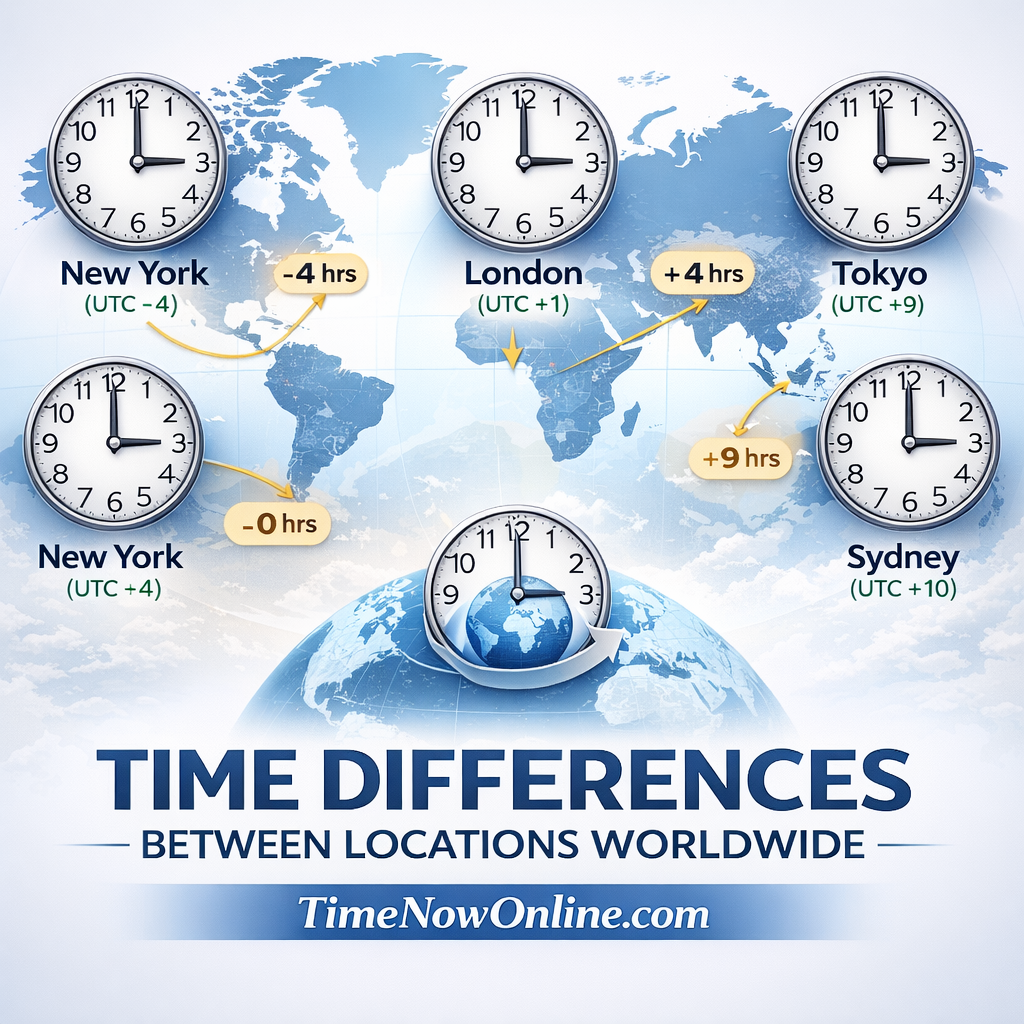
    Time Differences Between Locations Worldwide: A Simple Guide to Understanding Global Time

    When you communicate, travel, or do business across countries, one of the first things you notice is that time is different in every location. While it might be morning in one country, it could already be evening in another.

    Understanding time differences between locations worldwide helps people schedule meetings, plan travel, coordinate global teams, and connect with family across continents.

    Websites like timenowonline.com make it easier to check the current local time anywhere in the world.


    What Are Time Differences?

    Time differences happen because the Earth rotates on its axis. As the planet turns, different parts of the world face the Sun at different times.

    To organize global time, the world is divided into 24 time zones, each roughly representing one hour of difference.

    For example:

    CityTime ZoneExample Time
    New YorkUTC -58:00 AM
    LondonUTC +01:00 PM
    DubaiUTC +45:00 PM
    SydneyUTC +1112:00 AM

    Each step between zones usually equals one hour of time difference.


    Why Time Zones Exist

    Before time zones were introduced, every town followed its own local solar time, based on the position of the Sun.

    This worked fine until the 19th century, when railways and global travel made scheduling very confusing.

    In 1884, countries agreed to divide the world into time zones based on the Prime Meridian in Greenwich, England.

    This standard became known as Greenwich Mean Time (GMT) and later evolved into Coordinated Universal Time (UTC).


    How to Calculate Time Differences

    Calculating time differences between two locations is simple when you know their UTC offsets.

    Example:

    Sydney: UTC +11
    London: UTC +0

    Difference:

    11 hours ahead

    So if it is:

    10:00 AM in London
    It will be 9:00 PM in Sydney.

    Many people use online world clocks to calculate this instantly.


    Examples of Global Time Differences

    Here are some common time differences people check regularly:

    LocationCompared ToTime Difference
    Sydney New York15–16 hours
    London Tokyo9 hours
    Dubai Sydney7 hours
    Los AngelesLondon8 hours
    Singapore New York12–13 hours

    These differences may change slightly due to Daylight Saving Time (DST).


    Daylight Saving Time and Time Differences

    Some countries move their clocks forward or backward during certain parts of the year. This is called Daylight Saving Time.

    Because not every country follows DST, time differences can temporarily change.

    For example:

    Sydney London

    This is why checking a live time website is often the easiest solution.

    • During Australian summer: 11 hours
    • During other periods: 10 hours

    Why Time Differences Matter

    Understanding time differences is important for many reasons.

    Global Business

    Companies working with international teams must coordinate across multiple time zones.

    Travel Planning

    Travelers need to adjust to jet lag and arrival times.

    Online Communication

    People scheduling meetings or video calls must avoid contacting others at inconvenient hours.

    International Events

    Sports events, financial markets, and product launches depend on accurate time coordination.


    Tools to Check Time Differences

    Several online tools can help you quickly find the time anywhere in the world:

    • World clock websites
    • Time difference calculators
    • Smartphone clock apps
    • Online meeting schedulers

    On timenowonline.com, you can browse cities and countries to instantly see their current local time and time zone.


    Frequently Asked Questions

    How many time zones are there in the world?

    There are 24 primary time zones, but when including half-hour and quarter-hour differences, there are over 38 time variations worldwide.

    Which country has the most time zones?

    France technically has the most time zones due to overseas territories, while Russia spans 11 time zones.

    What is the largest time difference between two places?

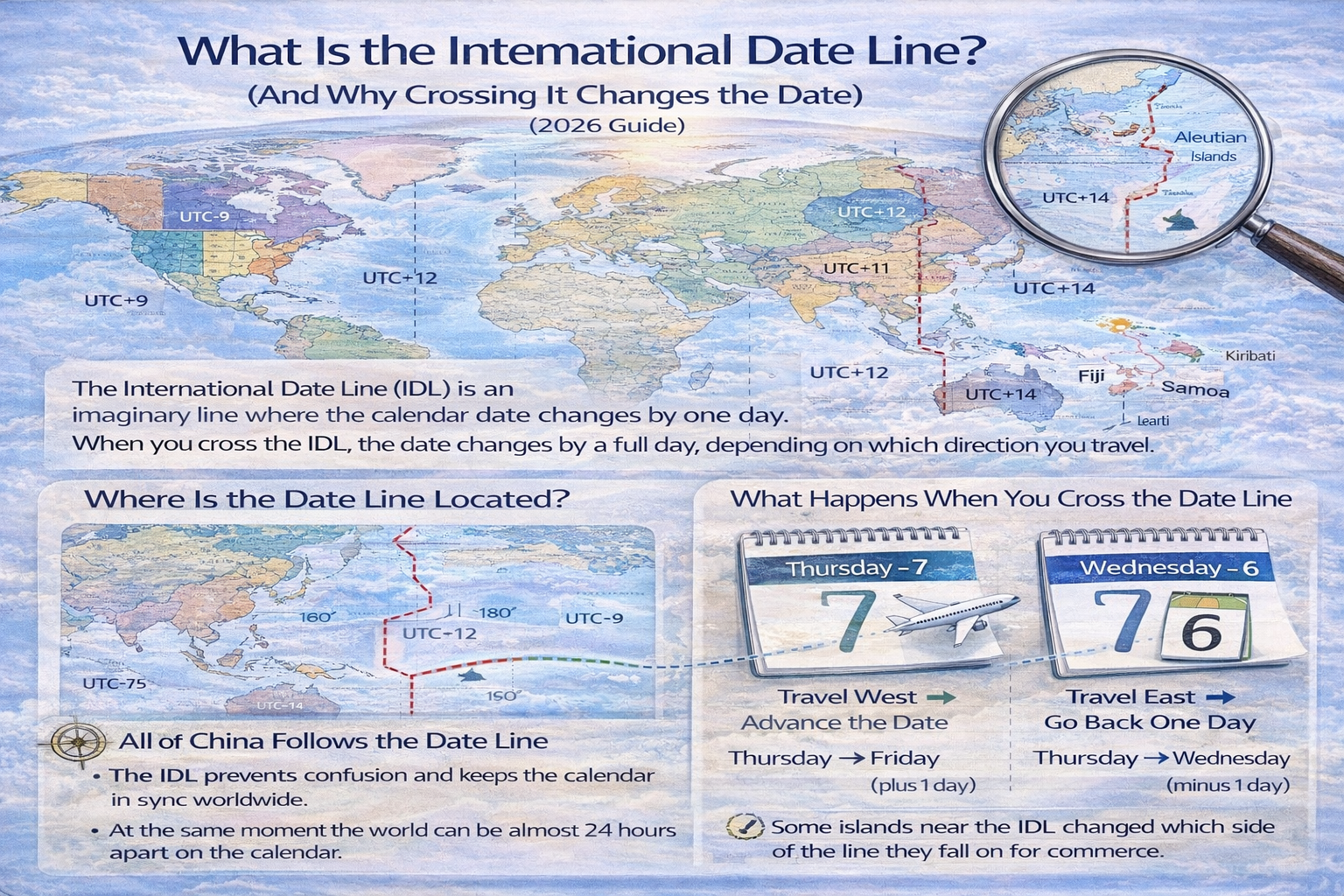
    The biggest difference can reach 26 hours between certain Pacific islands due to the International Date Line.

    Why do some countries have half-hour time zones?

    Countries like India (UTC +5:30) and Nepal (UTC +5:45) use half-hour or quarter-hour offsets to better match their geographic position.


    Conclusion

    Time differences between locations exist because the Earth rotates and countries follow different time zones. Understanding these differences helps people communicate, travel, and work more efficiently in a connected world.

    With global tools and websites like timenowonline.com, checking the time anywhere in the world is now fast and simple.

  • Why Does China Have Only One Time Zone? (2026 Guide)

    Why Does China Have Only One Time Zone? (2026 Guide)

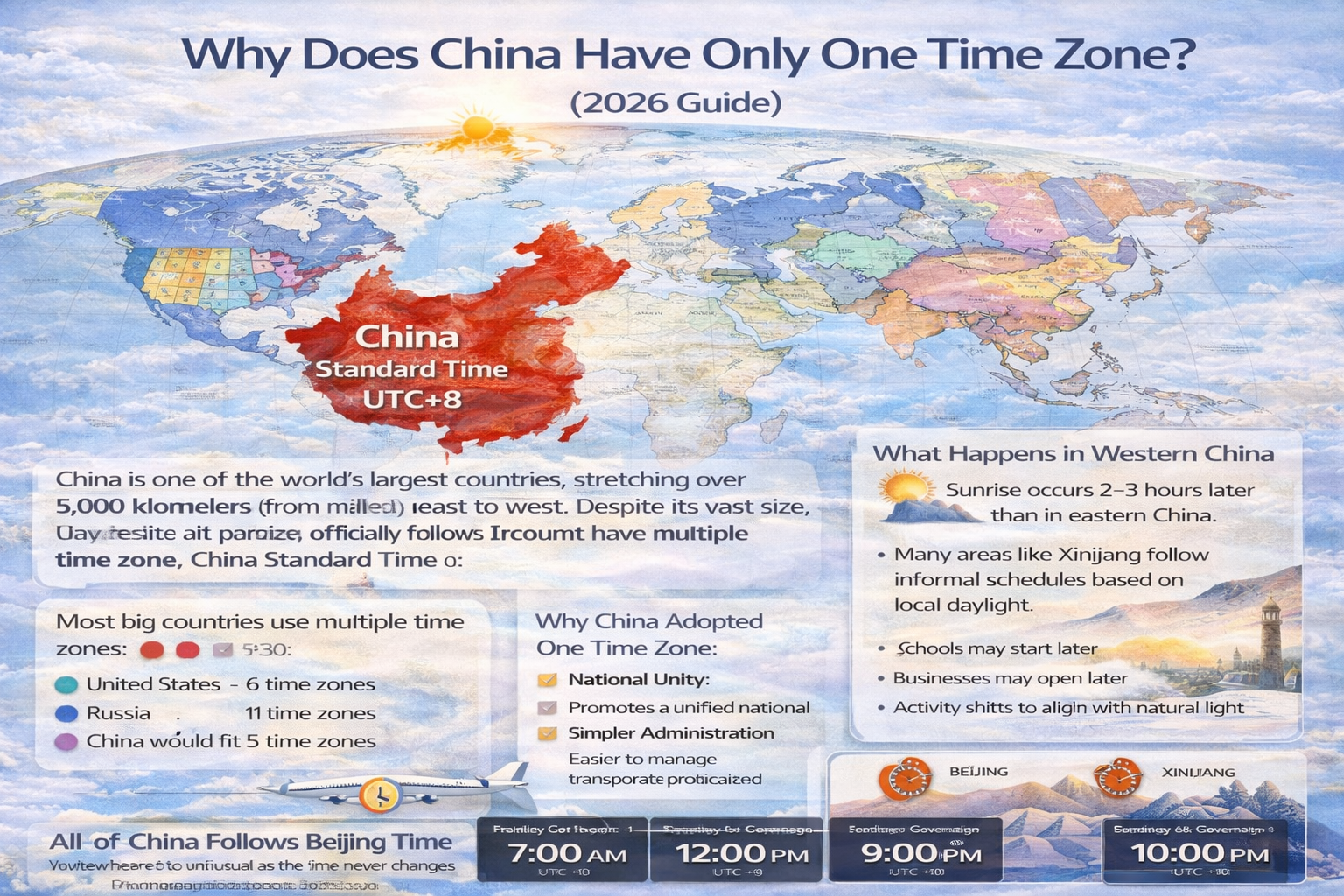
    China is one of the largest countries in the world, stretching more than 5,000 kilometers from east to west. Because of its enormous size, many people assume China must have multiple time zones, similar to countries like the United States or Russia.

    However, China officially follows only one national time zone: China Standard Time (UTC+8). This decision makes China unique among large countries and often surprises travelers and international observers.

    In this guide, we’ll explore why China uses a single time zone and how this decision affects daily life across the country.


    How Time Zones Normally Work

    The Earth is divided into 24 main time zones, each representing one hour of time difference.

    This system exists because the planet rotates 360 degrees in 24 hours, meaning it turns about 15 degrees every hour.

    Ideally, countries that stretch across wide geographic areas would use several time zones to match their position relative to the sun.

    For example:

    Based on its geographic size, China could theoretically use five different time zones.


    China Once Had Multiple Time Zones

    Before 1949, China actually had five official time zones, including:

    • Kunlun Time
    • Sinkiang Time
    • Kansu-Szechwan Time
    • Chungyuan Time
    • Changpai Time

    These time zones reflected the country’s large geographic spread.

    However, the system created complexity for communication and transportation.


    Why China Adopted One Time Zone

    After the establishment of the People’s Republic of China in 1949, the government decided to simplify timekeeping across the nation.

    China adopted Beijing Time (UTC+8) as the single official time zone.

    There were several reasons for this decision.

    National Unity

    Using one time zone helped promote a unified national schedule across the country.

    Simpler Administration

    A single time standard made it easier to coordinate transportation, broadcasting, and government activities.

    Centralized Governance

    The unified time system reinforced the role of Beijing as the political center of the country.


    What Happens in Western China

    Because China is geographically wide, sunrise and sunset times vary greatly between regions.

    In eastern cities like Shanghai and Beijing, sunrise occurs at typical morning hours.

    However, in western regions such as Xinjiang, sunrise can occur two or three hours later according to the official clock.

    To adapt, some communities in western China follow informal local schedules that better match daylight hours.

    For example:

    • Schools may start later
    • Businesses may open later
    • Daily activities shift to match natural daylight

    How Travelers Experience China’s Time Zone

    For travelers, China’s single time zone can create unusual experiences.

    Flying from eastern China to western China may take several hours, but the clock remains the same throughout the journey.

    This can make it feel like the sun is rising or setting at unexpected times.


    China’s Unique Time System

    China’s single time zone is one of the most unusual timekeeping systems in the world.

    Most countries with large territories divide their land into multiple time zones to align with daylight patterns.

    China chose a different approach, prioritizing national consistency over geographic accuracy.


    Final Thoughts

    China’s use of a single national time zone highlights how timekeeping is influenced not only by geography but also by politics and national decisions.

    While most large countries divide their territory into multiple time zones, China maintains a unified system centered on Beijing Time.

    Understanding this unique approach helps explain why sunrise and sunset times can vary so widely across different parts of the country.

  • The History of Time Zones: How the World Standardized Time (2026 Guide)

    The History of Time Zones: How the World Standardized Time (2026 Guide)

    Today, checking the time anywhere in the world is simple. With smartphones, online clocks, and digital devices, we can instantly know the time in any country or city. However, this global system of time zones did not always exist.

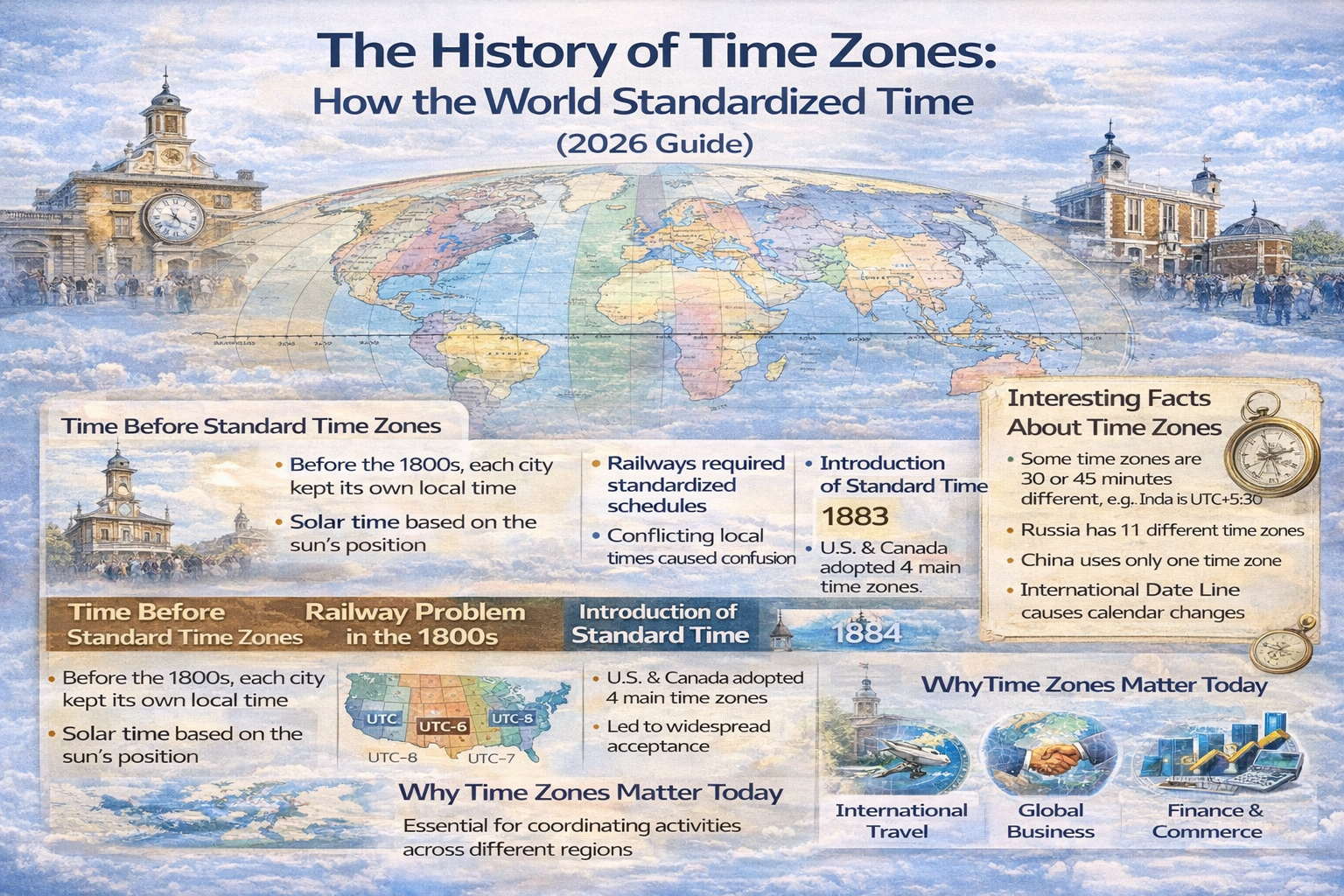
    Before the late 19th century, every city kept its own local time, based on the position of the sun in the sky. This meant that time could vary from one town to the next, even if they were only a short distance apart.

    The modern time zone system was created to solve these problems and bring consistency to global communication, travel, and commerce.


    Time Before Standard Time Zones

    Before time zones were introduced, people relied on solar time.

    Solar time was determined by the position of the sun. When the sun reached its highest point in the sky, it was considered local noon.

    Because the Earth rotates, solar noon occurs at slightly different times depending on a location’s longitude.

    This meant that neighboring cities could have clocks that differed by several minutes.

    While this system worked reasonably well for small communities, it became problematic as transportation and communication expanded.


    The Railway Problem

    The rapid expansion of railway systems during the 1800s created major challenges for timekeeping.

    Trains began connecting cities over long distances, and scheduling became extremely difficult when each town used its own local time.

    For example:

    • A train leaving one city might arrive in another where the local time was different.
    • Railway schedules became confusing and difficult to coordinate.

    This situation led to frequent scheduling errors and made travel planning complicated.

    Railway companies needed a standardized time system.


    The Introduction of Standard Time

    In 1883, railway companies in the United States and Canada introduced standardized time zones to solve scheduling problems.

    They divided the continent into four main time zones:

    • Eastern Time
    • Central Time
    • Mountain Time
    • Pacific Time

    Each region used the same clock time, making train schedules easier to manage.

    This system proved so effective that it quickly gained widespread acceptance.


    The International Meridian Conference (1884)

    A major milestone in global timekeeping occurred in 1884, when representatives from 25 countries met in Washington, D.C. for the International Meridian Conference.

    During this meeting, several important decisions were made:

    • The Prime Meridian would be located at Greenwich, England
    • Greenwich Mean Time (GMT) would serve as the global reference time
    • The world would be divided into time zones based on longitude

    This conference established the foundation for the modern global timekeeping system.


    The Development of Global Time Zones

    Following the conference, countries gradually adopted standardized time zones.

    The Earth was divided into 24 primary time zones, each roughly one hour apart.

    Each zone represents approximately 15 degrees of longitude, reflecting how far the Earth rotates in one hour.

    This system allows local time to align more closely with daylight patterns.


    The Transition from GMT to UTC

    For many years, Greenwich Mean Time (GMT) served as the global time standard.

    However, as technology advanced, scientists developed more precise methods of measuring time.

    Today, the official global time standard is Coordinated Universal Time (UTC).

    UTC is maintained using atomic clocks, which measure time based on the vibrations of atoms. These clocks are incredibly accurate and help keep global systems synchronized.


    How Time Zones Affect the Modern World

    Time zones play a critical role in modern life. They allow people across the globe to coordinate activities despite living in different regions.

    Time zones influence:

    • International travel schedules
    • Global business operations
    • Satellite navigation systems
    • Internet communications
    • Worldwide financial markets

    Without a standardized system of time zones, coordinating these activities would be extremely difficult.


    Interesting Facts About Time Zones

    Several unique facts highlight how complex global timekeeping can be.

    • Some countries use half-hour or 45-minute time zones, such as India and Nepal.
    • Russia spans 11 different time zones, the most of any country.
    • China uses only one time zone, despite being geographically very large.
    • The International Date Line helps maintain calendar consistency when traveling across the Pacific Ocean.

    These variations show that time zones are both a scientific system and a political decision.


    Final Thoughts

    The global time zone system was created to solve the challenges of transportation, communication, and international coordination. What began as a solution for railway scheduling in the 19th century eventually became the worldwide standard for organizing time.

    Today, thanks to time zones and modern atomic clocks, people across the world can coordinate activities with incredible precision.

    Understanding the history of time zones helps us appreciate the complex system that keeps the world running on time.

  • Why Some Countries Have Multiple Time Zones (2026 Guide)

    Why Some Countries Have Multiple Time Zones (2026 Guide)

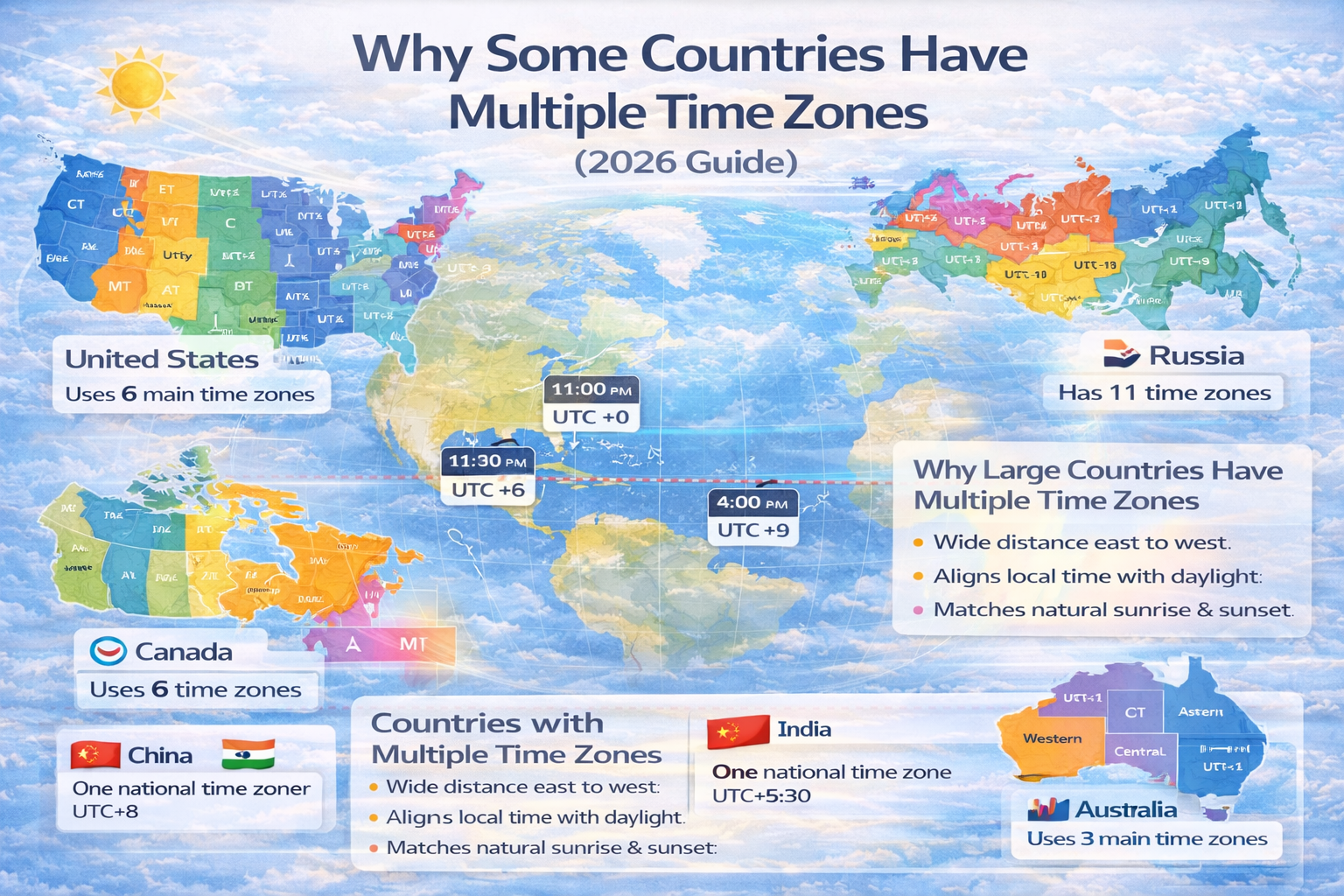
    When looking at a world map, you might notice that some countries operate under a single time zone while others use several. Large nations like the United States and Russia span thousands of kilometers from east to west, making it impractical for the entire country to follow the same local time.

    This is why some countries divide their territory into multiple time zones, allowing different regions to keep time that matches their position relative to the sun.

    In this guide, we’ll explore why multiple time zones exist, which countries use them, and how they affect daily life and global communication.


    Why Time Zones Exist

    Time zones exist because the Earth rotates once every 24 hours. As the planet turns, different parts of the world experience daylight and night at different times.

    To organize time globally, the Earth was divided into 24 main time zones, each roughly representing one hour of time difference.

    Each time zone covers approximately 15 degrees of longitude, since the Earth rotates 360 degrees in 24 hours.

    360 ÷ 24 = 15 degrees per hour.

    This system ensures that local noon occurs when the sun is near its highest point in the sky.


    Why Some Countries Need Multiple Time Zones

    Countries that stretch across a wide distance from east to west may experience sunrise and sunset at very different times.

    If the entire country used a single time zone, some regions would have extremely early sunrises or very late sunsets.

    To solve this issue, governments divide their territory into multiple time zones.

    This allows people in different regions to follow a schedule that better matches natural daylight.


    Countries With Multiple Time Zones

    Several large countries use more than one time zone to accommodate their geographic size.

    United States

    The United States uses six main time zones, including:

    • Eastern Time (ET)
    • Central Time (CT)
    • Mountain Time (MT)
    • Pacific Time (PT)
    • Alaska Time
    • Hawaii-Aleutian Time

    Because the country stretches across a large portion of North America, different states follow different local times.


    Russia

    Russia has the largest number of time zones in the world, spanning 11 different time zones.

    This massive country extends across both Europe and Asia, making a single national time impossible.

    Traveling from western Russia to eastern Russia can involve many hours of time difference.


    Canada

    Canada also uses multiple time zones due to its large size.

    These include:

    • Pacific Time
    • Mountain Time
    • Central Time
    • Eastern Time
    • Atlantic Time
    • Newfoundland Time

    Some of these zones even include half-hour differences, such as Newfoundland Time.


    Australia

    Australia uses three main time zones:

    • Australian Eastern Standard Time (AEST)
    • Australian Central Standard Time (ACST)
    • Australian Western Standard Time (AWST)

    Some Australian states also observe Daylight Saving Time, while others do not, which can temporarily change time differences within the country.


    Countries With Only One Time Zone

    Interestingly, some very large countries choose to use only one official time zone.

    China

    Despite spanning roughly the same width as the United States, China uses a single time zone known as China Standard Time (UTC+8).

    This means that sunrise in western China can occur much later than in eastern regions.

    The decision was made to keep the country on a unified national schedule.


    India

    India also uses a single national time zone, called Indian Standard Time (UTC+5:30).

    Even though India covers a wide geographic area, the government chose to maintain one standard time across the entire country.


    Challenges of Multiple Time Zones

    While multiple time zones help align local schedules with daylight, they can also create challenges.

    These include:

    • Confusion when scheduling meetings across regions
    • Transportation coordination across time zones
    • Differences in television broadcasts and national events

    Businesses and organizations often rely on UTC time or scheduling tools to avoid confusion.


    How Time Zones Affect Travel

    Traveling across a country with multiple time zones can result in noticeable clock changes.

    For example:

    A flight from New York to Los Angeles crosses three time zones.

    Even though the flight takes around six hours, travelers may arrive with the clock showing a time difference of only three hours.

    This is because local time changes along the journey.


    Why Understanding Time Zones Matters

    Understanding how time zones work helps people coordinate activities across different regions of the world.

    Time zones affect:

    • International business meetings
    • Flight schedules
    • Global events
    • Online communication
    • Remote work collaboration

    Because of this, many people rely on online world clock tools to quickly check the correct time in different locations.


    Final Thoughts

    Multiple time zones exist primarily because some countries cover vast geographic areas. Dividing these regions into different time zones allows local schedules to align more closely with daylight hours.

    While this system can sometimes create confusion, it plays an essential role in helping people coordinate time across different parts of the world.

    By understanding how time zones work, travelers, businesses, and remote teams can better manage schedules and communicate more effectively across global regions.


© 2026 Time Now Online. All rights reserved.