a flag flying in the wind on a pole

United Arab Emirates Time Now

Stay updated with the current time in the United Arab Emirates and plan your meetings, travel, and international calls with confidence. The UAE runs on a single time zone — Gulf Standard Time (GST) — four hours ahead of UTC, with no daylight saving time across all seven emirates, making the country one of the most stable and predictable clocks in the Middle East.

About United Arab Emirates

The United Arab Emirates (UAE), known in Arabic as الإمارات العربية المتحدة (Al-Imārāt Al-ʿArabīyah Al-Muttaḥidah), is a federation of seven emirates on the southeastern coast of the Arabian Peninsula. The country covers approximately 83,600 square kilometres and has a population of around 10 million people — though notably, only about 11–12% are Emirati citizens; the remaining 88% are expatriates from across the world, with large communities from India, Pakistan, Bangladesh, the Philippines, Egypt, and Western nations. This makes the UAE one of the most diverse populations on Earth.

The UAE was formed on 2 December 1971 when six emirates federated under the leadership of Sheikh Zayed bin Sultan Al Nahyan, the founding father of the nation. The seventh emirate, Ras Al Khaimah, joined in February 1972. The country shares borders with Saudi Arabia to the south and west and Oman to the east and northeast. The UAE has long coastlines on both the Persian Gulf to the north and the Gulf of Oman (an arm of the Indian Ocean) to the east.

The capital is Abu Dhabi, the largest emirate by area (covering around 87% of the UAE's land). Abu Dhabi city is a modern, cosmopolitan metropolis with a population of around 1.5 million and is the political, administrative, and oil capital of the country. Iconic landmarks include the magnificent Sheikh Zayed Grand Mosque (one of the largest mosques in the world, with capacity for over 40,000 worshippers), the Louvre Abu Dhabi (the first Louvre museum outside France), Yas Island (home to the Abu Dhabi Grand Prix circuit and theme parks like Ferrari World, Warner Bros. World, and SeaWorld), the imposing Emirates Palace hotel, and the historic Qasr Al Hosn fort.

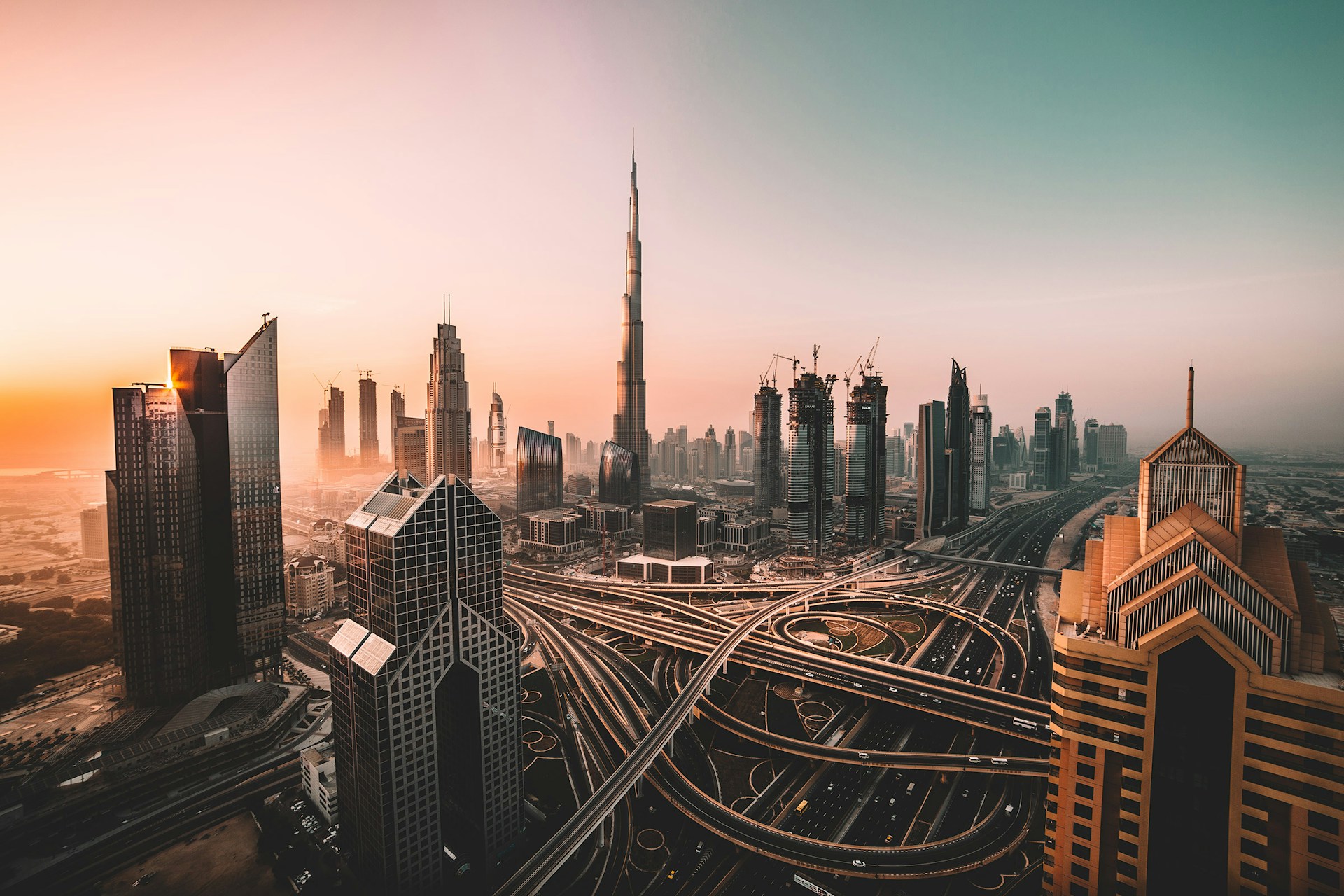
Dubai, the second-largest emirate by population, is the UAE's most globally famous city and a leading international business and tourism hub. With a population of around 3.6 million, Dubai has transformed in just a few decades from a small pearl-fishing port into one of the world's most futuristic cities. Iconic landmarks include the Burj Khalifa (the tallest building in the world at 828 metres), the Palm Jumeirah (the world's largest man-made island), the sail-shaped Burj Al Arab hotel, the Dubai Mall (one of the largest shopping malls in the world), the Dubai Fountain, the bustling Dubai Marina, and the historic Al Fahidi district. (See our Dubai Time Now page for a deeper dive into Dubai specifically.)

The other five emirates each have their own character:

  • Sharjah — The "cultural capital" of the UAE; UNESCO designated it as a Cultural Capital of the Arab World, home to over 20 museums and the spectacular Sharjah Heritage Museum.

  • Ajman — The smallest emirate by area; known for its relaxed atmosphere, beaches, and traditional dhow building.

  • Umm Al Quwain — A quiet, traditional emirate known for fishing, mangroves, and a slower pace of life.

  • Ras Al Khaimah (RAK) — The northernmost emirate, with stunning Hajar Mountains, Jebel Jais (the UAE's highest peak), and the world's longest zipline.

  • Fujairah — The only emirate located entirely on the Gulf of Oman (Indian Ocean side), famous for diving, snorkelling, and the historic Al Bidya Mosque.

The UAE's geography is dramatically varied for a relatively small country. Most of the country is hot, sandy desert, including parts of the legendary Empty Quarter (Rub' al Khali) — the world's largest contiguous sand desert. The east of the country features the rugged Hajar Mountains, which rise to 1,934 metres at Jebel Jais in Ras Al Khaimah. The country has long coastlines, sandy beaches, mangrove forests, coral reefs, and even the lush Liwa Oasis in the southwest.

Culturally, the UAE is a fascinating blend of traditional Emirati Bedouin heritage and ultramodern global influences. The official language is Arabic (specifically Gulf Arabic), but English is universally spoken — used for business, tourism, signage, and daily communication across the diverse expatriate population. The dominant religion is Sunni Islam (UAE nationals are predominantly Sunni Muslim), but the country is famously tolerant of other faiths, with Christian churches, Hindu temples, Sikh gurdwaras, and the spectacular Abrahamic Family House in Abu Dhabi (which contains a mosque, a church, and a synagogue side by side).

Emirati culture is famously hospitable. Traditional values include majlis (gatherings for discussion and hospitality), camel racing, falconry, and pearl diving heritage. The UAE has invested heavily in cultural development, opening the Louvre Abu Dhabi, the Guggenheim Abu Dhabi (under construction), the Sharjah Art Foundation, and many other world-class institutions.

The UAE's cuisine reflects its melting-pot population. Traditional Emirati dishes include machboos (spiced rice with meat), harees (a slow-cooked wheat and meat porridge), luqaimat (sweet dumplings with date syrup), and balaleet (sweetened vermicelli). However, you'll find food from every corner of the world — from world-class Michelin-starred restaurants to authentic Indian, Filipino, Lebanese, Iranian, and Egyptian eateries everywhere.

Economically, the UAE is one of the most developed and diversified economies in the Middle East. Originally built on oil and gas (which still account for around 30% of GDP), the country has aggressively diversified into tourism, financial services, aviation (Emirates and Etihad are among the world's most prestigious airlines), real estate, retail, technology, and renewable energy. Dubai is a leading global financial hub with the Dubai International Financial Centre (DIFC), while Abu Dhabi houses some of the world's largest sovereign wealth funds. The currency is the UAE Dirham (AED / د.إ), pegged to the US dollar at approximately 3.67 AED per USD.

For travellers and business professionals, the UAE's stable single time zone, lack of daylight saving, and incredible global connectivity make it one of the easiest international hubs to coordinate with. Dubai International Airport is among the world's busiest airports, and the country sits at a strategic crossroads between Europe, Asia, and Africa.

UAE's Quick Facts Table

Burj Al-Arab, Dubai

Understanding Gulf Standard Time (GST)

The UAE operates on Gulf Standard Time (GST), set at UTC+4. This is the same offset shared with Oman, Azerbaijan, Armenia, Georgia, and parts of Russia (Samara, Astrakhan), plus the Indian Ocean island nations of Mauritius, Seychelles, and Réunion. The "Gulf" in Gulf Standard Time refers to the Persian Gulf — the body of water that the UAE shares with neighbours like Saudi Arabia, Qatar, Iran, Kuwait, and Bahrain.

The UAE uses a single time zone covering all of its territory — from Abu Dhabi in the southwest, the global business hub of Dubai on the Persian Gulf coast, the cultural emirate of Sharjah, the small emirates of Ajman and Umm Al Quwain, the mountainous Ras Al Khaimah in the north, and Fujairah on the Indian Ocean coast. Despite the seven emirates having distinct identities and governance, every UAE city runs on the same official clock.

Does the UAE observe Daylight Saving Time? No, the UAE does not observe DST and stays on UTC+4 year-round. The country sits at relatively low latitudes (between 22° and 26° north) where the difference between summer and winter daylight is minimal — making seasonal clock changes unnecessary. The result is a stable, easy-to-track time zone with no spring or autumn adjustments. Combined with the country's modern infrastructure and excellent connectivity, this makes the UAE one of the easiest international hubs to coordinate with.

UAE Time vs Major World Cities

The UAE sits at UTC+4 year-round, placing it 3-4 hours ahead of the UK, conveniently positioned between European and Asian business hours, and well ahead of the Americas.

Note: Differences vary slightly during Daylight Saving Time in countries that observe it. The UAE itself does not observe DST.

Best Time to Call the UAE

From the United Kingdom

The UK is 3 to 4 hours behind the UAE depending on British Summer Time. During UK winter (GMT), the UAE is 4 hours ahead — call between 5:00 AM and 1:00 PM UK time to land at 9:00 AM – 5:00 PM in Abu Dhabi/Dubai. During UK summer (BST), the gap shrinks to 3 hours — call between 6:00 AM and 2:00 PM UK time to hit 9:00 AM – 5:00 PM in the UAE.

From the United States

The US is several hours behind the UAE:

  • East Coast (New York): Call between 1:00 AM and 9:00 AM ET, which is 9:00 AM – 5:00 PM in the UAE.

  • West Coast (Los Angeles): Call between 10:00 PM and 6:00 AM PT, hitting 9:00 AM – 5:00 PM in the UAE.

The most practical US-UAE window is 8:00 AM to 11:00 AM ET, which lands at the second half of the UAE workday (4:00 PM – 7:00 PM GST).

From Australia

Australia is 6 to 7 hours ahead of the UAE. Call between 3:00 PM and 11:00 PM AEST, which is 9:00 AM – 5:00 PM in Abu Dhabi/Dubai — covering the full UAE workday from a workable Australian afternoon-evening window.

From Singapore

Singapore is 4 hours ahead of the UAE. Call between 1:00 PM and 9:00 PM SGT, which is 9:00 AM – 5:00 PM in the UAE — making Singapore-UAE business calls extremely convenient.

From India

India is 1.5 hours ahead of the UAE. Call any time between 10:30 AM and 6:30 PM IST, which is 9:00 AM – 5:00 PM in the UAE. The close geography and large Indian expatriate community make UAE-India business one of the most active corridors in the world.

Important note about the UAE workweek

The UAE shifted to a Monday-Friday workweek for federal government employees in January 2022, with the previous Sunday-Thursday week now applying mostly in the private sector (though many private companies have also moved to Monday-Friday or a hybrid Monday-Friday with a half-day Friday). Friday remains the main day of communal Islamic prayer. Always check with your specific UAE contact about their working days, as practices vary across the country.

aerial photo of city highway surrounded by high-rise buildings

Famous Cities and Regions in United Arab Emirates

  • Abu Dhabi — The capital and largest emirate; home to the Sheikh Zayed Grand Mosque, Louvre Abu Dhabi, and the Yas Island entertainment hub.

  • Dubai — The global business and tourism powerhouse; home to the Burj Khalifa, Palm Jumeirah, Burj Al Arab, and Dubai Mall.

  • Sharjah — The UAE's "cultural capital", home to over 20 museums and the impressive Sharjah Heritage Museum.

  • Ajman — The smallest emirate; known for its relaxed atmosphere and traditional dhow building.

  • Umm Al Quwain — A quiet, traditional emirate famous for mangroves, fishing, and a slower pace.

  • Ras Al Khaimah (RAK) — The northernmost emirate, home to Jebel Jais (the UAE's highest peak at 1,934m) and the world's longest zipline.

  • Fujairah — On the Indian Ocean coast; gateway to diving, snorkelling, and the historic Al Bidya Mosque.

  • Al Ain — The "Garden City" inland from Abu Dhabi; home to the Al Ain Oasis (UNESCO) and Jebel Hafeet mountain.

  • The Empty Quarter (Liwa) — Edge of the world's largest sand desert; spectacular sand dunes and luxury desert resorts.

  • Hajar Mountains — Dramatic mountain range in the east of the country, popular for hiking and adventure.

  • Khor Fakkan — Beautiful east-coast town surrounded by mountains and beaches.

  • Saadiyat Island — Abu Dhabi's cultural district with the Louvre and the upcoming Guggenheim.

Stock Exchange and Business Hours in UAE

The UAE has two main stock exchanges: the Abu Dhabi Securities Exchange (ADX) based in Abu Dhabi, and the Dubai Financial Market (DFM) based in Dubai. Both operate on Gulf Standard Time (UTC+4) and are major financial markets in the Gulf region. The country also hosts Nasdaq Dubai, an international exchange that lists global securities. Standard business hours across the UAE are typically 9:00 AM to 6:00 PM, Monday to Friday (or Sunday to Thursday for some private sector companies), often with a one-hour lunch break. UAE business culture values relationship-building, hospitality, and personal connections — meetings often start with extended small talk and Arabic coffee or tea before getting to business.

Note: NYSE/LSE hours shift by one hour during their respective Daylight Saving periods. UAE time stays constant year-round.

white mosque at daytime

What UAE is Famous For

  • The Burj Khalifa — The tallest building in the world at 828 metres, in Dubai

  • Sheikh Zayed Grand Mosque — One of the world's largest and most beautiful mosques, in Abu Dhabi

  • The Palm Jumeirah — The world's largest man-made island, visible from space

  • Emirates and Etihad Airways — Among the world's most prestigious and luxurious airlines

  • Dubai International Airport (DXB) — One of the busiest airports in the world

  • The Louvre Abu Dhabi — The first Louvre museum outside France, opened in 2017

  • Formula 1 Abu Dhabi Grand Prix — Held annually at Yas Marina Circuit

  • Camel racing and falconry — Traditional Emirati sports with deep cultural roots

  • The Empty Quarter (Rub' al Khali) — The world's largest contiguous sand desert

  • Tax-free shopping and luxury retail — Dubai Mall and Mall of the Emirates are among the world's largest malls

  • Sovereign wealth funds — Abu Dhabi Investment Authority (ADIA) is one of the world's largest

  • A 200+ nationality population — One of the most diverse populations on Earth

Weather and Seasons in UAE

The UAE has a hot desert climate with two main seasons rather than four — a hot summer and a mild winter. Rainfall is minimal across most of the country (averaging just 100mm per year), and the country enjoys over 3,500 hours of sunshine annually.

Winter (November – March)

The most pleasant time of year and peak tourism season. Temperatures range from 18°C to 28°C during the day and 12–18°C at night, with low humidity, sunny skies, and refreshing sea breezes. This is the best time for outdoor activities — beach days, desert safaris, dune bashing, hiking in the Hajar Mountains, and exploring city sights. The mountainous Jebel Jais area in Ras Al Khaimah can drop to near freezing on winter nights.

Spring (April – May)

Spring brings rapidly rising temperatures from the mid-20s °C to 35°C+ by May, with humidity beginning to climb. April is still a great time to visit, but May feels significantly hotter. This is the shoulder season — fewer tourists, lower prices, and still pleasant for early-morning sightseeing.

Summer (June – September)

UAE summers are intensely hot and humid. Coastal cities like Dubai and Abu Dhabi regularly hit 40–45°C during the day, with high humidity making it feel even hotter. Inland areas (Al Ain, Liwa) can exceed 50°C. Most Emiratis and expatriates avoid being outside during midday, with much of life moving indoors to air-conditioned malls, hotels, and offices. Beach activities happen at sunrise or after sunset. Ramadan (which moves through the calendar) often falls during summer months — visitors should be aware that public eating, drinking, and smoking during daylight hours during Ramadan is restricted.

Autumn (October)

A brief transitional season as temperatures begin to ease from summer extremes back to comfortable levels by November. October is still warm (28–35°C) but humidity drops, making it more bearable than summer.

Best months by activity
  • Outdoor sightseeing and desert tours: November to March

  • Beach holidays: November to April

  • Mountain hiking (Jebel Jais, Jebel Hafeet): December to March

  • Indoor luxury (malls, hotels, fine dining): Year-round, especially summer

  • Avoid for outdoor activities: June, July, August (extreme heat)

Facts About UAE

  1. No daylight saving, ever. The UAE has never observed DST and stays on UTC+4 every day of the year, making the country's clock perfectly stable.

  2. One country, one clock, seven emirates. Despite being a federation of 7 emirates with different rulers, all UAE territory uses a single time zone — making cross-emirate business and travel completely seamless.

  3. Same time as Oman, Azerbaijan, and Mauritius. The UAE shares UTC+4 year-round with several other countries, including some Indian Ocean island nations.

  4. 3-4 hours ahead of London. The UAE-UK time relationship is consistent and predictable — 4 hours in UK winter, 3 hours in UK summer.

  5. 30 minutes ahead of India. The UAE is 1.5 hours behind India, due to India's unique UTC+5:30 offset. This makes UAE-India business calls easy to schedule.

  6. The UAE workweek changed in 2022. UAE federal government employees switched from Sunday-Thursday to Monday-Friday in January 2022, joining most of the world's standard workweek. The private sector has been gradually following.

  7. Strategic time-zone position. The UAE is geographically positioned so it can comfortably do business with Europe in the morning, Asia in the afternoon, and the Americas in the evening — all in one workday.

herd of camel sitting on desert sand

Frequently asked questions About UAE

What time zone is the UAE in?

The United Arab Emirates is in Gulf Standard Time (GST) at UTC+4 year-round. This is the same time zone shared with Oman, Azerbaijan, Armenia, Georgia, and parts of Russia (Samara), as well as Indian Ocean islands like Mauritius and Seychelles. The UAE uses this single time zone across all seven emirates — Abu Dhabi, Dubai, Sharjah, Ajman, Umm Al Quwain, Ras Al Khaimah, and Fujairah.

What is the time difference between the UAE and India?

The UAE is 1.5 hours behind India. When it's 9:00 AM in Abu Dhabi, it's 10:30 AM in Mumbai. India uses the unusual UTC+5:30 offset, while the UAE uses UTC+4. Despite the half-hour offset, this is one of the most active business corridors in the world thanks to the close geography and the massive Indian expatriate community in the UAE.

Does the UAE observe daylight saving time?

No, the UAE does not observe daylight saving time and has never used it. The country stays on UTC+4 every single day of the year, with no clock changes in spring or autumn. This is partly because the UAE sits at relatively low latitudes (between 22° and 26° north), where the difference between summer and winter daylight hours is minimal — making seasonal clock changes unnecessary.

What does GST stand for?

GST stands for Gulf Standard Time, the official time zone of the UAE and Oman at UTC+4. The "Gulf" refers to the Persian Gulf, which the UAE shares with Saudi Arabia, Qatar, Iran, Kuwait, and Bahrain. Note that GST in the UAE context shouldn't be confused with Goods and Services Tax (a tax often abbreviated GST in countries like Australia, Canada, India, and Singapore).

How many time zones does the UAE have?

The UAE has just one time zone covering all seven emirates and the entire country. From Abu Dhabi in the southwest to Ras Al Khaimah in the north and from the Persian Gulf coast to the Indian Ocean coast at Fujairah, every location in the UAE uses the same Gulf Standard Time. This makes scheduling across the country completely straightforward.

What is the best time to call the UAE from the UK?

The most practical window for calling the UAE from the UK is between 5:00 AM and 1:00 PM UK time (during winter/GMT), which lands at 9:00 AM to 5:00 PM in Abu Dhabi/Dubai — covering the heart of the UAE workday. During UK summer (BST), shift the window slightly later to 6:00 AM – 2:00 PM. The 3-4 hour gap means UK morning to early afternoon overlaps perfectly with the UAE business day.

Is Abu Dhabi time the same as Dubai time?

Yes, Abu Dhabi and Dubai use exactly the same time — both operate on Gulf Standard Time at UTC+4. In fact, every city across the UAE — including Sharjah, Ajman, Ras Al Khaimah, Fujairah, Al Ain, and Khor Fakkan — runs on identical official time. There is zero time difference between any two locations in the UAE.

What is the time difference between the UAE and the UK?

The UAE is 3 to 4 hours ahead of the UK depending on British Summer Time. During UK winter (GMT), the UAE is 4 hours ahead — when it's 9:00 AM in London, it's already 1:00 PM in Abu Dhabi or Dubai. During UK summer (BST), the gap shrinks to 3 hours. The difference shifts by one hour twice a year because the UK observes daylight saving while the UAE does not.

What is the best time to call the UAE from Australia?

The best window for calling the UAE from Sydney is between 3:00 PM and 11:00 PM AEST, which corresponds to 9:00 AM to 5:00 PM in the UAE — covering the full UAE workday. Australian afternoon and evening calls catch the prime business hours in the UAE, allowing both sides to remain within practical scheduling windows.

What is the best time to call the UAE from the United States?

From the US East Coast, calling between 1:00 AM and 9:00 AM ET works well, landing at 9:00 AM to 5:00 PM in the UAE. The most practical overlap is 8:00 AM to 11:00 AM ET, which lines up with the second half of the UAE workday (4:00 PM to 7:00 PM GST). From the West Coast, calls usually need to happen before 6:00 AM PT to reach UAE working hours.

What is the time difference between the UAE and the United States?

The UAE is 8 to 9 hours ahead of New York and 11 to 12 hours ahead of Los Angeles, depending on US daylight saving. When it's noon in Abu Dhabi, it's around 3:00 AM in New York and midnight in Los Angeles. The most common business overlap is UAE afternoon catching US morning, which is when most transatlantic and trans-pacific calls are scheduled.

What time does the UAE stock market open and close?

The UAE has two main stock exchanges. The Abu Dhabi Securities Exchange (ADX) opens at 10:00 AM GST and closes at 3:00 PM GST. The Dubai Financial Market (DFM) opens at 10:00 AM GST and closes at 2:00 PM GST. Both operate Monday through Friday and follow UAE public holidays — including UAE National Day (2 December), Eid al-Fitr, Eid al-Adha, and the Islamic New Year.

What is the time difference between the UAE and Australia?

Sydney is typically 6 to 7 hours ahead of the UAE depending on Australian daylight saving. During Australian summer (October-April), Sydney is 7 hours ahead of Abu Dhabi; during Australian winter, the gap is 6 hours. Australian afternoon and evening catches UAE morning to mid-afternoon — making UAE-Australia business reasonable to schedule.

What is the UAE's international calling code?

The UAE's international dialling code is +971, which must be dialled before any UAE phone number when calling from overseas. UAE mobile numbers typically start with 50, 52, 54, 55, 56, or 58 (after dropping the leading 0), so the international format is +971 5X XXX XXXX. Each emirate has its own landline area code — Abu Dhabi is 2, Dubai is 4, Sharjah is 6, Ajman is 6, Umm Al Quwain is 6, Ras Al Khaimah is 7, and Fujairah is 9.

Has the UAE workweek changed?

Yes — the UAE made a major change in January 2022, switching the federal government workweek from Sunday-Thursday to Monday-Friday, with a half-day on Friday. This made the UAE the first Gulf country to align with the international Monday-Friday workweek. Many private sector companies have also adopted Monday-Friday or hybrid schedules, though some still operate Sunday-Thursday. Friday remains the main day of communal Islamic prayer regardless of workweek arrangements.

cityscape of lighted building during nighttime