
What Are People Searching About Time in 2026?
TimeNowOnline is your go-to world clock resource — giving you instant access to the current time in any city, time zone converters, and daylight saving time updates, all in one place. Whether you're scheduling a meeting across the globe or just checking what time it is somewhere new, TimeNowOnline has you covered — anytime, anywhere.
Rachel
4/30/20263 min read
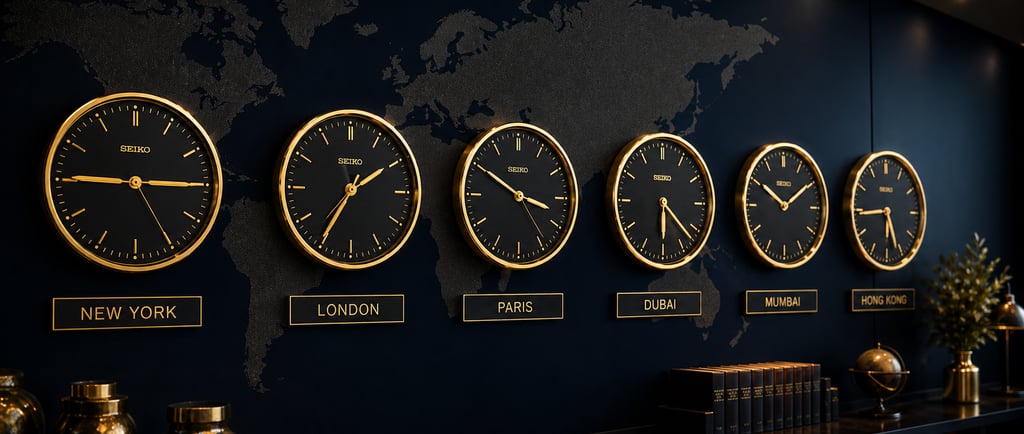
Whether it's sorting out a meeting across time zones or figuring out when to "spring forward," here's a look at the biggest time-related search trends happening right now — and what they tell us about how the world thinks about time today.
Trend 1 — "What time is it right now?" — Still the #1 Search
It sounds almost too simple, but searches for the current local time — and the current time in specific cities — remain among the most consistent queries on Google globally. In 2026, utility searches like "weather" and "time" anchor the top of global search rankings, with users returning to them multiple times a day across every device.
What's changed is the follow-up question. People don't just want to know the time — they want to know the time somewhere else. Searches like "what time is it in Tokyo right now", "current time in New York", and "time difference between London and Sydney" have exploded as remote work, international travel, and global streaming schedules make cross-timezone awareness a daily need.
Trend 2 — Daylight Saving Time: The Twice-a-Year Spike
Every year, like clockwork (pun intended), Daylight Saving Time triggers a massive surge in searches. In 2026, DST started in the United States on Sunday, March 8, when clocks jumped forward from 2 a.m. to 3 a.m. — and the next change, "falling back," happens on November 1, 2026.
But in 2026, DST isn't just a scheduling nuisance — it's a cultural conversation. A majority of Americans (54%, according to a recent Gallup poll) would prefer to end the twice-yearly change entirely. Searches around "is daylight saving time ending?" and "permanent daylight saving time" reflect genuine public frustration.
Trend 3 — Time Zone Confusion: More Relevant Than Ever
Remote work, international freelancing, and virtual events have made time zone awareness a daily skill. People are searching for simple converters, but also for nuanced questions like "do I lose an hour or gain one?" and "why is India only 30 minutes off from its neighbours?"
Countries have been quietly abolishing or reforming DST too. In 2026, places like Brazil, Russia, Turkey, and most of Asia skip the clock change entirely — meaning the time offset between countries can shift temporarily during DST windows, throwing off meeting schedules.
Trend 4 — UTC, GMT & "What Does Z Mean?" — The Nerdy Searches
With AI tools, global calendars, and apps now part of everyday life, a growing number of searches are surprisingly technical. People want to understand UTC vs GMT, what "Z" means at the end of a timestamp, and how to read ISO 8601 date formats.
These aren't just developer questions anymore — they pop up when someone tries to book a Zoom meeting from a calendar invite, reads a flight confirmation, or tries to figure out when a live-streamed event starts.
Trend 5 — Event-Driven Searches: The Olympics Effect
Major global events create huge spikes in time-related searches. In early 2026, the Winter Olympics drove enormous search volume around schedule conversions — "when does the race start in my time?" The same pattern plays out with the Super Bowl, FIFA World Cup, and international award shows.
With streaming available everywhere, audiences worldwide want to watch live — which means every broadcast time needs to be translated into local time, and search engines are the fastest calculator people reach for.
To Wrap Up: Time Is More Complex — and More Searched — Than Ever
In 2026, people aren't just asking "what time is it?" — they're asking it in the context of a world that never sleeps, spans hundreds of time zones, and argues passionately about whether we should stop moving our clocks twice a year.
From billions of daily utility searches, to the biannual DST confusion spike, to the quiet growth of UTC-literacy among everyday users — time is one of the most searched, most misunderstood, and most universally relevant topics on the internet.
Time is one of the most searched topics on the internet — every single day, billions of people turn to Google to ask something about clocks, zones, or calendars. But in 2026, the questions have become more specific, more global, and more urgent than ever before.
💡 Fun fact: Google processes over 16 billion searches per day globally. Time-related queries are among the most repeated — because unlike most facts, the answer changes every single minute.
🇺🇸 United States: Spring forward March 8 · Fall back November 1 (Hawaii and most of Arizona are exempt)
🇪🇺 Europe: Clocks went forward March 29 · Fall back October 25 — three weeks later than the US, temporarily shifting the time gap between the two regions.
Did you know? While many people associate daylight saving time with farming, the two are actually unrelated — it was the farmers who protested the original 1918 act.
🌐 Around 38 countries observe DST in 2026
⛔ Most of Asia and Africa skip it entirely
🇦🇺 Australia's seasons run opposite to the Northern Hemisphere
🕰 Before 1883, there were over 144 different local times in North America alone
💡 Quick answer: UTC (Coordinated Universal Time) is the global time standard. GMT (Greenwich Mean Time) is technically the same offset but is a time zone, not a standard. The "Z" in timestamps stands for "Zulu" — NATO/aviation shorthand for UTC+0.
Never Miss the Right Time, Anywhere
TimeNowOnline gives you instant access to current times, time zone converters, and world clocks — all in one place.
Time Now Online
Time Now Online delivers accurate, real-time local time for cities, countries, and time zones worldwide. Compare time zones, convert time instantly, and plan meetings with ease using our fast, free tools.
About Us
Legal
© 2026. All rights reserved.
Time data is based on standard global time zone databases and updates automatically.
Places & Seasons
time & meetings