
Which Countries Have the Most Time Zones in the World?
Discover which countries have the most time zones and how multiple time zones impact travel, business, and global communication.
TIME ZONES
Rachel
4/9/20263 min read
Time zones play a crucial role in how we organize our daily lives, especially in a world that is increasingly connected. While many countries operate within a single time zone, some nations span vast geographic areas and require multiple time zones to keep time aligned with the sun. But which countries have the most time zones, and why does it matter?
Countries With the Highest Number of Time Zones
When it comes to the number of time zones, one country stands above the rest:
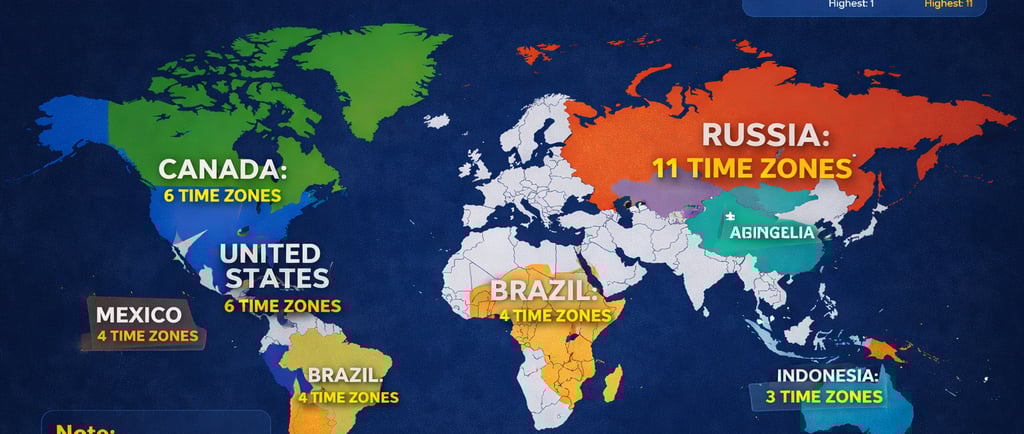
Russia holds the record with 11 time zones, stretching across Europe and Asia. Due to its enormous size, Russia covers a significant portion of the Earth’s longitudinal span, making multiple time zones necessary for daily life and administration.
Following Russia, several other large countries also use multiple time zones:
United States – 6 time zones (including Alaska and Hawaii)
Canada – 6 time zones
Brazil – 4 time zones
Mexico – 4 time zones
Australia – 3 main time zones
Indonesia – 3 time zones
These countries are spread across wide geographic regions, making it impractical to operate under a single time standard.
Why Do Large Countries Need Multiple Time Zones?
The Earth rotates 360 degrees every 24 hours, meaning every 15 degrees of longitude represents roughly one hour of time difference. When a country stretches across several of these longitudinal divisions, a single time zone would cause major disruptions.
For example, if a large country used only one time zone, people in the western regions might experience sunrise very late in the morning, while those in the east might see the sun rise too early. Multiple time zones help align daily schedules with natural daylight.
Countries That Choose Simplicity Over Accuracy
Interestingly, not all large countries use multiple time zones. Some choose to operate on a single standard time for simplicity.
For example:
China uses only one time zone despite spanning a wide area
India also follows a single time zone
While this simplifies scheduling and administration, it can lead to unusual daylight patterns in certain regions. In western China, for instance, the sun may not rise until late morning according to official time.
Time Zones and Global Communication
Understanding time zones is essential in today’s global environment. Businesses, remote teams, and individuals frequently communicate across borders, making time coordination more important than ever.
Countries with multiple time zones add an extra layer of complexity. For example, scheduling a meeting in the United States requires knowing whether the person is in New York, Los Angeles, or another region entirely.
This is why tools like world clocks and time converters are widely used. They help eliminate confusion and ensure that meetings, calls, and events happen at the correct time.
Impact on Travel and Daily Life
Multiple time zones can also affect travel. Crossing time zones often leads to jet lag, where the body struggles to adjust to a new schedule. This is especially noticeable in countries like Russia or the United States, where travelers may cross several time zones in a single trip.
For locals, multiple time zones can influence business operations, broadcasting schedules, and even national events. For example, live television broadcasts may air at different times depending on the region.
The Role of Technology
Today, technology has made managing time zones much easier. Smartphones, computers, and online tools automatically adjust time based on location. This reduces confusion and helps people stay organized when dealing with multiple time zones.
For websites like yours, tools such as:
provide real value to users and improve their experience.
Conclusion
Countries with multiple time zones are typically large nations that span vast geographic regions. Russia leads with 11 time zones, followed by countries like the United States, Canada, and Australia.
Understanding how time zones work is essential for communication, travel, and global coordination. As the world becomes more connected, knowing the time in different regions helps people stay efficient, avoid mistakes, and connect more easily across borders.
Time Now Online
Time Now Online delivers accurate, real-time local time for cities, countries, and time zones worldwide. Compare time zones, convert time instantly, and plan meetings with ease using our fast, free tools.
About Us
Legal
© 2026. All rights reserved.
Time data is based on standard global time zone databases and updates automatically.
Places & Seasons
time & meetings