
Why Some Countries Don’t Use Daylight Saving Time (2026 Guide)
Most countries don’t use Daylight Saving Time and keep a consistent time year-round. This guide explains why and how it affects global scheduling.
DAYLIGHT SAVING TIME
Rachel
4/6/20263 min read
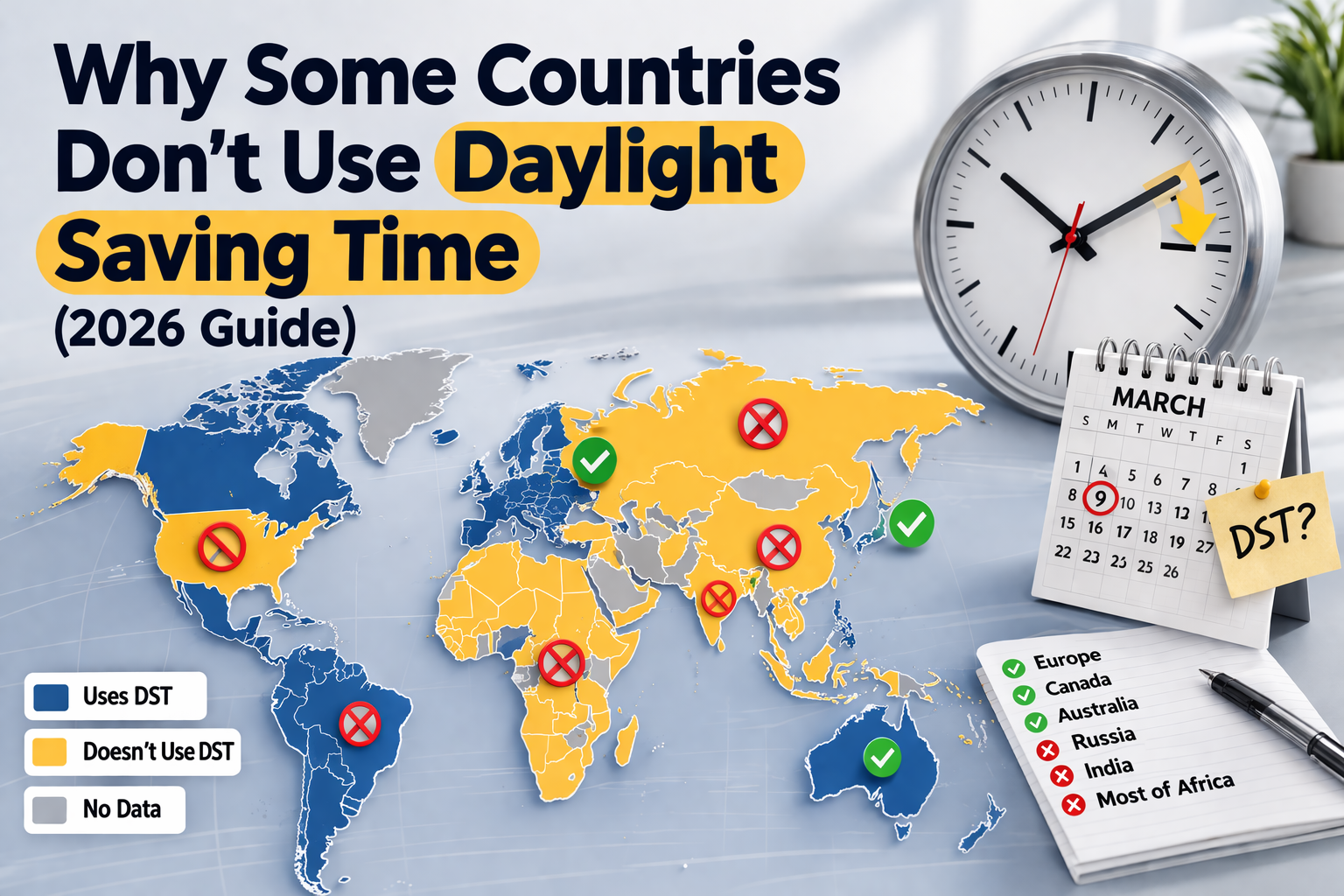
Every year, millions of people adjust their clocks forward or backward due to Daylight Saving Time (DST). In many countries, this change happens twice a year and is intended to make better use of daylight during warmer months.
However, not every country follows this system. In fact, most countries in the world do not use Daylight Saving Time at all. This often surprises people who assume the clock change is a global practice.
In this guide, we’ll explain why some countries avoid Daylight Saving Time and how it affects global time coordination.
What Is Daylight Saving Time?
Daylight Saving Time is a system where clocks are moved forward by one hour during the spring and moved back again during autumn or fall.
The main idea behind DST is to:
Extend daylight hours in the evening
Reduce energy consumption
Encourage outdoor activity during longer days
For example, if the sun normally sets at 6:00 PM, moving clocks forward one hour means the sunset will appear closer to 7:00 PM.
Many countries in North America and Europe use this system each year.
Why Many Countries Do Not Use DST
Despite its popularity in some regions, many countries have chosen not to adopt Daylight Saving Time.
There are several reasons for this.
1. Countries Near the Equator Have Consistent Daylight
Nations located close to the equator experience very little variation in daylight hours throughout the year.
Because sunrise and sunset times stay relatively stable, changing the clock provides little benefit.
Examples of countries near the equator that do not use DST include:
For these countries, daylight remains fairly consistent all year.
2. The Benefits of DST Are Debated
While DST was originally introduced to save energy, modern research suggests the energy savings may be very small or even nonexistent.
Some studies have found that:
Electricity usage may not decrease significantly
People may use more heating or cooling instead
Productivity may temporarily decrease after clock changes
Because of this, some countries have decided the disruption is not worth the potential benefits.
3. Public Health and Sleep Concerns
Changing the clock can affect people’s sleep schedules.
Studies have linked daylight saving time changes with:
Temporary sleep disruption
Increased fatigue
Higher accident rates immediately after clock changes
These concerns have led some governments to reconsider whether DST is necessary.
4. Simplicity and Consistency
Countries that do not use DST enjoy a simpler timekeeping system.
Without clock changes, their local time remains consistent throughout the year. This makes scheduling and international communication easier.
Businesses and travelers also benefit from predictable time differences.
Countries That Do Use Daylight Saving Time
Although many countries avoid DST, several major regions still follow it.
These include:
However, even within these countries, some regions choose not to participate.
For example:
Hawaii does not observe DST
Arizona does not change clocks (except the Navajo Nation)
How DST Affects International Time Differences
Daylight Saving Time can create temporary changes in global time differences.
For example:
When the United States changes clocks but Europe has not yet changed, the usual time difference between the two regions may shift for a short period.
This can sometimes create confusion when scheduling international meetings or flights.
Because of this, many organizations use UTC time as a consistent global reference.
Will Daylight Saving Time End?
In recent years, several governments have debated whether to eliminate Daylight Saving Time completely.
Some regions are considering:
Staying on permanent standard time
Keeping daylight saving time all year
Removing clock changes entirely
However, changes to national time systems can take time because they affect transportation, business schedules, and international coordination.
Final Thoughts
Although Daylight Saving Time remains common in parts of the world, many countries have chosen not to adopt it. Factors such as geography, energy efficiency, public health concerns, and scheduling simplicity all influence these decisions.
As global communication becomes more connected, understanding which countries follow DST — and which do not — can help avoid confusion when coordinating time across different regions.
For accurate global time information, many people rely on world clock tools that automatically adjust for time zones and daylight saving changes.
Time Now Online
Time Now Online delivers accurate, real-time local time for cities, countries, and time zones worldwide. Compare time zones, convert time instantly, and plan meetings with ease using our fast, free tools.
About Us
Legal
© 2026. All rights reserved.
Time data is based on standard global time zone databases and updates automatically.
Places & Seasons
time & meetings