
Why Do Some Countries Have 30-Minute and 45-Minute Time Zones?
Discover why some countries use 30-minute and 45-minute time zones instead of whole hours. Learn which countries do it and the history behind these unique time zones.
TIME ZONES
Rachel
7/26/20264 min read

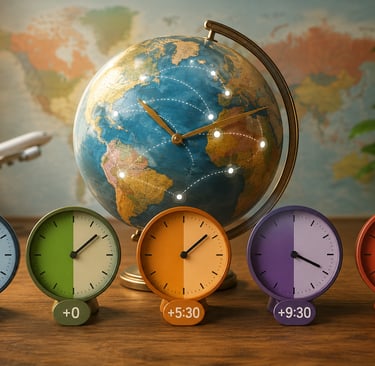
Most countries follow time zones that differ by whole hours from Coordinated Universal Time (UTC). For example, Japan uses UTC+9, Germany uses UTC+1, and New York uses UTC−5 during standard time.
However, not every country follows this pattern.
Several countries use 30-minute or even 45-minute offsets, making them stand out from the rest of the world. While these unusual time zones may seem confusing at first, each has a fascinating historical, geographical, or political reason behind it.
In this guide, we'll explore why these unique time zones exist, which countries use them, and how they help local communities.
Why Aren't All Time Zones Whole Hours?
Time zones were originally based on the position of the Sun. Every 15 degrees of longitude equals roughly one hour of solar time.
As countries developed railways, telegraphs, aviation, and international trade, standardised time zones became essential. While many nations adopted whole-hour offsets for simplicity, others chose offsets that better matched their geographical location, cultural identity, or neighbouring countries.
The result is a world where not every clock changes by exactly one hour.
Countries That Use 30-Minute Time Zones
🇮🇳 India (UTC+5:30)
India follows Indian Standard Time (IST), which is UTC+5:30.
Rather than splitting the country into multiple time zones, India chose a single national time based on the city of Mirzapur, located near the country's centre.
This provides a practical balance between sunrise and sunset across the nation.
🇮🇷 Iran (UTC+3:30)
Iran uses UTC+3:30 as its standard time.
The offset better reflects the country's geographic position compared to a whole-hour time zone.
🇦🇫 Afghanistan (UTC+4:30)
Afghanistan's UTC+4:30 offset sits almost perfectly between neighbouring countries, helping align daylight hours more naturally with daily life.
🇲🇲 Myanmar (UTC+6:30)
Myanmar uses UTC+6:30 rather than UTC+6 or UTC+7.
The country has maintained this offset for decades as part of its national timekeeping system.
🇱🇰 Sri Lanka (UTC+5:30)
Sri Lanka currently shares the same time as India.
The country has changed its official time several times throughout history before settling on UTC+5:30.
🇦🇺 Australia (Some Regions)
Australia has multiple time zones, and one of them is unusual.
Australian Eastern Standard Time (AEST): UTC+10
Australian Central Standard Time (ACST): UTC+9:30
Australian Western Standard Time (AWST): UTC+8
South Australia and the Northern Territory both use UTC+9:30.
Countries That Use 45-Minute Time Zones
🇳🇵 Nepal (UTC+5:45)
Nepal has one of the world's most unique time zones.
Rather than following India (UTC+5:30), Nepal chose UTC+5:45 to establish its own national identity and better reflect its local solar time.
It remains the only country using this exact offset.
🇦🇺 Australia (Eucla – UTC+8:45)
The small town of Eucla in Western Australia unofficially follows UTC+8:45.
Although not an officially recognised Australian time zone nationwide, it is widely used by local residents and businesses.
🇳🇿 New Zealand (Chatham Islands – UTC+12:45)
The Chatham Islands, located east of mainland New Zealand, operate on UTC+12:45.
During daylight saving, the islands move to UTC+13:45, making them one of the earliest inhabited places to welcome a new day.
Why Do Countries Choose Unusual Time Zones?
There isn't a single reason.
Governments consider several factors before choosing an official time.
Geography
Countries located between standard meridians may prefer a half-hour offset because it better matches the position of the Sun.
National Identity
Some countries intentionally use a unique time zone to distinguish themselves from neighbouring nations.
Nepal is one of the best-known examples.


Practical Daily Life
The goal is to make sunrise, sunset, school hours, and working hours align more naturally with local daylight.
Historical Decisions
Many unusual time zones were introduced decades ago and have simply remained because changing them would create unnecessary disruption.
Are 30-Minute and 45-Minute Time Zones Common?
No.
Most countries use whole-hour UTC offsets.
Only a small number of countries and territories use:
UTC+3:30
UTC+4:30
UTC+5:30
UTC+5:45
UTC+6:30
UTC+8:45
UTC+9:30
UTC+12:45
These unusual offsets are part of what makes global timekeeping so interesting.
Why Do These Time Zones Matter?
Understanding these offsets helps when:
Scheduling international meetings
Booking flights
Planning video calls
Developing global software
Trading across international markets
Travelling between countries
Assuming every country changes by whole hours can easily result in scheduling mistakes.
Frequently Asked Questions
Which country uses a 45-minute time zone?
Nepal uses UTC+5:45, making it the best-known country with a 45-minute offset.
Why does Nepal use UTC+5:45?
Nepal adopted the offset to better reflect its geographical location and maintain a distinct national time separate from neighbouring India.
Which Australian states use a 30-minute time zone?
South Australia and the Northern Territory use Australian Central Standard Time (UTC+9:30).
Does any country use a 15-minute time zone?
No sovereign country uses a 15-minute offset. However, some regions use 45-minute offsets, such as Nepal and the Chatham Islands.
How many countries use 30-minute time zones?
Several countries do, including India, Iran, Afghanistan, Myanmar, Sri Lanka, and parts of Australia.
Final Thoughts
Although most of the world follows whole-hour time zones, several countries have chosen 30-minute and 45-minute offsets that better suit their geography, history, or national identity.
These unique time zones remind us that global timekeeping isn't always as simple as adding or subtracting an hour. Whether you're planning an international meeting, travelling overseas, or simply curious about how the world keeps time, understanding these unusual offsets can help you avoid confusion and appreciate the fascinating history behind them.
Time Now Online
Time Now Online delivers accurate, real-time local time for cities, countries, and time zones worldwide. Compare time zones, convert time instantly, and plan meetings with ease using our fast, free tools.
About Us
Legal
© 2026. All rights reserved.
Time data is based on standard global time zone databases and updates automatically.
Places & Seasons
time & meetings