red and white flag on pole during daytime

Chile Time Now

Stay updated with the current time in Chile and plan your meetings, travel, and international calls with confidence. Chile runs on Chile Standard Time (CLT, UTC-4) during winter and switches to Chile Summer Time (CLST, UTC-3) during daylight saving — making it one of the few South American countries that still observes seasonal clock changes.

About Chile

Chile, officially the Republic of Chile (República de Chile), is one of the most geographically remarkable countries in the world. Often described as a long, narrow ribbon of land between the Andes Mountains and the Pacific Ocean, Chile stretches over 4,300 kilometres from north to south but averages just 177 kilometres wide — making it the longest country in the world (north-to-south). The country covers approximately 756,000 square kilometres with a population of around 19.5 million people. Chile shares borders with Peru to the north, Bolivia to the northeast, and Argentina to the east along the Andes, plus a long Pacific coastline to the west. Chilean territory also includes Easter Island (Rapa Nui) in Polynesia, the Juan Fernández Islands, and a claim to the Chilean Antarctic Territory.

The capital is Santiago de Chile, located in the country's Central Valley between the Andes and the coastal mountain ranges. With a metropolitan population of around 7 million people, Santiago is Chile's economic, cultural, and political heart — a modern, cosmopolitan city often described as the "economic powerhouse of South America". The city is famous for its dramatic backdrop of snow-capped Andean peaks (visible from much of the city in winter), the historic Plaza de Armas, the bohemian Bellavista district at the foot of Cerro San Cristóbal, the elegant Lastarria neighbourhood, and the modern Sanhattan financial district. Santiago is also the headquarters of major multinational companies and one of the most important business hubs in Latin America.

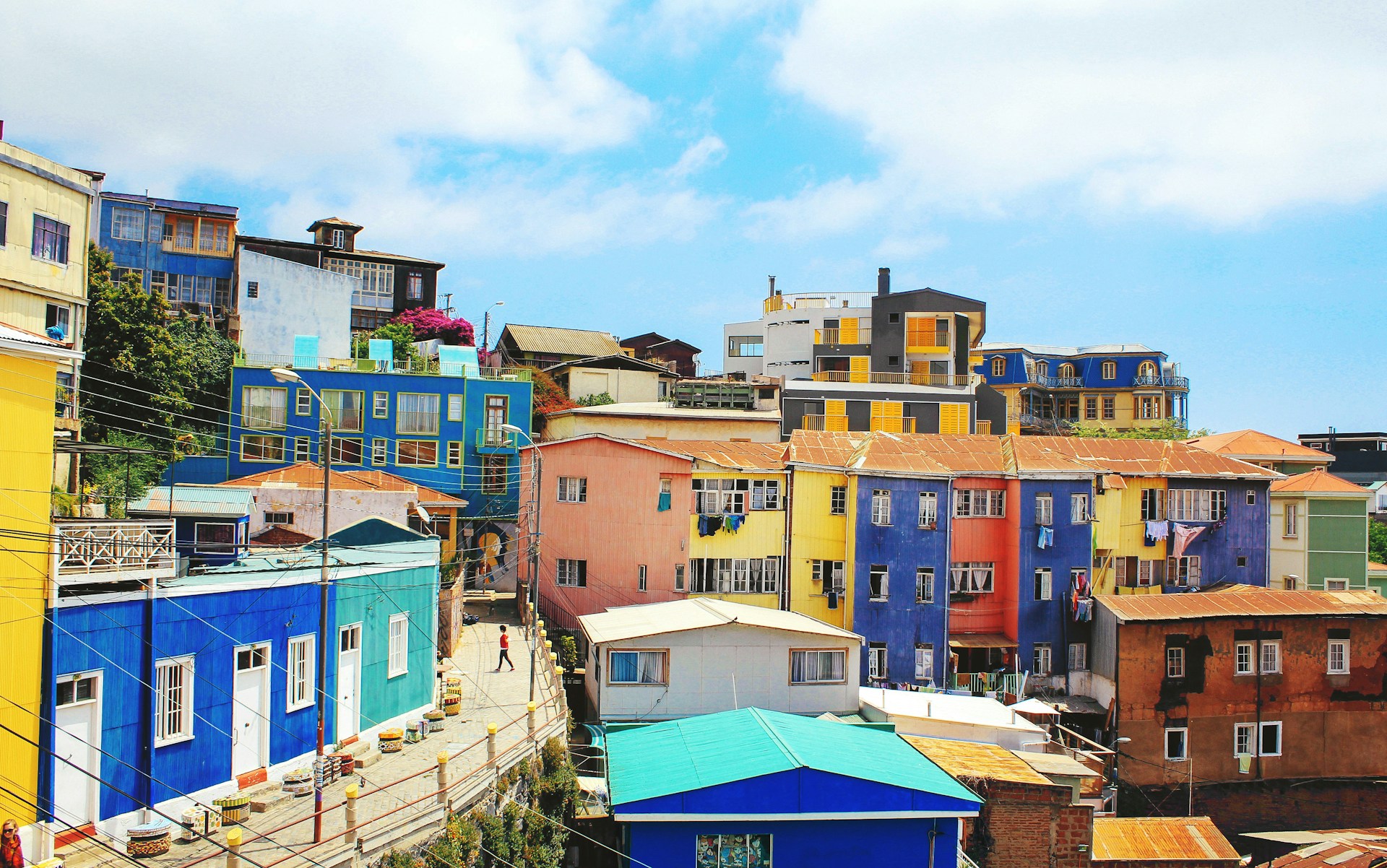
Valparaíso, on the Pacific coast just 90 minutes from Santiago, is Chile's main port and one of the most picturesque cities in South America. UNESCO-listed Valparaíso is famous for its colourful houses cascading down 42 hills, its historic funicular elevators (ascensores), vibrant street art scene, bohemian culture, and association with the celebrated Chilean poet Pablo Neruda (whose home La Sebastiana is now a museum). Adjacent Viña del Mar is Chile's most popular beach resort city.

Other notable Chilean cities include Concepción (the country's third-largest metro area, in the south-central region), La Serena (a historic colonial city in the north), Puerto Montt (the gateway to Patagonia and the Lakes Region), Punta Arenas (the southern Patagonian city on the Strait of Magellan), Iquique and Antofagasta (major mining cities in the north), and Valdivia (a beautiful southern city with strong German heritage).

Chile's geography is one of the most spectacular on Earth. The north contains the Atacama Desert, the driest non-polar desert in the world — some weather stations have never recorded rainfall in their entire history. The Atacama is also one of the world's premier astronomy destinations, home to the ALMA and Paranal observatories. Central Chile has a Mediterranean climate similar to California, ideal for the country's world-famous wine production. Southern Chile transitions into the temperate Lakes Region (with snow-capped volcanoes, deep lakes, and lush forests), then into the dramatic Patagonian wilderness — including Torres del Paine National Park (one of the world's most famous trekking destinations), countless glaciers, fjords, and the windswept landscapes of Tierra del Fuego.

The country is famously prone to earthquakes due to its location along the Pacific Ring of Fire — Chile experienced the largest earthquake ever recorded (the 1960 Valdivia earthquake at 9.5 magnitude). It's also home to many active volcanoes, including the iconic Villarrica, Osorno, and Chaitén.

Culturally, Chile is one of the most distinctive nations in Latin America. The official language is Spanish, though Chilean Spanish (often called español chileno) is famously distinctive — known for fast speech, unique slang, and the use of vos in informal contexts. Indigenous languages, primarily Mapudungun (the Mapuche language) and Aymara, are also recognised. Chile has produced two Nobel Prize-winning poetsPablo Neruda (Literature, 1971) and Gabriela Mistral (Literature, 1945, the first Latin American woman to win a Nobel) — as well as celebrated novelists like Isabel Allende and filmmakers like Pablo Larraín.

Chilean cuisine reflects the country's geography, featuring abundant seafood (salmon, sea bass, king crab, sea urchin, mussels), traditional dishes like empanadas, pastel de choclo (corn pie), cazuela, asado, completos (Chilean hot dogs), and curanto, plus the famous Chilean wine. Chile is one of the world's top wine producers, with the Maipo, Colchagua, Casablanca, and Aconcagua valleys producing internationally celebrated Cabernet Sauvignon, Carménère, Sauvignon Blanc, and Chardonnay.

Economically, Chile has the most stable and prosperous economy in Latin America, often described as a model for development in the region. The country is the world's largest copper producer (the metal accounts for around 50% of Chilean exports), as well as a major exporter of lithium, fruit, salmon, and wine. Chile is a member of the OECD (the only South American country alongside Colombia in the OECD), the Pacific Alliance, and has free trade agreements with most major economies. The currency is the Chilean Peso (CLP / $).

For travellers and business professionals, Chile's seasonal time-zone shifts are worth noting — the country switches DST in early September (when Northern Hemisphere countries are still observing summer time) and falls back in early April (when Northern Hemisphere countries are starting their summer time). This creates brief periods where Chile's time relationship with Europe and North America can shift by 1 to 2 hours.

Chile's Quick Facts Table

landscape photography of blue and yellow houses

Understanding Chile Time (CLT / CLST)

Chile operates on Chile Standard Time (CLT), set at UTC-4 during the southern hemisphere winter (roughly April to September). From early September to early April, the country switches to Chile Summer Time (CLST) at UTC-3, putting it on the same time as Argentina, Brazil, and Uruguay during summer. Chile is one of only two South American countries (along with Paraguay) that still observes daylight saving time — most other countries in the region (Brazil, Argentina, Uruguay) abolished DST years ago.

The country uses two main time zones:

  • Continental Chile (CLT/CLST) — UTC-4 / UTC-3 (DST) — covers the mainland from Arica in the north to the central Patagonia region, including Santiago, Valparaíso, Concepción, and Puerto Montt.

  • Magallanes Region (UTC-3 year-round) — The far-southern Magallanes region, including Punta Arenas and Puerto Williams, stays on UTC-3 permanently with no daylight saving.

  • Easter Island (EAST/EASST) — UTC-6 / UTC-5 (DST) — Chile's remote Pacific territory observes its own time zone, 2 hours behind continental Chile.

Does Chile observe Daylight Saving Time? Yes. Continental Chile shifts forward to UTC-3 on the first Saturday after the first Sunday of September (around 9 September) and falls back to UTC-4 on the first Saturday after the first Sunday of April (around 7 April). The Magallanes region opted out of DST in 2017, choosing to stay on UTC-3 year-round.

Chile Time vs Major World Cities

Continental Chile sits at UTC-4 in winter and UTC-3 in summer, placing it 3-4 hours behind the UK, 1-2 hours ahead of New York (during US DST), and ahead of most US time zones during southern hemisphere summer.

Note: Chile's daylight saving time runs from September to April (opposite of the Northern Hemisphere), so the gap to other countries can shift by 1-2 hours when DST changes happen.

Best Time to Call Chile

From the United Kingdom

The UK is 3 to 5 hours ahead of Chile depending on both Chilean and UK daylight saving. Most of the year, the gap is 4 hours.

  • During UK summer & Chilean winter (May–August): Chile is 5 hours behind. Call between 1:00 PM and 9:00 PM UK time to land at 8:00 AM – 4:00 PM in Santiago.

  • During UK winter & Chilean summer (October–March): Chile is 3 hours behind. Call between 11:00 AM and 7:00 PM UK time to hit 8:00 AM – 4:00 PM in Santiago.

From the United States

The US is mostly behind or aligned with Chile:

  • East Coast (New York): Call between 8:00 AM and 4:00 PM ET, which is 9:00 AM – 5:00 PM in Santiago. Near-perfect business overlap.

  • West Coast (Los Angeles): Call between 5:00 AM and 1:00 PM PT, hitting 9:00 AM – 5:00 PM in Santiago.

From Australia

Australia is 14 to 16 hours ahead of Chile depending on DST in both countries. Call between 9:00 PM and 12:00 AM AEST, which is 7:00 AM – 10:00 AM in Santiago.

From Continental Europe

Most of Europe (France, Germany, Italy, Spain) is 4 to 6 hours ahead of Chile. Call between 1:00 PM and 9:00 PM CET/CEST, which is 8:00 AM – 4:00 PM in Santiago.

From Singapore

Singapore is 11 to 12 hours ahead of Chile. Call between 8:00 PM and 11:00 PM SGT, which is 9:00 AM – 12:00 PM in Santiago — morning hours in Chile.

From Dubai

Dubai is 7 to 8 hours ahead of Chile. Call between 4:00 PM and 12:00 AM Dubai time, which is 9:00 AM – 5:00 PM in Santiago.

herd of horses on bushes and grasses across mountain

Famous Cities and Regions in Chile

  • Santiago — The cosmopolitan capital and economic heart of Chile; nestled between the Andes and coastal mountains.

  • Valparaíso — UNESCO-listed port city famous for its colourful hillside houses, funicular lifts, and bohemian culture.

  • Viña del Mar — Chile's most popular beach resort city, just north of Valparaíso.

  • Atacama Desert — The driest non-polar desert on Earth and a world-class destination for stargazing and surreal landscapes.

  • San Pedro de Atacama — A small adobe town in the heart of the Atacama, gateway to lagoons, geysers, and salt flats.

  • Easter Island (Rapa Nui) — Remote Polynesian island famous for its mysterious moai statues; UNESCO World Heritage Site.

  • Patagonia and Torres del Paine — One of the world's most spectacular national parks, with iconic granite peaks.

  • Punta Arenas — Southernmost major city in Chile, on the Strait of Magellan; gateway to Antarctica.

  • The Lakes Region (Puerto Varas, Pucón) — Stunning volcanic lakes, snow-capped peaks, and German colonial heritage.

  • Concepción — Major southern city; cultural heart of Chilean rock music and historic in the country's politics.

  • The Wine Valleys (Maipo, Colchagua, Casablanca) — World-famous wine regions producing celebrated Carménère and other varietals.

  • Chiloé Island — Mystical southern island famous for wooden churches (UNESCO), folklore, and unique architecture.

Stock Exchange and Business Hours in Chile

Chile's main financial exchange is the Santiago Stock Exchange (BCS — Bolsa de Comercio de Santiago), founded in 1893 and based in Santiago's financial district. The BCS is one of the largest and most stable stock exchanges in Latin America and operates on Chilean time (CLT/CLST). Standard business hours across Chile are typically 9:00 AM to 6:00 PM, Monday to Friday, often with a one- to two-hour lunch break. Chilean business culture is more punctual and structured than in some other Latin American countries — meetings tend to start on time, and formal communication is the norm.

Note: Chile's DST is opposite the Northern Hemisphere — Chile shifts forward in September and back in April. NYSE/LSE hours shift with their own DST schedules.

assorted-color concrete buildings under white skies

What Chile is Famous For

  • Wine — World-famous Carménère, Cabernet Sauvignon, and Sauvignon Blanc from valleys like Maipo, Colchagua, and Casablanca

  • The Atacama Desert — The driest non-polar desert on Earth and a global astronomy hub

  • Easter Island (Rapa Nui) — Mysterious moai statues and Polynesian heritage

  • Patagonia and Torres del Paine — Some of the world's most spectacular wilderness

  • Pablo Neruda — Nobel Prize-winning poet and Chilean cultural icon

  • Copper mining — Chile is the world's largest producer of copper, supplying around 28% of global output

  • Salmon and seafood — Chile is the world's second-largest salmon producer

  • The Chilean economy — Often called the most stable and prosperous in Latin America

  • Football and Alexis Sánchez — A passionate football culture and 2-time Copa América champions (2015, 2016)

  • Volcanoes and earthquakes — Home to the largest earthquake ever recorded (Valdivia, 1960, 9.5 magnitude)

  • Chilean cuisine and pisco — Empanadas, completos, curanto, and the iconic pisco sour cocktail

  • Skiing in the Andes — World-class resorts like Portillo and Valle Nevado, just hours from Santiago

Weather and Seasons in Chile

Chile's incredible north-to-south length means it spans almost every climate zone on Earth — from extreme desert in the north to subantarctic in the south, with Mediterranean and oceanic zones in between. As a Southern Hemisphere country, Chile's seasons are the opposite of the Northern Hemisphere.

Summer (December – February)

Chilean summer is the peak local holiday season. Santiago and central Chile see hot, dry weather of 18–32°C with virtually no rainfall — perfect conditions for visiting wine country and the Andes. The Atacama Desert remains hot during the day (25–30°C) but cool at night. Patagonia experiences its mildest weather, with daytime temperatures of 15–25°C — peak season for trekking in Torres del Paine. Easter Island enjoys warm tropical weather (25–30°C). This is also when Chileans flock to coastal resorts like Viña del Mar.

Autumn (March – May)

Autumn brings spectacular colour to Chile's wine valleys and the Lakes Region. Santiago cools gradually from 25°C in March to around 15°C by May. The wine harvest (vendimia) happens in March and April, with festivals across the wine country. Patagonia begins to cool, with brilliant autumn colours in the lenga forests. This is one of the best times to visit central Chile.

Winter (June – August)

Chilean winters vary dramatically by region:

  • Santiago and central Chile: Cool, damp, often grey (5–15°C) with occasional rain. The Andes get heavy snow, making this peak ski season at Portillo, Valle Nevado, and other Andean resorts.

  • Atacama Desert: Mild and very dry (15–22°C during the day, near-freezing at night) — actually one of the best times to visit.

  • Patagonia: Cold, snowy, and often windy. Many tourist services close for winter.

  • The North Coast (Iquique, Antofagasta): Mild and sunny year-round (15–22°C).

Spring (September – November)

Spring is one of the most beautiful times to visit Chile. Santiago warms up gradually (15–25°C), the Atacama wildflowers bloom briefly after winter rains (the famous desierto florido phenomenon), and Patagonia awakens with longer days and milder weather. Spring is excellent for wine country tours, Santiago city breaks, and early-season Patagonia trips.

Facts About Chile

  1. Chile is one of the few South American countries that still observes DST. While Brazil, Argentina, Uruguay, and most of the continent abolished daylight saving years ago, Chile (along with Paraguay) still shifts clocks twice a year.

  2. The Magallanes Region opted out of DST in 2017. This far-southern Chilean region — including Punta Arenas — stays on UTC-3 year-round, while the rest of mainland Chile shifts seasonally.

  3. Easter Island has its own time zone. Chile's remote Pacific territory (Rapa Nui) operates at UTC-6 (UTC-5 during DST) — 2 hours behind continental Chile.

  4. Chile shifts DST opposite the Northern Hemisphere. Chile shifts forward in early September and back in early April — opposite to the US, UK, and Europe — so the time gap to those countries changes 4 times a year (twice when each hemisphere shifts).

  5. Same time as Argentina in summer. During Chilean summer (September–April), Santiago and Buenos Aires share UTC-3. During Chilean winter, Argentina is 1 hour ahead of Chile.

  6. Chile is one of the longest countries in the world (4,300+ km north-to-south) but uses only 2 main time zones on its mainland (continental Chile and Magallanes) plus Easter Island far out in the Pacific.

a large yellow building with a clock tower

Frequently asked questions About Argentina

What time zone is Chile in?

Chile is in Chile Standard Time (CLT) at UTC-4 during the southern hemisphere winter and Chile Summer Time (CLST) at UTC-3 during summer (September to April). The country has 3 time zones in total: continental Chile (CLT/CLST), the Magallanes Region in the south (UTC-3 year-round), and Easter Island (UTC-6 / UTC-5 with DST). Chile is one of the few South American countries that still observes daylight saving time.

Is Chile on the same time as Brazil?

It depends on the season and which part of Brazil. During Chilean summer, Santiago is on the same time as São Paulo and Rio de Janeiro (both UTC-3). During Chilean winter, Brazil's main time zone (BRT) is 1 hour ahead of Chile. Western Brazil (the Amazon and Acre states) is on UTC-4 or UTC-5 — closer to or matching Chilean Standard Time.

Does Chile observe daylight saving time?

Yes, continental Chile observes daylight saving time. Clocks shift forward to UTC-3 on the first Saturday after the first Sunday of September (around 9 September) and fall back to UTC-4 on the first Saturday after the first Sunday of April (around 7 April). The Magallanes Region in southern Chile opted out of DST in 2017 and stays on UTC-3 year-round.

What does CLT stand for?

CLT stands for Chile Standard Time (also written as CLST during daylight saving — Chile Summer Time). The abbreviation is widely used internationally. Chile uses CLT during the southern hemisphere winter (UTC-4) and CLST during summer (UTC-3). For Easter Island, the abbreviation is EAST (Easter Island Standard Time) and EASST (Easter Island Summer Time).

How many time zones does Chile have?

Chile has 3 time zones: Continental Chile (UTC-4 / UTC-3) covering Santiago, Valparaíso, and most of the country; Magallanes Region (UTC-3 year-round) in the far south, including Punta Arenas; and Easter Island (UTC-6 / UTC-5), the country's remote Pacific territory. This makes Chile one of the more complex South American countries in terms of time zone management.

What is the best time to call Chile from the UK?

The most practical window for calling Chile from the UK is between 1:00 PM and 9:00 PM UK time (during UK summer when Chile is 5 hours behind), which lands at 8:00 AM to 4:00 PM in Santiago. During UK winter and Chilean summer (when Chile is just 3 hours behind), the window shifts to 11:00 AM – 7:00 PM UK time. The 3-5 hour gap makes UK-Chile calls reasonably workable during normal business hours.

What is the time difference between Chile and the UK?

Continental Chile is 3 to 5 hours behind the UK depending on the season. During UK summer (BST) and Chilean winter (April-September), Chile is 5 hours behind London. During UK winter (GMT) and Chilean summer (September-March), Chile is 3 hours behind London. The gap shifts by 2 hours twice a year because Chile and the UK have opposite DST seasons.

What is the time difference between Chile and the United States?

Santiago is 0 to 2 hours ahead of New York and 3 to 5 hours ahead of Los Angeles, depending on DST in both countries. During US summer DST (March-November) and Chilean winter (April-September), Chile is 1 hour ahead of New York. During Chilean summer DST (September-April), Chile is 2 hours ahead of New York. The US-Chile time gap shifts up to 4 times per year due to the opposite hemisphere DST schedules.

What is the best time to call Chile from the United States?

It's one of the easiest international scheduling relationships in the Americas. From the US East Coast, 8:00 AM to 4:00 PM ET lands at 9:00 AM to 5:00 PM in Santiago — almost a perfect business overlap. From the West Coast, calling between 5:00 AM and 1:00 PM PT works well. The 0-2 hour gap between Chile and the US East Coast makes these markets especially well-aligned for business communication.

What is the best time to call Chile from Australia?

The best window for calling Chile from Sydney is between 9:00 PM and 12:00 AM AEST, which corresponds to 7:00 AM to 10:00 AM in Santiago — early morning Chilean business hours. Because Australia and Chile are about 14-16 hours apart, the overlap windows are tight. Australian late-evening calls catch the very start of the Chilean workday.

What is the time difference between Chile and Australia?

Sydney is typically 14 to 16 hours ahead of Santiago depending on DST in both countries. During Australian summer (October-April) and Chilean summer (September-April), Sydney is 14 hours ahead. The gap can stretch to 16 hours during Australian summer when Chile is on standard time. Most Australia-Chile calls happen during Australian late evening or very early morning, which catches Chilean morning to early afternoon.

What time does Chile's stock market open and close?

The Santiago Stock Exchange (BCS — Bolsa de Comercio de Santiago) opens at 9:30 AM CLT/CLST and closes at 4:00 PM, Monday through Friday. The exchange runs continuously without a midday break and follows Chilean public holidays — including Independence Day (18 September, the country's biggest national celebration), Labour Day (1 May), and the Christmas/New Year period. The BCS is one of the largest and most stable stock exchanges in Latin America.

Is Santiago time the same as Buenos Aires time?

It depends on the season. During Chilean summer (September-April), Santiago and Buenos Aires are on the same time — both UTC-3. During Chilean winter (April-September), Argentina (UTC-3 year-round) is 1 hour ahead of Chile (UTC-4). Since Argentina abolished DST in 2009 but Chile still observes it, this seasonal shift now happens every year.

What is Chile's international calling code?

Chile's international dialling code is +56, which must be dialled before any Chilean phone number when calling from overseas. Chilean mobile numbers are 9 digits long after the country code, beginning with 9 (for example, +56 9 XXXX XXXX). For landlines, you dial +56 followed by the area code — Santiago's area code is 2, Valparaíso's is 32, Concepción's is 41, and Punta Arenas's is 61.

body of water near mountain coated by snow