
What Is Daylight Saving Time and Why Does It Still Exist in 2026?
What is daylight saving time, why do we still have it in 2026, and how does it affect international scheduling? A simple, clear explanation."
DAYLIGHT SAVING TIME
Rachel
4/16/20264 min read
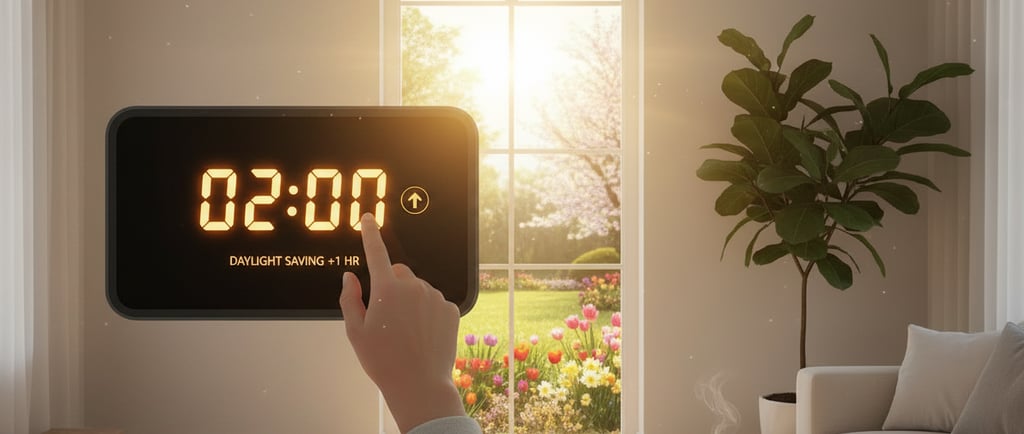
Twice a year, millions of people around the world do something that feels increasingly bizarre in the modern age — they manually change every clock in their home by one hour. Phones and laptops update automatically now, but the microwave, the car dashboard, and the oven? Those are still on you.
Daylight saving time, or DST, is one of those things almost everyone has an opinion about and very few people fully understand. Where did it come from? Why do some countries do it and others don't? And why, in 2026, are we still doing it at all?
Here's a straightforward breakdown.
What Is Daylight Saving Time?
Daylight saving time is the practice of moving the clocks forward by one hour during the warmer months of the year. The idea is to shift an hour of daylight from the early morning — when most people are still asleep — to the evening, when people are more likely to be outside and active.
When clocks go forward in spring, evenings get lighter for longer. When they go back in autumn, mornings get lighter earlier and evenings get darker sooner. The popular saying to remember which way the clocks move is "spring forward, fall back."
Where Did It Come From?
The idea is often credited to Benjamin Franklin, who jokingly suggested in 1784 that Parisians could save candles by waking up earlier to use natural morning light. It wasn't meant seriously.
The first country to actually implement daylight saving time was Germany, in 1916, during World War One. The goal was to reduce coal consumption by making better use of natural daylight. Other countries quickly followed, and the practice spread widely throughout the 20th century.
In the decades since, the original energy-saving justification has been repeatedly questioned. Modern research suggests the actual energy savings are minimal — and in some cases, air conditioning use in lighter evenings actually increases energy consumption rather than reducing it.
Does Every Country Observe Daylight Saving Time?
No — and this is where it gets confusing for remote workers and global travellers.
Only around 70 countries currently observe daylight saving time, mostly in Europe, North America, and parts of South America and the Pacific. Large parts of the world do not change their clocks at all, including most of Africa, Asia, and the Middle East.
China, India, Japan, and most countries in Southeast Asia have no daylight saving time. Russia abolished it in 2014. Several US states, including Arizona, don't observe it either.
To make things even more complicated, the dates on which clocks change vary by country. The US and Canada typically change in March and November. Most of Europe changes in late March and late October. Australia, being in the southern hemisphere, does the opposite — clocks go forward in October and back in April.
This means there are certain weeks every year where the time difference between, say, Sydney and London shifts by an hour in one direction or the other, catching people off guard when scheduling international calls.
Why Does It Cause So Much Confusion?
For anyone working or communicating across borders, daylight saving time is a genuine source of scheduling errors. Because different countries change their clocks on different dates, the time difference between two locations can shift temporarily — sometimes for a period of two to three weeks — before settling back to its usual offset.
For example, if you regularly schedule a weekly call between someone in New York and someone in London, there are specific weeks in March and November where the usual five-hour difference becomes four hours or six hours, depending on who has already changed their clocks and who hasn't yet.
If you're not aware of this, you'll show up to that call at the wrong time. It happens more often than you'd think.
The easiest way to avoid this is to use a time zone tool that automatically accounts for daylight saving adjustments rather than relying on fixed time differences you've memorised. Time Now Online's Time Zone Converter does exactly this — it factors in each location's current DST status so the time you see is always accurate, regardless of what time of year it is.
Will Daylight Saving Time Ever Be Abolished?
Possibly. The debate has been ongoing for years, and several regions have moved closer to scrapping it entirely. The European Union voted in 2019 to end the practice, though individual member states have been slow to finalise the change. In the US, the Sunshine Protection Act — which would make daylight saving time permanent — has been proposed multiple times in Congress but hasn't passed into law as of 2026.
For now, most countries that observe DST are still doing it, and the twice-yearly clock change remains a fixture of life for a large portion of the world's population.
The Bottom Line
Daylight saving time was introduced over a century ago to solve a problem that no longer exists in the same form. Whether it stays or goes, understanding how it works — and how it affects time differences between countries — is genuinely useful, especially if you work, travel, or communicate internationally.
The simplest thing you can do is use a reliable time tool that handles DST automatically, so you never have to think about it yourself. Check the current time in any city worldwide at Time Now Online — no calculations, no guesswork, just the right time every time.
Time Now Online
Time Now Online delivers accurate, real-time local time for cities, countries, and time zones worldwide. Compare time zones, convert time instantly, and plan meetings with ease using our fast, free tools.
About Us
Legal
© 2026. All rights reserved.
Time data is based on standard global time zone databases and updates automatically.
Places & Seasons
time & meetings