
Why Do Some Countries Have More Than One Time Zone?
Learn why some countries have multiple time zones while others use just one. Discover how geography, politics, and history shape time zones around the world.
TIME ZONES
Rachel
7/2/20262 min read
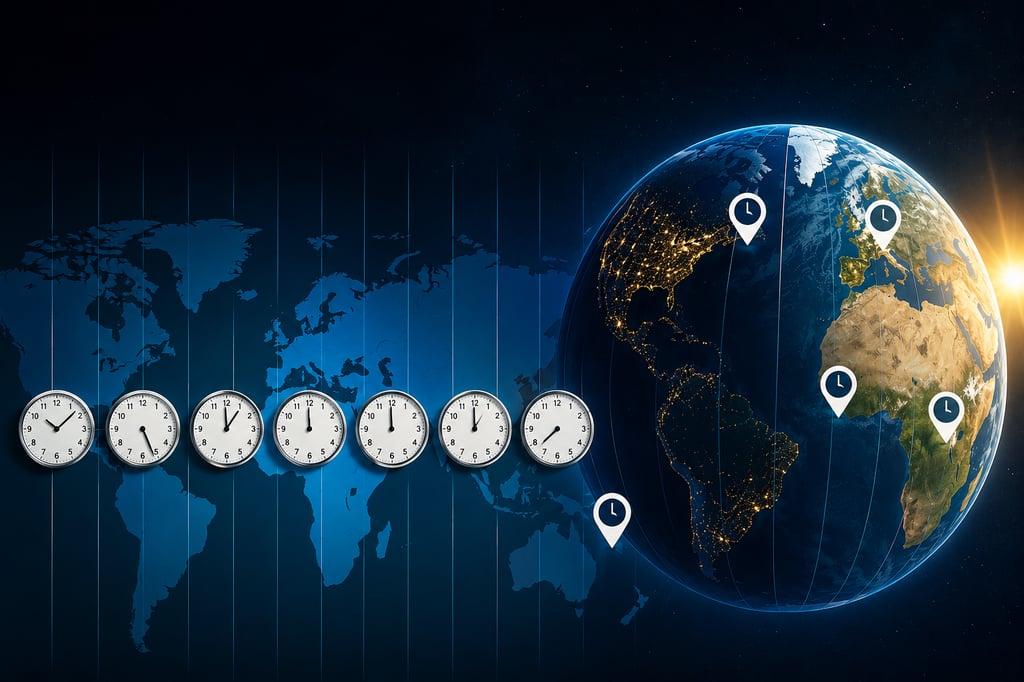

If you've ever wondered why some countries have several time zones while others use just one, you're not alone. Time zones can seem confusing at first, but they're designed to help keep local time aligned with the position of the sun.
Countries with large land areas often need multiple time zones because the Earth rotates, causing sunrise and sunset to occur at different times across long distances. Smaller countries usually only need one official time zone.
Let's explore why.
How Time Zones Work
The Earth rotates once every 24 hours.
Since the planet is divided into approximately 360 degrees of longitude, every 15 degrees represents about one hour of time.
This creates the world's standard time zones based on Coordinated Universal Time (UTC).
Countries With Multiple Time Zones
Large countries often span thousands of kilometres from east to west.
Examples include:
Russia – 11 official time zones
United States – 6 primary time zones (more including territories)
Canada – 6 primary time zones
Australia – 3 main time zones
Brazil – 4 time zones
Without multiple time zones, people living in the eastern and western parts of these countries would experience sunrise and sunset at very unusual times.
Countries That Use One Time Zone
Many countries choose to use a single official time zone.
Examples include:
Using one time zone makes business, education, transportation, and government services much easier to coordinate.
Why Doesn't China Have Multiple Time Zones?
China is one of the world's largest countries.
Geographically, it could easily use five different time zones.
Instead, the entire country follows China Standard Time (UTC+8).
This decision was made to simplify administration and create a unified national schedule.
As a result, sunrise and sunset vary greatly between eastern and western China.
Politics Can Influence Time Zones
Time zones aren't based only on geography.
Governments sometimes choose time zones for political or economic reasons.
Examples include:
Spain uses Central European Time even though much of the country lies closer to the Greenwich Meridian.
India uses one national time zone (UTC+5:30) despite its large width.
Nepal uses the unique UTC+5:45 offset.
Rwanda remains on Central Africa Time (UTC+2) all year and does not observe daylight saving time.
What About Daylight Saving Time?
Some countries move their clocks forward during summer.
This is called Daylight Saving Time (DST).
Countries such as:
adjust their clocks seasonally.
Others, including Rwanda, Japan, Singapore, and China, keep the same time throughout the year.
Why Understanding Time Zones Matters
Knowing how time zones work helps when:
Scheduling international meetings
Booking flights
Planning travel
Watching live sporting events
Trading in global financial markets
Working remotely with international teams
Calling family and friends overseas
Check the Current Time Anywhere
Whether you're planning a trip, organising an international meeting, or simply curious about another country's local time, checking a live world clock makes scheduling much easier.
TimeNowOnline provides current local time, UTC offsets, daylight saving information, and time differences for countries around the world.
Frequently Asked Questions
Why do countries have different time zones?
Countries use different time zones because the Earth rotates, causing different regions to experience daylight at different times.
Which country has the most time zones?
Russia has 11 official time zones, making it the country with the most mainland time zones.
Does every country observe daylight saving time?
No. Many countries, including Rwanda, Japan, Singapore, and China, do not observe daylight saving time.
Why does China only have one time zone?
China uses one official time zone (UTC+8) to simplify administration and maintain a consistent national schedule.
How many time zones are there worldwide?
There are 24 standard time zones, but many countries use half-hour and 45-minute offsets, creating more than 35 different UTC offsets used around the world.
Time Now Online
Time Now Online delivers accurate, real-time local time for cities, countries, and time zones worldwide. Compare time zones, convert time instantly, and plan meetings with ease using our fast, free tools.
About Us
Legal
© 2026. All rights reserved.
Time data is based on standard global time zone databases and updates automatically.
Places & Seasons
time & meetings