
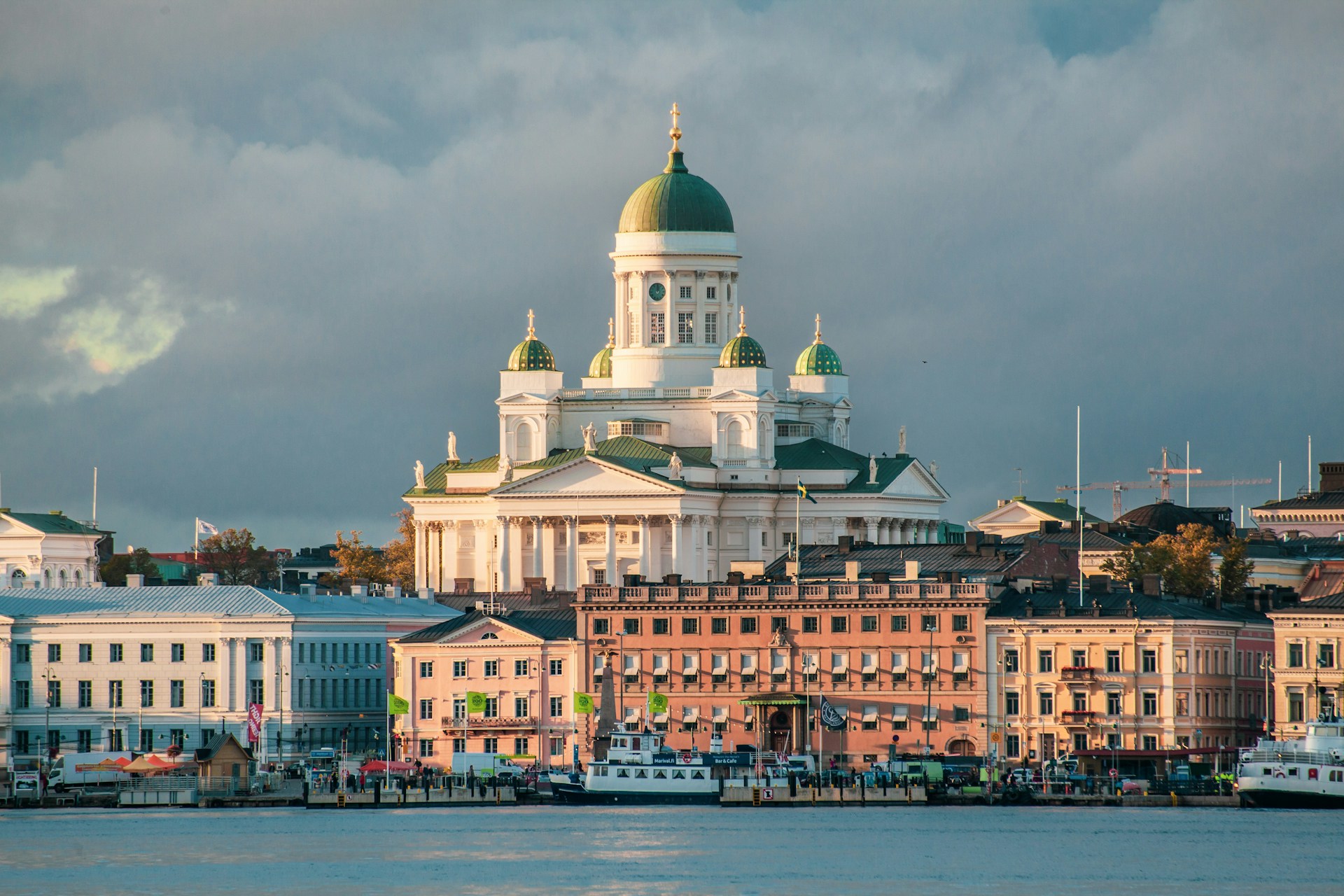
white concrete mosque near body of water

Finland Time Now

Finland Time Now with a live clock. Check the current local time in Finland, including the UTC offset, time zone information, and time differences with cities around the world. Finland follows Eastern European Time (EET, UTC+2) during standard time and Eastern European Summer Time (EEST, UTC+3) during daylight saving time. The country observes daylight saving time, with clocks moving forward in spring and back in autumn. Finland uses one official time zone across Helsinki, Espoo, Tampere, Vantaa, Oulu, Turku, Jyväskylä, Lahti, Kuopio, and Pori, making it easy to plan business meetings, travel, online events, international calls, and global communication.

About Finland

Finland is a Nordic country in Northern Europe, renowned for its pristine natural landscapes, thousands of lakes, vast forests, innovative technology, and exceptional quality of life. It shares borders with Sweden, Norway, and Russia, while its southern coastline lies along the Gulf of Finland and the Baltic Sea. The capital, Helsinki, is the country's political, cultural, and economic centre and is recognised for its modern architecture, vibrant design scene, and waterfront attractions.

Finland follows one official time zone throughout the country. During standard time, it uses Eastern European Time (EET – UTC+2), and during daylight saving time it switches to Eastern European Summer Time (EEST – UTC+3). Major cities including Helsinki, Espoo, Tampere, Vantaa, Oulu, Turku, Jyväskylä, Lahti, Kuopio, and Pori all follow the same local time, making travel, business, and communication simple across the country.

Known as the "Land of a Thousand Lakes," Finland actually has more than 188,000 lakes and around 179,000 islands. It is famous for breathtaking national parks, the Northern Lights (Aurora Borealis), the Midnight Sun, and the Arctic wilderness of Lapland, making it a popular destination for outdoor adventures throughout the year.

Finland is consistently ranked among the world's happiest countries and is recognised for its excellent education system, advanced technology sector, clean environment, and high standard of living. It is also the birthplace of globally recognised companies such as Nokia and is known for innovations in telecommunications, gaming, renewable energy, and sustainable design.

Whether you are planning a trip to Helsinki, visiting Lapland to meet Santa Claus, exploring the lakes around Tampere, enjoying the historic city of Turku, or scheduling international business meetings, knowing the current local time in Finland helps ensure accurate planning, travel arrangements, online events, and communication throughout the year.

Finland Quick Facts Table

aerial photography of street at night covered with snow

The Republic of Finland follows one official time zone, meaning the local time is the same across the entire country.

This provides consistent timekeeping throughout Finland. Helsinki, Espoo, Tampere, Vantaa, Oulu, Turku, Jyväskylä, Kuopio, Lahti, and Vaasa all follow Eastern European Time (EET – UTC+2) during standard time and Eastern European Summer Time (EEST – UTC+3) during daylight saving time.

Finland follows:

  • Eastern European Time (EET) – UTC+2 (standard time)

  • Eastern European Summer Time (EEST) – UTC+3 (daylight saving time)

The Republic of Finland observes daylight saving time, with clocks moving forward in spring and back in autumn.

Because Finland uses a single official time zone, there are no time differences between cities within the country.

Finland is located in Northern Europe in the Nordic region, bordered by Sweden, Norway, Russia, and the Baltic Sea and Gulf of Bothnia.

Whether you are planning a trip to Helsinki, visiting Tampere, exploring Turku, relaxing in Lapland, or coordinating international business meetings, knowing the current local time in Finland helps ensure accurate scheduling throughout the year.

Understanding Finland

Finland's time system is straightforward because the country follows one official time zone. The entire nation uses Eastern European Time (EET – UTC+2) during standard time and Eastern European Summer Time (EEST – UTC+3) during daylight saving time.

Because Finland maintains a single official time zone, there are no regional time differences anywhere in the country. Whether you are in Helsinki, Espoo, Tampere, Vantaa, Oulu, Turku, Jyväskylä, Kuopio, Lahti, or Vaasa, the local time is always the same.

For international coordination, knowing the current time in Finland is useful for planning:

  • Business meetings

  • International calls

  • Travel arrangements

  • Flight coordination

  • Academic schedules

  • Remote work and virtual meetings

  • Online conferences and events

  • International trade and logistics

Finland observes daylight saving time, meaning the country switches between Eastern European Time (EET – UTC+2) during winter and Eastern European Summer Time (EEST – UTC+3) during summer. This provides better use of daylight during the warmer months while remaining aligned with many other European countries.

Located in Northern Europe in the Nordic region, Finland shares borders with Sweden, Norway, and Russia, with coastlines along the Baltic Sea and the Gulf of Bothnia. The country is internationally recognised for its thousands of lakes, vast forests, Northern Lights, innovative technology sector, high quality of life, and the vibrant capital city of Helsinki.

Whether you are checking world clocks, arranging international meetings, planning a trip to Helsinki, exploring Lapland, visiting Turku, discovering Tampere, or coordinating business with partners across Europe, understanding Finland's single official time zone makes scheduling simple, accurate, and reliable throughout the year.

What Time Is It in Finland Right Now?

Finland Time vs Major World Cities

Finland follows one official time zone throughout the year. The entire country uses Eastern European Time (EET – UTC+2) during standard time and Eastern European Summer Time (EEST – UTC+3) during daylight saving time. Because Finland observes daylight saving time, its local time changes seasonally in line with most European countries.

The same official time is used across all major cities, including Helsinki, Espoo, Tampere, Vantaa, Oulu, Turku, Jyväskylä, Kuopio, Lahti, and Vaasa, making scheduling simple whether you're travelling, working remotely, or communicating with people across the country.

Understanding Finland time is useful for:

  • Business meetings

  • International calls

  • Travel planning

  • Flight coordination

  • Academic schedules

  • Remote work and virtual meetings

  • Online conferences and webinars

  • International trade and logistics

Because Finland observes daylight saving time, clocks move forward by one hour on the last Sunday in March and back by one hour on the last Sunday in October. When comparing Finland's time with countries that do not observe daylight saving time, the time difference may vary during parts of the year.

Located in Northern Europe in the Nordic region, Finland shares borders with Sweden, Norway, and Russia, with coastlines along the Baltic Sea and the Gulf of Bothnia. The country is internationally recognised for its thousands of lakes, vast forests, Northern Lights, innovative technology sector, excellent education system, and vibrant capital city of Helsinki.

When comparing Finland time with major world cities such as London, New York, Toronto, Dubai, Singapore, Tokyo, Sydney, and Los Angeles, it is important to consider each city's local time zone and any daylight saving time adjustments that may be in effect.

Note: Finland follows one official time zone throughout the year and observes daylight saving time. The entire country, including Helsinki, Espoo, Tampere, Vantaa, Oulu, Turku, Jyväskylä, Kuopio, Lahti, and Vaasa, follows Eastern European Time (EET, UTC+2) during standard time and Eastern European Summer Time (EEST, UTC+3) during daylight saving time. Because there is only one official time zone, the local time is the same across the country, making it easy for residents, businesses, travellers, and international visitors to coordinate meetings, flights, online events, phone calls, and global communication accurately throughout the year.

Best Time to Call Finland

From Australia

Finland follows one official time zone—Eastern European Time (EET, UTC+2) during standard time and Eastern European Summer Time (EEST, UTC+3) during daylight saving time.

  • Sydney / Melbourne: Finland is usually 8–9 hours behind

  • Brisbane: Finland is usually 8 hours behind

  • Perth: Finland is usually 5–6 hours behind

For business calls, aim for late afternoon or early evening in Australia (4:00 PM – 8:00 PM) to reach morning and afternoon business hours in Finland.

From the United Kingdom

Finland is generally 2 hours ahead of the UK.

  • During UK Standard Time (GMT):

    • Finland: 2 hours ahead

  • During British Summer Time (BST):

    • Finland: 2 hours ahead

Calling between 9:00 AM and 3:00 PM UK time is ideal for reaching late morning to afternoon in Finland.

This provides an excellent overlap for business, travel planning, and international communication.

From the United States

Finland is well ahead of North American time zones.

  • East Coast (New York): Usually 7 hours ahead (6 hours during U.S. daylight saving time)

  • Central Time (Chicago): Usually 8 hours ahead (7 hours during daylight saving time)

  • West Coast (Los Angeles): Usually 10 hours ahead (9 hours during daylight saving time)

Business hours overlap best during the U.S. morning and Finland's afternoon.

From Asia

Most Asian countries are ahead of or close to Finland, depending on the location.

Morning in Finland generally corresponds to afternoon or early evening across much of Asia, making communication convenient.

From the Middle East

The Middle East is generally 1–2 hours ahead of Finland.

The best overlap is generally late morning to afternoon in Finland and afternoon to early evening in the Middle East, making international business communication straightforward.

Note: Finland follows one official time zone—Eastern European Time (EET, UTC+2) during standard time and Eastern European Summer Time (EEST, UTC+3) during daylight saving time. Daylight saving time is observed, with clocks moving forward by one hour on the last Sunday in March and back by one hour on the last Sunday in October. As a result, Finland's time difference with countries that do not observe daylight saving time may vary during parts of the year.

green and yellow city tram

Famous Cities and Regions in Finland

  • Helsinki — Finland's capital and largest city, famous for its beautiful waterfront, Helsinki Cathedral, Suomenlinna Sea Fortress (a UNESCO World Heritage Site), modern Nordic architecture, and vibrant design district.

  • Tampere — Finland's third-largest city, known for its industrial heritage, beautiful lakes, museums, and the scenic Pyynikki Observation Tower.

  • Turku — Finland's oldest city and former capital, celebrated for Turku Castle, medieval history, riverside cafés, cultural festivals, and the Turku Archipelago.

  • Rovaniemi — Located in Finnish Lapland, renowned as the Official Hometown of Santa Claus, offering Arctic adventures, Northern Lights, and Santa Claus Village.

  • Lapland — Finland's northernmost region, famous for the Aurora Borealis (Northern Lights), reindeer, husky safaris, ski resorts, midnight sun, and pristine wilderness.

  • Lake Saimaa — Finland's largest lake, known for its thousands of islands, boating, fishing, scenic nature, and the rare Saimaa ringed seal.

  • Åland Islands — An autonomous archipelago between Finland and Sweden, celebrated for its peaceful island lifestyle, cycling routes, maritime history, and picturesque coastal villages.

  • Oulu — A leading technology and university city, recognised for innovation, winter cycling culture, beautiful parks, and its growing startup ecosystem.

  • Porvoo — One of Finland's oldest towns, famous for its colourful riverside warehouses, cobblestone streets, historic Old Town, artisan shops, and cafés.

  • Koli National Park — One of Finland's most iconic national parks, offering spectacular hilltop views, forests, hiking trails, lakes, and scenery that has inspired Finnish artists for generations.

Finland has one of Europe's most advanced and innovative economies, supported by technology, manufacturing, forestry, telecommunications, clean energy, financial services, logistics, tourism, and international trade. The country is internationally recognised for companies in telecommunications, engineering, sustainable technology, and exports of machinery, paper products, electronics, metals, chemicals, and forest products.

Finland's stock market is centred on the Nasdaq Helsinki Stock Exchange, which is part of the Nasdaq Nordic Exchange. The exchange facilitates trading in shares, government bonds, corporate bonds, exchange-traded funds (ETFs), derivatives, and other financial instruments, supporting investment and economic growth throughout Finland and the Nordic region.

Key sectors in Finland include:

  • Information technology and software

  • Financial and banking services

  • Manufacturing and engineering

  • Forestry and paper products

  • Telecommunications

  • Renewable energy and clean technology

  • Tourism and hospitality

  • Logistics and shipping

  • Electronics and machinery

  • International trade and exports

Business and commercial activity is mainly centred around Helsinki, the nation's capital and financial hub. Other important business cities include Espoo, Tampere, Turku, Oulu, Vantaa, Lahti, Jyväskylä, Kuopio, and Vaasa.

Because Finland follows one official time zone—Eastern European Time (EET, UTC+2) during standard time and Eastern European Summer Time (EEST, UTC+3) during daylight saving time—business scheduling remains well coordinated with other European countries throughout the year.

Most government offices, banks, and businesses generally operate between 8:00 AM and 5:00 PM, Monday to Friday, although opening hours may vary depending on the industry, company, and public holidays.

Note: Finland follows one official time zone. The entire country, including Helsinki, Espoo, Tampere, Vantaa, Oulu, Turku, Jyväskylä, Kuopio, Lahti, and Vaasa, follows Eastern European Time (EET – UTC+2) during standard time and Eastern European Summer Time (EEST – UTC+3) during daylight saving time. Finland observes daylight saving time, with clocks moving forward by one hour in spring and back in autumn. Having one official time zone makes scheduling straightforward for business, travel, tourism, remote work, and international communication across the country.

Stock Exchange and Business Hours in Finland

houses near tree and mountain covered by snow

What Finland Is Famous For

  • Helsinki — Finland's capital and largest city, famous for its stunning waterfront, Helsinki Cathedral, Suomenlinna Sea Fortress (a UNESCO World Heritage Site), modern Nordic design, museums, and vibrant café culture.

  • Northern Lights (Aurora Borealis) — Finnish Lapland is one of the world's best places to witness the spectacular Aurora Borealis, attracting visitors throughout the winter months.

  • Santa Claus Village — Located in Rovaniemi, the Official Hometown of Santa Claus, this world-famous destination welcomes visitors year-round to meet Santa Claus and cross the Arctic Circle.

  • Sauna Culture — Finland is internationally renowned for its traditional Finnish sauna, with over 3 million saunas across the country, making it one of Finland's most treasured cultural traditions.

  • Lake Saimaa — Finland's largest lake, famous for its thousands of islands, boating, fishing, beautiful scenery, and the rare Saimaa ringed seal, one of the world's most endangered seals.

  • Suomenlinna Sea Fortress — One of Finland's most visited landmarks and a UNESCO World Heritage Site, celebrated for its historic fortifications, museums, tunnels, and scenic Baltic Sea views.

  • Lapland — Finland's northernmost region, known for snowy forests, reindeer, husky safaris, ski resorts, the midnight sun, Arctic adventures, and breathtaking wilderness.

  • Thousands of Lakes and Forests — Finland is often called the "Land of a Thousand Lakes," with around 188,000 lakes and vast forests covering nearly three-quarters of the country, making it a paradise for outdoor enthusiasts.

  • Design, Technology, and Innovation — Finland is globally recognised for its leadership in education, innovation, clean technology, and design, and as the birthplace of companies such as Nokia, along with its thriving startup ecosystem.

  • Midnight Sun — During summer, especially in northern Finland, the sun remains above the horizon for weeks, creating the famous Midnight Sun phenomenon that attracts travellers from around the world.

Weather and Seasons in Finland

Finland has a cool temperate climate with four distinct seasons, offering unique landscapes and outdoor experiences throughout the year. Located in Northern Europe, the country experiences pleasant summers, colourful autumns, snowy winters, and fresh springs. Finland's diverse climate makes it a year-round destination for nature, outdoor adventures, winter sports, and cultural experiences.

🌸 Spring (March – May)

Spring brings melting snow, longer daylight hours, blooming forests, and gradually warmer temperatures as nature comes back to life.

  • Temperatures vary by region:

    • Southern Finland: 0°C to 15°C

    • Central Finland: -2°C to 14°C

    • Lapland: -8°C to 10°C

  • Snow gradually melts across much of the country

  • Forests, parks, and gardens begin to bloom

  • Excellent for hiking, sightseeing, cycling, and wildlife watching

  • Fewer crowds at major tourist attractions

  • Best time to visit Helsinki, Turku, Porvoo, Lake Saimaa, and Nuuksio National Park

☀️ Summer (June – August)

Summer is generally considered the best time to visit Finland, with warm temperatures, very long daylight hours, and vibrant festivals.

  • Temperatures vary by region:

    • Southern Finland: 18°C to 28°C

    • Central Finland: 16°C to 26°C

    • Lapland: 12°C to 22°C

  • The Midnight Sun occurs in northern Finland

  • Excellent conditions for hiking, boating, fishing, camping, and festivals

  • Ideal for exploring lakes, forests, islands, and national parks

  • Best time to visit Helsinki, Turku Archipelago, Lake Saimaa, Åland Islands, Rovaniemi, and Finnish Lapland

🍂 Autumn (September – November)

Autumn transforms Finland into vibrant shades of red, orange, and gold, making it one of the country's most scenic seasons.

  • Temperatures vary by region:

    • Southern Finland: 3°C to 18°C

    • Central Finland: 0°C to 15°C

    • Lapland: -5°C to 10°C

  • Spectacular autumn foliage ("Ruska") throughout forests and national parks

  • Comfortable weather for hiking and photography

  • Mushroom and berry picking season

  • The first Northern Lights become visible in Lapland

  • Best time to visit Koli National Park, Lapland, Oulanka National Park, and Lake Inari

❄️ Winter (December – February)

Winter turns Finland into a snowy wonderland, famous for Arctic adventures and festive celebrations.

  • Temperatures vary by region:

    • Southern Finland: -10°C to 2°C

    • Central Finland: -18°C to -2°C

    • Lapland: -30°C to -5°C

  • Heavy snowfall across much of the country

  • Excellent conditions for skiing, snowboarding, snowmobiling, and husky safaris

  • One of the world's best destinations to see the Northern Lights

  • Visit Santa Claus Village in Rovaniemi

  • Best time to visit Lapland, Rovaniemi, Levi, Ylläs, Saariselkä, and Santa Claus Village

Finland's four distinct seasons offer something unique throughout the year. Whether you're planning to experience the Midnight Sun, witness the Northern Lights, enjoy thousands of lakes in summer, or explore snowy forests in winter, understanding Finland's seasonal weather helps you choose the best time for your trip.

Facts About Finland

  1. Finland is located in Northern Europe. It covers approximately 338,455 square kilometres (130,678 square miles) and shares borders with Sweden, Norway, Russia, and the Baltic Sea (Gulf of Finland and Gulf of Bothnia).

  2. Helsinki is the capital of Finland. It is the country's political, economic, and cultural centre, renowned for its beautiful waterfront, Helsinki Cathedral, modern Nordic architecture, and Suomenlinna UNESCO World Heritage Site.

  3. Finland has a population of around 5.6 million people. Despite its relatively small population, it consistently ranks among the world's happiest countries and is known for its high quality of life.

  4. Finland is known for its outstanding education system. The country is internationally recognised for high-quality education, innovation, equality, and excellent public services.

  5. Finland follows one official time zone. The country uses Eastern European Time (EET – UTC+2) during standard time and Eastern European Summer Time (EEST – UTC+3) during daylight saving time.

  6. Finland is home to over 188,000 lakes. Often called the "Land of a Thousand Lakes," Finland actually has one of the highest numbers of lakes in the world, making it famous for its stunning natural scenery.

  7. Around 75% of Finland is covered by forests. The country's vast woodlands, national parks, and wilderness areas make it one of Europe's most nature-rich destinations.

  8. Finland uses the Euro (EUR) as its official currency. The country adopted the euro in 2002, replacing the Finnish markka.

  9. Finland is famous as the Official Hometown of Santa Claus. Located in Rovaniemi in Finnish Lapland, Santa Claus Village welcomes visitors from around the world throughout the year.

  10. Finland experiences four distinct seasons. Visitors enjoy warm summers, colourful autumns, snowy winters, and fresh springs, making it a year-round destination for outdoor activities and nature.

  11. Tourism is an important part of Finland's economy. Visitors travel to explore Helsinki, Rovaniemi, Lapland, Lake Saimaa, Turku, Åland Islands, Koli National Park, and the spectacular Northern Lights.

  12. Finland is famous for its saunas, Northern Lights, and natural beauty. Its combination of pristine forests, thousands of lakes, Arctic wilderness, modern cities, and innovative society makes it one of Northern Europe's most unique destinations.

a cabin in the snow under a green aurora bore

Frequently Asked Questions About Finland

1. What time zone does Finland use?

Finland uses Eastern European Time (EET, UTC+2) during standard time and Eastern European Summer Time (EEST, UTC+3) during daylight saving time.

2. Does Finland observe daylight saving time?

Yes. Finland observes daylight saving time (DST). Clocks move forward by one hour on the last Sunday in March and back by one hour on the last Sunday in October.

3. Does Finland have more than one time zone?

No. Finland has one official time zone, so the local time is the same across the entire country, including Helsinki, Turku, Tampere, Oulu, Rovaniemi, Kuopio, Lahti, Vaasa, Jyväskylä, and Joensuu.

4. What is the current UTC offset in Finland?

Finland's UTC offset is UTC+2 during standard time (EET) and UTC+3 during daylight saving time (EEST).

5. What is the best time to call Finland from another country?

The best time to call Finland is generally during 9:00 AM to 5:00 PM local time, which aligns with normal business hours. If calling internationally, check the current time difference to avoid contacting people late at night or early in the morning.

6. Is the time the same throughout Finland?

Yes. Every city and region in Finland follows the same official time, making it easy to plan travel, business meetings, online events, and domestic communication.

7. Which major cities use Finland's official time?

All major Finnish cities use the same official time, including Helsinki, Tampere, Turku, Oulu, Rovaniemi, Lahti, Kuopio, Vaasa, Jyväskylä, and Joensuu.

8. Why is knowing the current time in Finland important?

Knowing the current time in Finland helps you schedule international business meetings, flights, online conferences, remote work, virtual events, travel plans, and phone calls accurately while accounting for daylight saving time changes.

moose pulling snow sled

Explore More Country Time Zones

🌍 Closest Time Zones (Same or Near)

🌍 Nordic & Nearby Countries
Time Now Online

Time Now Online delivers accurate, real-time local time for cities, countries, and time zones worldwide. Compare time zones, convert time instantly, and plan meetings with ease using our fast, free tools.

About Us

Legal

© 2026. All rights reserved.

Time data is based on standard global time zone databases and updates automatically.

Places & Seasons

time & meetings