
What Is the International Date Line? (And Why Crossing It Changes the Date)
Blog post Understand what the International Date Line is, where it runs, and why crossing it changes the calendar date when traveling across the world..
TIME ZONES
Rachel
4/7/20263 min read
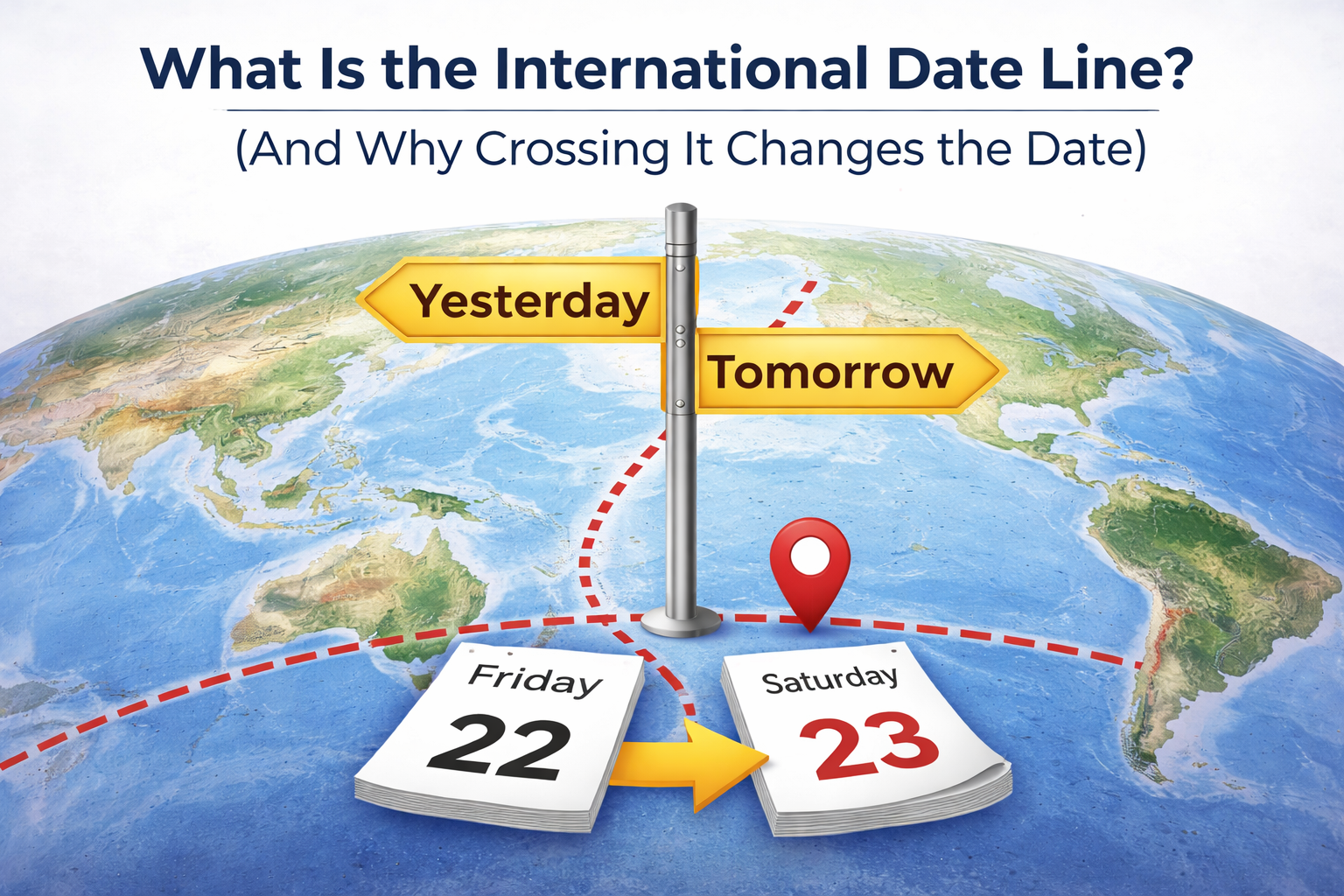
The International Date Line runs roughly along the 180° longitude line in the Pacific Ocean, opposite the Prime Meridian (0° longitude) in Greenwich, England.
However, the line does not run perfectly straight. It zigzags around certain countries and island groups to avoid splitting them into two different calendar days.
For example, the line bends around areas such as:
This ensures that each country stays within the same calendar day.
Why the International Date Line Exists
The Earth rotates once every 24 hours, creating day and night.
As the planet rotates, time zones shift gradually around the globe. After moving through all 24 time zones, the calendar must adjust to maintain consistency.
The International Date Line acts as the place where that adjustment happens.
Without the IDL:
Traveling around the world could cause the calendar to drift out of sync
Different regions might experience the same date at different times incorrectly
The date line ensures that the global calendar remains coordinated.
What Happens When You Cross the Date Line
Crossing the International Date Line changes the date by one full day.
Traveling West Across the Date Line
When traveling west, you add one day.
Example:
If it is Monday in the United States, crossing west into Asia could make it Tuesday.
Traveling East Across the Date Line
When traveling east, you subtract one day.
Example:
If it is Tuesday in Japan, crossing east toward North America may bring you back to Monday.
Why the Date Line Is Not Straight
Although the International Date Line roughly follows the 180° meridian, it bends around certain regions.
Countries prefer to remain on the same calendar day across their entire territory. If the line were perfectly straight, some islands or regions would experience a different day than the rest of their country.
To avoid this problem, the line was adjusted to keep nations unified under the same date.
The First and Last Places to See the New Day
Because of how time zones work, some regions experience the new day earlier than others.
Places near UTC+14, such as parts of Kiribati, are among the first locations on Earth to enter a new calendar day.
Meanwhile, areas near UTC−12 are among the last places to experience that same day.
This means that at one moment, different parts of the world can be nearly 24 hours apart on the calendar.
How Airlines Handle the Date Line
Airlines and travel schedules account for the International Date Line when calculating arrival times.
Because flights often cross multiple time zones and sometimes the date line, travelers may experience unusual situations.
For example:
A flight might depart on one day and arrive two days later
Another flight might appear to arrive before it departed
These changes occur due to time zone differences and the calendar adjustment at the date line.
Interesting Facts About the International Date Line
Several interesting facts make the International Date Line unique.
It runs mostly through the Pacific Ocean to avoid dividing countries.
The line is not officially defined by international law but is widely accepted.
Some Pacific island nations changed their position relative to the date line to improve trade with neighboring countries.
The line helps maintain the global calendar balance when traveling around the world.
Why the International Date Line Matters
The International Date Line plays an important role in keeping the world’s time and calendar system organized.
It ensures that the progression of days remains consistent across different time zones.
Understanding the date line is especially helpful for:
Travelers crossing the Pacific Ocean
Businesses coordinating across continents
Global transportation systems
International communication
Final Thoughts
The International Date Line is a crucial part of the global timekeeping system. While time zones determine the local time in different regions, the date line ensures that the calendar remains synchronized around the world.
Crossing this imaginary line may cause travelers to gain or lose a day, but it ultimately keeps the global schedule running smoothly.
By understanding how the International Date Line works, it becomes easier to navigate time differences and global travel.
Time Now Online
Time Now Online delivers accurate, real-time local time for cities, countries, and time zones worldwide. Compare time zones, convert time instantly, and plan meetings with ease using our fast, free tools.
About Us
Legal
© 2026. All rights reserved.
Time data is based on standard global time zone databases and updates automatically.
Places & Seasons
time & meetings